
How Stormwater Credits Work in South Florida: A Developer’s Guide
Learn how stormwater credits work in South Florida. Our civil engineering experts explain the process, benefits, and regulatory framework for land development projects.
Understanding the Regulatory Framework for Stormwater Management
In South Florida, the primary authority governing stormwater is the South Florida Water Management District (SFWMD), which works in conjunction with the Florida Department of Environmental Protection (FDEP) and local municipalities. The core objective of these regulations is twofold: managing water quantity and improving water quality. Water quantity rules focus on peak discharge attenuation, ensuring that a post-development site does not release stormwater at a higher rate than it did pre-development, thereby preventing downstream flooding. Water quality regulations are arguably more complex, focusing on the removal of pollutants like nitrogen and phosphorus from runoff before it enters natural water bodies. This is typically achieved through an Environmental Resource Permit (ERP), which mandates a specific level of water quality treatment. For many projects, meeting these stringent nutrient removal targets with on-site systems can be challenging due to space limitations or unfavorable soil conditions. This regulatory pressure is the primary driver behind the market for off-site stormwater credits.
What Are Stormwater Credits and How Are They Generated?
Comparison: On-Site Stormwater System vs. Off-Site Credit Purchase
| Feature | On-Site Stormwater System | Off-Site Credit Purchase |
|---|---|---|
| Land Use Impact | Requires significant land dedication for ponds, swales, or underground vaults, reducing developable area. | Frees up the entire site for buildings, parking, and amenities, maximizing land value and ROI. |
| Upfront Costs | Includes costs for excavation, materials, structures, and landscaping. Can be highly variable. | A direct, one-time capital expense for the credits. Cost is known and fixed early in the project. |
| Long-Term Maintenance | Requires ongoing maintenance, including mowing, sediment removal, and structural repairs for the life of the project. | No on-site maintenance obligation for the developer or property owner's association. |
| Permitting Complexity | Requires detailed drainage design, calculations, and modeling to prove compliance, subject to extensive agency review. | Streamlines the water quality portion of the ERP application by using a pre-approved, agency-accepted solution. |
| Design Flexibility | The need for a large pond can severely constrain the site plan design and overall layout. | Offers complete flexibility in site layout, unencumbered by stormwater infrastructure needs. |
| Construction Risk | Subject to construction delays, cost overruns, and potential issues with soil or groundwater. | Eliminates construction risk associated with the stormwater treatment component of the project. |
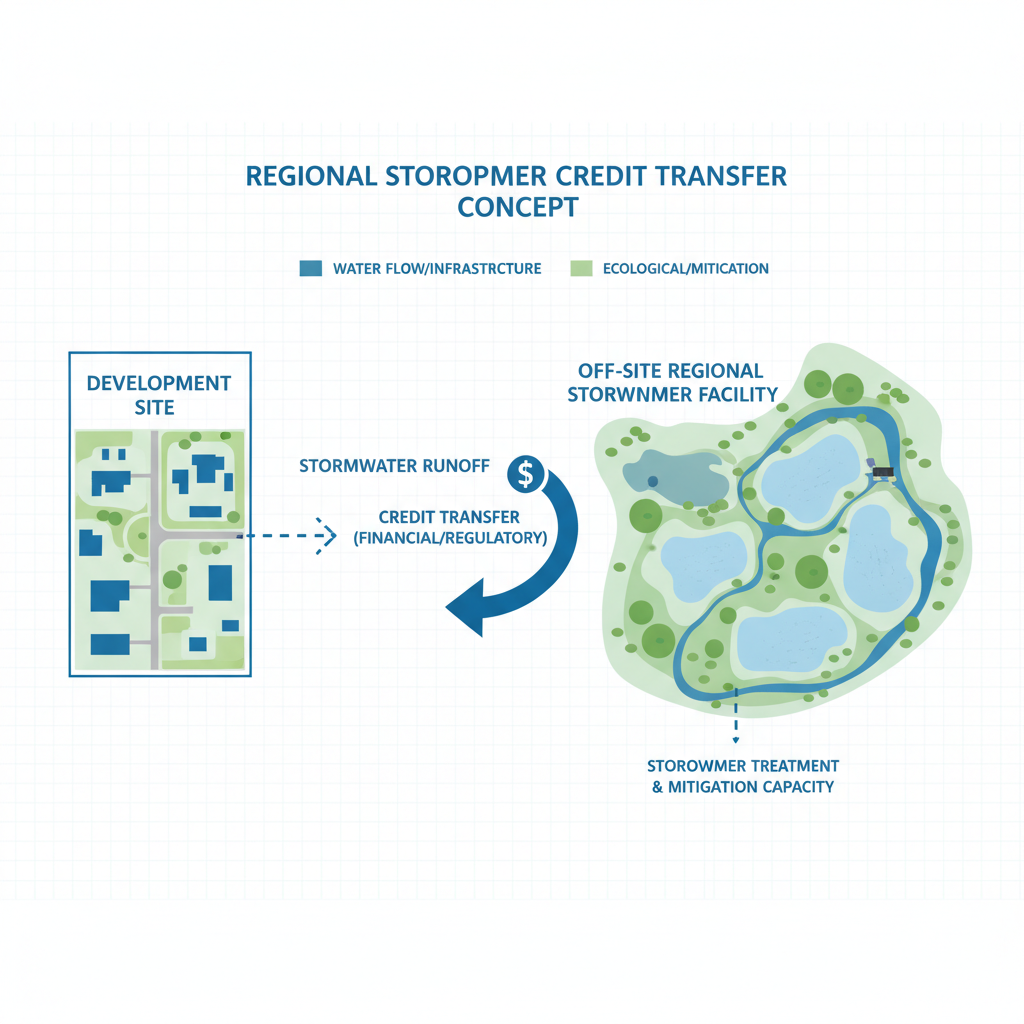
A stormwater credit is a quantifiable, tradable unit representing a specific amount of pollutant removal (e.g., one pound of phosphorus) that has been achieved at an off-site location. These credits are generated by privately owned and operated regional stormwater treatment facilities (STFs), often referred to as mitigation banks. These large-scale facilities are strategically designed and constructed to provide highly efficient water quality treatment for an entire watershed or basin. The process for a mitigation bank to generate certified credits is rigorous. It involves extensive design, modeling, and a complex permitting process with the SFWMD. The agency must approve the facility’s design and its calculated pollutant removal efficiency. Once operational, the bank is subject to continuous monitoring and reporting to verify its performance. This robust oversight ensures that each credit sold represents a real, verifiable environmental benefit, providing regulators with the confidence to approve their use for off-site mitigation.
The Role of Water Management Districts in Credit Trading
The SFWMD plays a central role in facilitating and regulating the stormwater credit market. A critical concept in this system is the ‘mitigation bank service area.’ A mitigation bank is only permitted to sell credits to development projects located within its designated service area boundaries. These boundaries are based on hydrologic basins, ensuring that the off-site treatment provides a tangible benefit to the same watershed impacted by the development. During the permitting process, the developer’s Civil Engineer near me must demonstrate to the SFWMD that the chosen mitigation bank is eligible to serve the project site. The agency performs a thorough agency review of the permit submittals, which must include documentation of the credit purchase. The SFWMD maintains a credit ledger for each bank, meticulously tracking the sale and application of credits to prevent them from being sold or used more than once. This verification is a critical checkpoint in the ERP application approval process.
When to Consider Purchasing Stormwater Credits
The decision to use stormwater credits is a strategic one, driven by a project’s specific constraints and goals. This option is particularly advantageous in several common scenarios. For urban infill and redevelopment projects on small or irregularly shaped parcels, dedicating valuable land to a stormwater pond is often economically unviable. Purchasing credits allows developers to maximize the building footprint and increase development density. Sites with challenging physical characteristics, such as a high water table or soils with poor infiltration rates (as determined by a Geotechnical soil report), can make conventional on-site systems expensive and ineffective. In these cases, credits offer a more predictable and reliable path to compliance. Furthermore, projects located in watersheds with strict Total Maximum Daily Load (TMDL) requirements for specific pollutants may find that off-site credits from a high-efficiency STF are the most cost-effective way to meet these advanced treatment standards.
The Process of Acquiring and Applying Stormwater Credits
Navigating the process of using stormwater credits requires a systematic approach. The first step involves a detailed site assessment and preliminary drainage design to calculate the project’s specific water quality treatment requirements. This determines the type and number of credits (e.g., pounds of phosphorus) that must be purchased. Once the requirement is quantified, the project’s engineer identifies eligible mitigation bank options within the correct service area. The developer then negotiates the purchase with the selected bank and secures a credit reservation letter. This document is a critical piece of the permit application package submitted to the SFWMD. The ERP application must clearly state the intent to use off-site mitigation and include all supporting documentation from the bank. The SFWMD reviews the package to confirm the calculations are correct, the bank is eligible, and the credits are available. Upon approval, the credits are formally debited from the bank’s ledger and assigned to the project.
Financial and Logistical Advantages of Stormwater Credits
The benefits of using stormwater credits extend beyond simple regulatory compliance. The most significant advantage is often financial. By freeing up land that would otherwise be used for a pond, developers can increase the project’s return on investment (ROI) by adding more residential units, retail space, or other revenue-generating features. This ability to maximize development density is a powerful driver, particularly in high-value real estate markets in South Florida. Logistically, credits simplify both the construction and long-term management of a property. They eliminate a major component of site construction, reducing potential delays and cost overruns. Furthermore, they remove the long-term burden of maintenance from a future property owner’s association, a significant selling point. This can also streamline the permitting timeline, as the water quality compliance mechanism is a standardized, pre-vetted solution that is familiar to agency reviewers, often leading to fewer comments and faster approvals.
How RSP Engineers Navigates the Stormwater Credit Process
At RSP Engineers, our approach begins with a comprehensive feasibility study for every project. We analyze the site’s unique characteristics and the developer’s goals to determine the most effective stormwater strategy. This includes a detailed financial comparison of on-site construction versus off-site credit acquisition. We utilize advanced stormwater modeling software to precisely calculate the project’s pollutant loading and determine the exact number of credits required, ensuring our clients do not overpay. Our team has established relationships with mitigation bankers and regulatory staff across South Florida, which facilitates a smooth and efficient transaction process. We manage every step, from identifying the most cost-effective credit source to preparing a complete and defensible ERP application. Our meticulous documentation and clear communication with agency reviewers are designed to minimize requests for additional information and secure permit approval in a timely manner, keeping the project on schedule.
Common Challenges and Pitfalls to Avoid
While stormwater credits offer many advantages, developers must be aware of potential pitfalls. A primary error is misunderstanding the strict service area boundaries; purchasing credits from a bank outside the project’s designated basin will result in permit denial. Another common issue is waiting too long to secure credits. In active markets, credit availability can be limited, and failing to obtain a credit reservation letter early can jeopardize the project timeline. Furthermore, it is crucial to remember that credits typically only satisfy water quality treatment requirements. The project must still include an on-site system to manage water quantity and provide peak discharge attenuation as required by the SFWMD and local ordinances. Incomplete documentation in permit submittals is another frequent cause of delays. The application must be thorough and clearly demonstrate how all regulatory criteria are being met, both on-site and off-site.
Partner with RSP Engineers for Your South Florida Development
Successfully leveraging stormwater credits requires deep regulatory knowledge and precise engineering. The team at RSP Engineers provides the expert guidance needed to navigate every stage of the process. From initial feasibility and cost-benefit analysis to final permit approval, we ensure your stormwater management strategy aligns with your project’s financial and development goals. Our expertise in site development, drainage design, and agency negotiations makes us the ideal partner for complex projects in South Florida. Contact us today to discuss how we can optimize your next project.
Conclusion: A Strategic Tool for Modern Land Development
Stormwater credits represent more than just an alternative method for compliance; they are a strategic tool for intelligent land development in South Florida. By converting a land-intensive infrastructure requirement into a straightforward financial transaction, credits empower developers to maximize site utility, reduce long-term liabilities, and achieve greater design flexibility. As urban density increases and environmental regulations evolve, understanding and utilizing these market-based solutions is essential. Partnering with an experienced civil engineering firm is the first step toward successfully integrating this powerful tool into your project’s path to zoning compliance and profitability.
FAQs
-
Generally, yes, provided the project is located within the service area of an approved stormwater mitigation bank. They are most commonly used for commercial, multifamily, and industrial land development projects where land value is high and space is limited. The feasibility for each project should be confirmed with a Professional Engineer.
-
No, this is a critical distinction. Stormwater credits are designed to meet water quality treatment requirements (i.e., pollutant removal). The project is still responsible for managing water quantity on-site to meet peak discharge attenuation and flood control standards mandated by the SFWMD and local government.
-
The price is market-driven and set by the mitigation bank. It depends on factors such as the cost to permit, construct, and operate the regional treatment facility, the specific pollutant being treated (e.g., phosphorus vs. nitrogen), and local supply and demand within the service area. Prices can vary significantly between different basins.