
How Engineers Design for 100-Year Storms
Explore how Florida civil engineers design drainage systems for 100-year storms, using advanced modeling and compliance with local regulations.
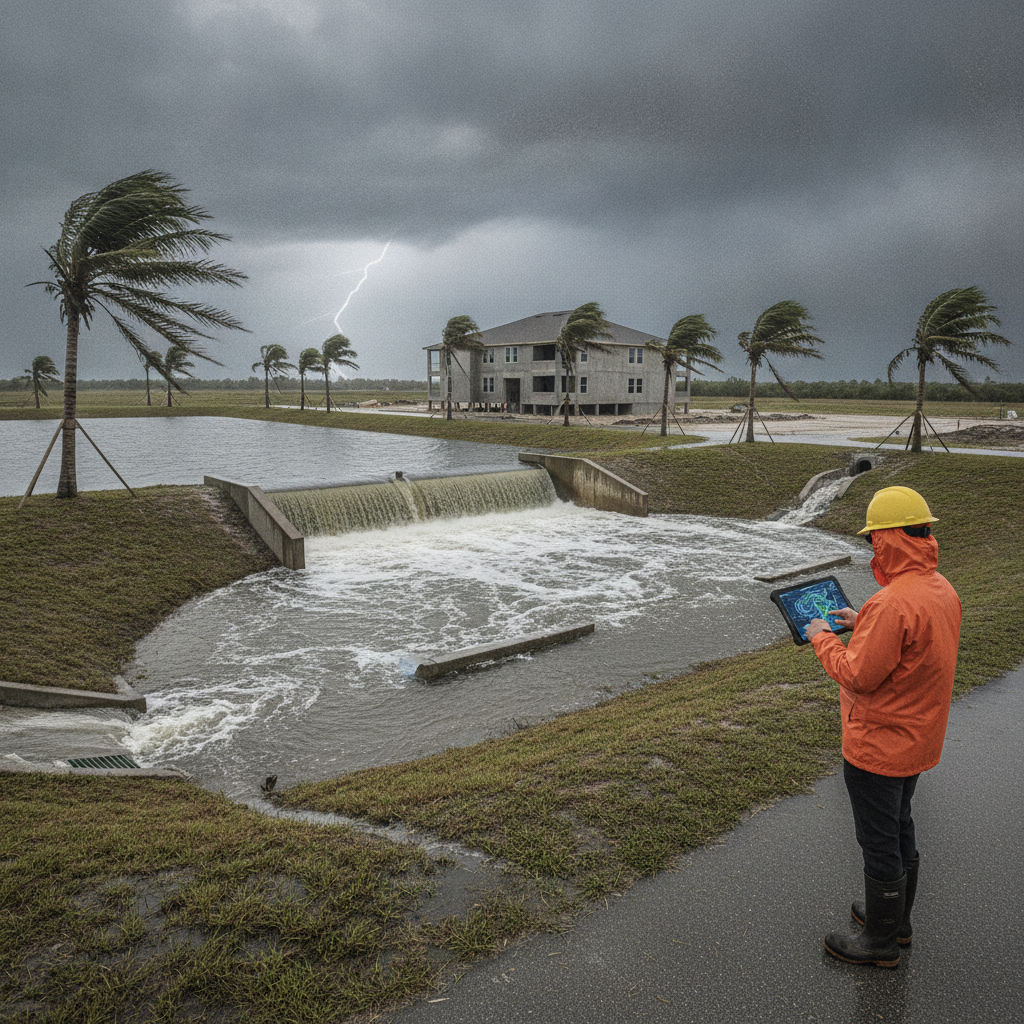
Understanding the 100-Year Storm Concept
The term “100-year storm” is often misunderstood. It is a statistical measure indicating a storm with a 1% probability of occurring in any given year. Engineers use this concept to design infrastructure that can withstand extreme weather events, ensuring public safety and property protection. The selection of design storms, such as 25-, 50-, and 100-year events, depends on the required level of service for a particular project.
Rainfall Data and Design Methods in Florida
Storm Event Design Applications
| Storm Event | Return Period | Typical Application |
|---|---|---|
| 25-Year Storm | 4% chance annually | Minor roadways, small developments |
| 50-Year Storm | 2% chance annually | Major roadways, commercial areas |
| 100-Year Storm | 1% chance annually | Critical infrastructure, floodplains |
| 500-Year Storm | 0.2% chance annually | High-risk areas, emergency planning |
Florida engineers rely on data from sources like NOAA Atlas 14 and regional Water Management Districts to determine rainfall intensity and duration. The Florida Department of Transportation (FDOT) also provides design storms for various applications. Engineers use these data sets to model stormwater behavior over 24-hour and longer durations, which are crucial for accurate flood routing and infrastructure design.
Design Storm Impacts on Infrastructure
The choice of a design storm influences several aspects of infrastructure planning: Pond stage-storage and outfall sizing: Ensures adequate capacity to manage stormwater volumes. Minimum finished-floor elevations: Protects structures from flooding. Conveyance and culvert sizing: Facilitates efficient water flow. Emergency overflow/weirs: Provides safety measures for excess water. Tailwater and downstream conditions: Considers the impact on existing water bodies. Freeboard: Adds a safety margin above predicted water levels.
Modeling Approaches for Stormwater Design
Engineers employ various modeling techniques to simulate stormwater behavior: Rational Method: Used for small drainage areas to estimate peak discharge. NRCS/SCS Method: Applies to larger watersheds, considering soil type and land use. Routing models like ICPR or HEC-HMS: Simulate complex hydrologic and hydraulic processes.
Jurisdictional Levels of Service and Cost-Benefit Analysis
Different jurisdictions in Florida may have varying levels of service requirements for stormwater management. Engineers must balance these requirements with project budgets, ensuring that designs are both cost-effective and compliant with regulations. This involves a careful analysis of flood risk versus construction costs.
RSP Engineers’ Approach to 100-Year Storm Design
At RSP Engineers, we employ a comprehensive approach to designing for 100-year storms. Our team integrates advanced modeling techniques with local regulatory knowledge to create robust stormwater management systems. We prioritize permitting compliance and work closely with clients to ensure that all designs meet the specific needs of their projects.
Common Issues in Stormwater Design
Designing for 100-year storms can present several challenges, including: Accurate prediction of rainfall patterns and intensities. Balancing design costs with flood risk mitigation. Ensuring compliance with evolving regulatory standards. Addressing site-specific constraints such as topography and soil conditions.
Contact RSP Engineers
For expert guidance on designing for 100-year storms, contact RSP Engineers. Our team of Florida Licensed Engineers specializes in stormwater management, permitting, and drainage design. We are committed to delivering solutions that meet your project’s unique needs and regulatory standards.
Conclusion
Designing for 100-year storms is a complex but essential aspect of Florida civil engineering. By understanding the statistical nature of these events and employing advanced modeling techniques, engineers can create infrastructure that withstands extreme weather conditions. RSP Engineers is dedicated to providing innovative solutions that balance cost, compliance, and flood risk mitigation.
FAQs
-
A 100-year storm is a weather event with a 1% chance of occurring in any given year. It is used as a benchmark for designing infrastructure to withstand extreme conditions.
-
Engineers select design storms based on project requirements, regulatory standards, and risk assessments. Factors such as location, land use, and infrastructure type influence this decision.
-
Common modeling techniques include the Rational Method, NRCS/SCS Method, and routing models like ICPR or HEC-HMS, which simulate hydrologic and hydraulic processes.