
How AI Is Transforming Civil Engineering
Explore how AI and machine learning are revolutionizing civil engineering in Florida, enhancing site development, drainage, permitting, and more, while maintaining the essential role of a licensed Pro
AI-Assisted Site Layout and Optioneering
AI technologies are enhancing site plan design by providing engineers with advanced tools for layout optimization. Through generative design algorithms, AI can propose multiple site configurations, allowing engineers to evaluate various options quickly. This process not only saves time but also ensures that the most efficient and sustainable design is selected. Traditional methods relied heavily on manual calculations and iterative design processes. In contrast, AI-assisted tools can analyze numerous variables simultaneously, offering a comprehensive view of potential site layouts. This capability is particularly beneficial in Florida, where zoning compliance and environmental considerations are paramount.
Drainage and Hydrology Modeling
Comparison of Traditional vs. AI-Augmented Approaches
| Task | Traditional Approach | AI-Augmented Approach | Benefit |
|---|---|---|---|
| Site Layout | Manual design iterations | Generative design algorithms | Faster, optimized layouts |
| Drainage Modeling | Historical data analysis | Real-time data integration | More accurate predictions |
| Code Compliance | Manual document review | Automated compliance checks | Reduced review time |
| Topographic Surveys | Field surveys | Drone and LiDAR mapping | Higher accuracy, less time |
| Traffic Simulation | Static models | Dynamic, real-time models | Improved traffic management |
AI is transforming drainage design and hydrology modeling by providing more accurate predictions of water flow and stormwater behavior. Machine learning algorithms can process vast amounts of data to optimize stormwater management systems, ensuring they are both effective and compliant with local regulations. In traditional approaches, engineers relied on historical data and simplified models. AI, however, can incorporate real-time data and complex environmental variables, resulting in more precise and reliable models. This advancement is crucial for Florida’s unique hydrological challenges.
Automated Code and Zoning Compliance
AI-driven software is streamlining the permitting process by automating code and zoning compliance checks. These tools can quickly review design documents against local regulations, identifying potential issues before submission. This reduces the likelihood of costly delays and rework during the agency review phase. By automating these checks, engineers can focus on refining designs rather than navigating complex regulatory requirements. This efficiency is particularly beneficial in Florida, where zoning compliance can be intricate and time-consuming.
Drone and LiDAR for Topographic Surveys
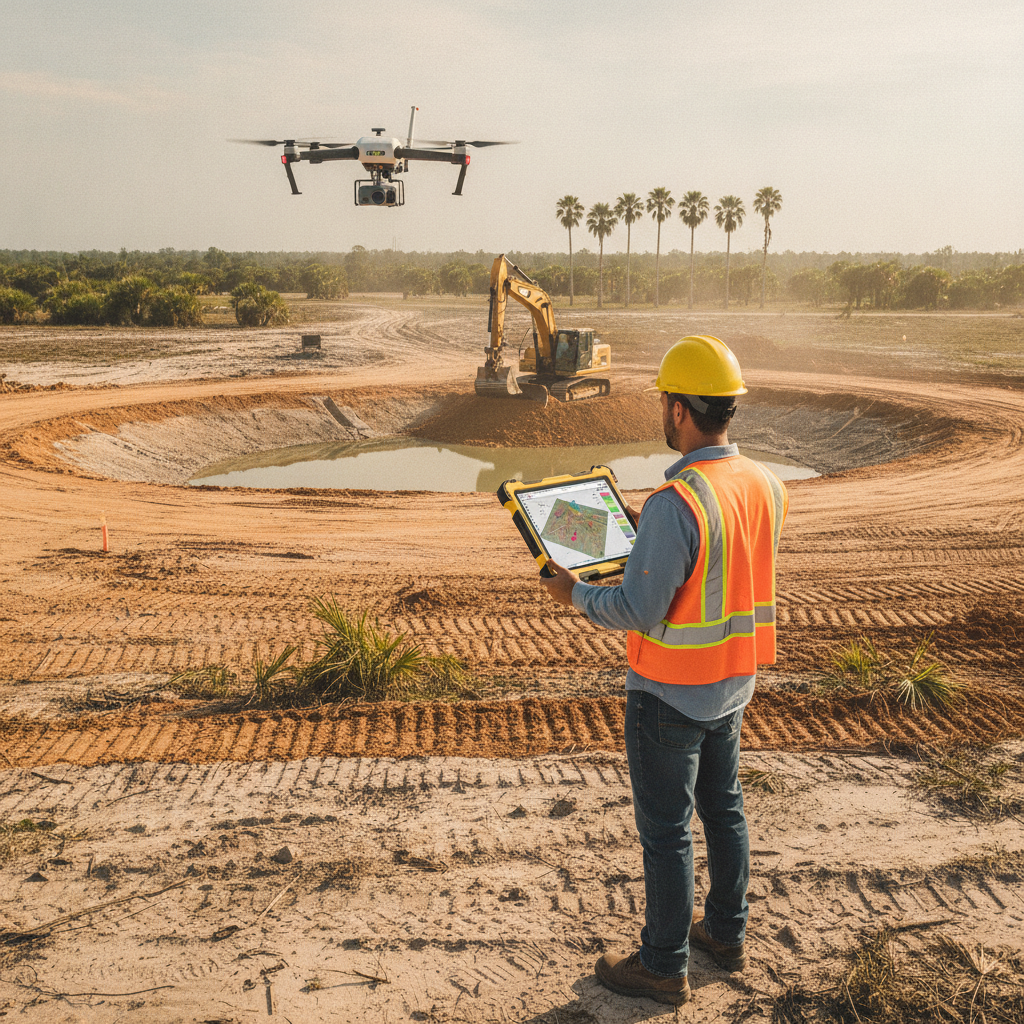
The integration of drones and LiDAR technology with AI is revolutionizing topographic surveys and earthwork calculations. Drones equipped with LiDAR sensors can capture high-resolution data, which AI algorithms then process to generate accurate topographic maps and calculate cut-and-fill volumes. This technology provides a significant advantage over traditional surveying methods, which are labor-intensive and time-consuming. The ability to quickly and accurately assess site conditions is invaluable for site development projects in Florida.
Traffic Modeling and Simulation
AI is enhancing traffic modeling and simulation by providing more dynamic and accurate predictions of traffic patterns. Machine learning models can analyze real-time traffic data, allowing engineers to simulate various scenarios and optimize roadway designs. This capability is essential for Florida’s growing urban areas, where efficient traffic management is critical. AI-driven simulations help ensure that new developments do not adversely impact existing transportation networks.
Predictive Cost Estimating and Construction Scheduling
AI tools are improving cost estimating and construction scheduling by analyzing historical data and predicting future trends. These tools can identify potential cost overruns and schedule delays, allowing project managers to make informed decisions and mitigate risks. In Florida’s competitive construction market, accurate cost and schedule predictions are vital for maintaining project viability and profitability.
Digital Twins and BIM Integration
Digital twins and Building Information Modeling (BIM) are being enhanced by AI to provide more comprehensive and interactive project models. These technologies allow engineers to visualize and simulate every aspect of a project, from design to construction and maintenance. AI-enhanced BIM models facilitate better coordination among stakeholders, reducing the likelihood of design conflicts and construction errors. This integration is particularly beneficial for complex projects in Florida, where coordination between multiple disciplines is essential.
RSP Engineers’ Approach to AI Integration
At RSP Engineers, we are committed to leveraging AI technologies to enhance our site development and civil engineering services. Our team of Florida Licensed Engineers integrates AI tools into our workflows to improve efficiency and accuracy while maintaining the highest standards of safety and compliance. We ensure that all AI-driven processes are overseen by experienced Professional Engineers, who validate the results and ensure that all designs meet regulatory requirements. This approach allows us to deliver innovative solutions while safeguarding the integrity of our projects.
Common Issues with AI in Civil Engineering
While AI offers numerous benefits, there are challenges associated with its implementation. Data quality and availability can significantly impact the accuracy of AI models. Ensuring that AI tools are fed with reliable and comprehensive data is crucial for their effectiveness. Additionally, the integration of AI into existing workflows requires careful planning and training. Engineers must be equipped with the skills to interpret AI-generated insights and apply them effectively in their projects.
Contact RSP Engineers
For project-specific guidance on integrating AI into your civil engineering projects, contact RSP Engineers. Our team of Florida Licensed Engineers is ready to assist with site development, permitting, and more. Reach out to us today to learn how we can enhance your project with cutting-edge AI technologies.
Conclusion
AI is transforming the landscape of civil engineering in Florida, offering enhanced efficiency and accuracy in site development, stormwater management, and more. While AI provides powerful tools, the expertise of a licensed Professional Engineer remains crucial to ensure that all designs are safe and compliant. As AI continues to evolve, it will undoubtedly play an increasingly important role in shaping the future of civil engineering.
FAQs
-
AI improves site layout design by using generative algorithms to explore multiple configurations quickly, optimizing for efficiency and sustainability.
-
No, AI cannot replace the need for a Professional Engineer. While AI enhances efficiency, a licensed engineer is essential for ensuring safety and regulatory compliance.
-
The limitations of AI in drainage modeling include the need for high-quality data and the potential for model inaccuracies if data is incomplete or outdated.