
Data Center Water Quality Treatment Requirements
A guide for data center developers on Florida’s stormwater quality treatment requirements, including WQV, treatment trains, TSS/nutrient removal, and permitting.
Defining Water Quality Volume (WQV) for Data Center Sites
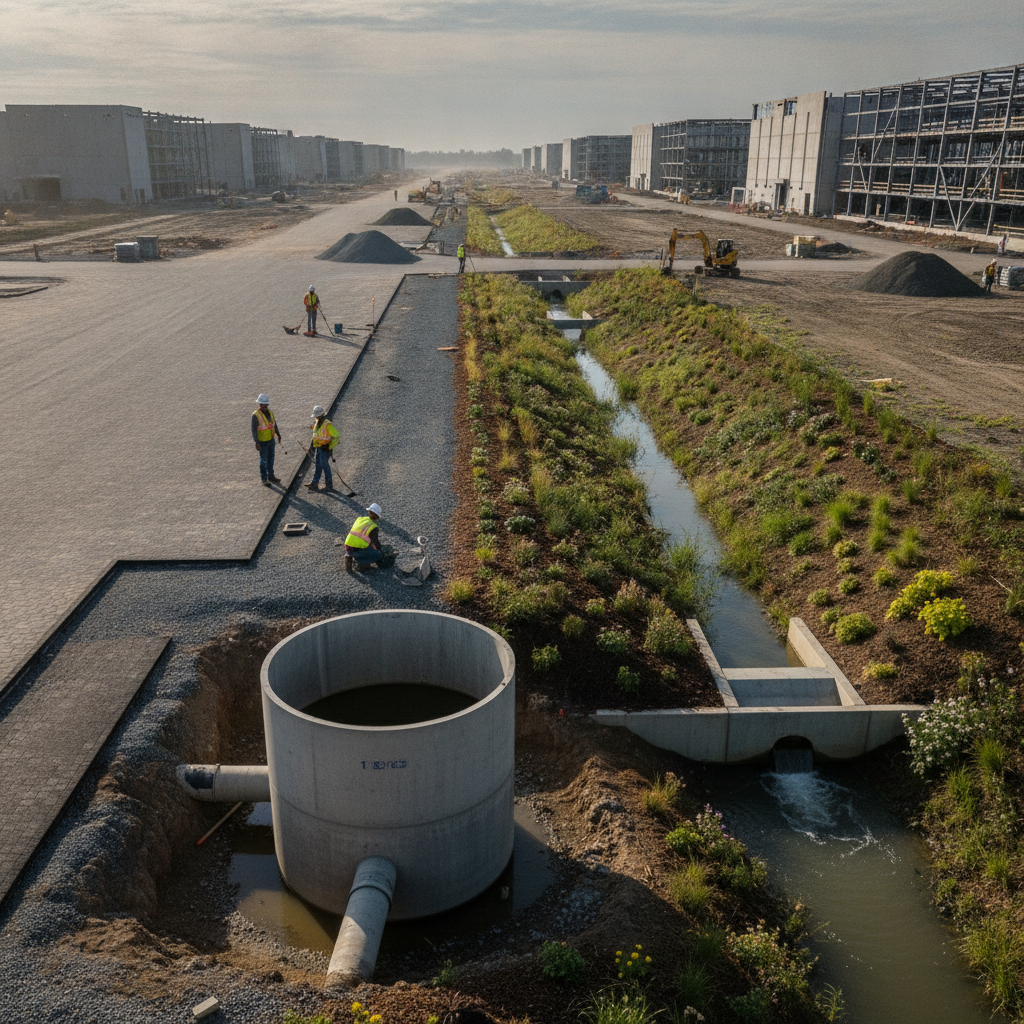
The foundation of any stormwater treatment design in Florida is the Water Quality Volume (WQV). This is the specific volume of runoff that must be captured and treated to remove a majority of post-development pollutants. For most jurisdictions and Water Management Districts (WMDs) in Florida, the WQV is typically calculated based on the runoff generated by the first inch of rainfall over the project’s developed area. For data centers, which feature vast rooftops, extensive parking lots, and wide access roads, these impervious surfaces contribute to a significant WQV that demands a robust treatment strategy. Calculating the WQV is the first step in the drainage design process. Civil engineers must accurately delineate all contributing drainage basins on the site and apply the appropriate runoff coefficients and rainfall data as stipulated by the governing agency, such as the South Florida Water Management District (SFWMD) or the St. Johns River Water Management District (SJRWMD). This initial calculation directly influences the size, type, and cost of the entire stormwater management system, making its accuracy paramount for project planning and budgeting.
Designing Effective Stormwater Treatment Trains
BMP Selection for Data Center Pollutant Sources
| Pollutant Source | Target Pollutants | Recommended BMP(s) | Key Design Consideration |
|---|---|---|---|
| Rooftop Runoff | Particulates, Dissolved Metals (from roofing) | In-line filters, vegetated swales, or direct discharge to wet detention | Ensure clean, non-industrial roofing materials are used to minimize pollutant load. |
| Parking Lots & Access Roads | TSS, Hydrocarbons, Trash, Heavy Metals | Hydrodynamic separator (pretreatment), followed by wet detention or bio-retention | Size pretreatment units based on peak flow and sediment loading analysis. |
| Generator Yard / Fuel Transfer Area | Hydrocarbons, Dissolved Metals, TSS | Oil/water separator, specialized media filter, spill containment berms | Must be an isolated system that does not co-mingle with general site runoff before treatment. |
| Landscaped Areas | Nutrients (N, P), Pesticides, Sediments | Vegetated filter strips, bioswales, controlled fertilizer management plan | Design grading to promote sheet flow into vegetated areas for natural filtration. |
| Loading Docks | TSS, Trash, potential for minor spills | Trench drains with sump and/or baffle box pretreatment | Ensure regular clean-out schedule is part of the facility's operational plan. |
A single solution is rarely sufficient to meet Florida’s stringent water quality standards. Instead, effective design relies on a treatment train—a sequence of Best Management Practices (BMPs) working in series to progressively remove pollutants. This multi-stage approach enhances overall system performance and resilience. A typical treatment train for a data center might begin with pretreatment devices that capture coarse sediments, trash, and debris before the runoff enters the primary treatment system. For example, runoff from a parking area might first flow through a baffle box or a hydrodynamic separator to remove larger solids and free-floating oils. From there, the partially treated water would be conveyed to a primary BMP, such as a wet detention pond, a vegetated bioswale, or an advanced filtration system. This layered strategy ensures that each component operates efficiently, maximizing pollutant removal and extending the maintenance life of downstream facilities. The selection and sequencing of these Best Management Practices (BMPs) are core to a successful civil engineering design.
Meeting Total Suspended Solids (TSS) and Nutrient Removal Targets
Florida’s regulations primarily focus on the removal of two categories of pollutants: solids and nutrients. The standard benchmark for most projects is achieving at least 80% removal of post-development Total Suspended Solids (TSS). These fine particles can degrade water clarity, harm aquatic habitats, and carry other adsorbed pollutants. While data centers are not high-traffic sites like retail centers, pollutants from atmospheric deposition, tire wear, and construction-phase sediment can still contribute to TSS loading. Equally important, and often more challenging, is nutrient removal. Nitrogen and Phosphorus are key targets, as they contribute to eutrophication and harmful algal blooms in Florida’s water bodies. The required removal efficiency for these nutrients can vary significantly based on the project’s location, particularly if it falls within a nutrient-impaired watershed. The drainage design must incorporate BMPs specifically chosen for their nutrient uptake capabilities, such as wet detention ponds with littoral zones or specialized bio-retention media, to achieve permitting approval.
Special Considerations for Generator Yards and Fueling Areas
Data centers rely on backup generators, which necessitates on-site fuel storage and transfer areas. These zones represent potential hotspots for contamination and require specialized stormwater treatment. A standard site-wide treatment system is not adequate to handle the potential for hydrocarbon contamination, heavy metals from engine components, or accidental diesel spills. Regulatory agencies require these high-risk areas to be isolated from the main stormwater system and treated with dedicated BMPs. Effective solutions include the use of oil/water separators, specialized media filters designed to capture dissolved metals, and robust spill containment structures like double-walled tanks and impervious containment berms. The design must integrate with the facility’s Spill Prevention, Control, and Countermeasure (SPCC) plan. This proactive approach to isolating and treating runoff from generator yards is a non-negotiable aspect of the site development plan and is heavily scrutinized during agency review.
Conventional vs. Proprietary BMPs: A Cost-Benefit Analysis
Developers often face a choice between conventional and proprietary BMPs. Conventional systems, like wet detention ponds and vegetated swales, are well-understood and effective but often require a significant land footprint. For data centers, where every square foot of real estate is valuable, dedicating large areas to stormwater ponds can conflict with the need for equipment yards, cooling infrastructure, and future expansion. This is where proprietary BMPs offer a compelling alternative. These manufactured systems, including underground filtration vaults, media filter cartridges, and advanced hydrodynamic separators, can achieve high pollutant removal rates in a fraction of the space. While their initial capital cost may be higher, the land savings can provide a substantial return on investment. A thorough civil engineering analysis must weigh capital costs, long-term maintenance requirements, and land value to determine the optimal strategy for each specific site.
Navigating Total Maximum Daily Load (TMDL) Watersheds
A project’s location can introduce another layer of regulatory complexity. If a data center is sited within a watershed designated with a Total Maximum Daily Load (TMDL), it means the receiving water body is already impaired by specific pollutants, most commonly nutrients. Development within these basins is subject to heightened scrutiny and often requires a more advanced level of stormwater treatment than the standard requirements. For example, a project in a nutrient-impaired basin may need to demonstrate a net improvement in water quality, meaning the post-development runoff must be cleaner than the pre-development condition. This can necessitate larger treatment systems, advanced nutrient removal technologies, and more complex modeling to document compliance. Performing thorough environmental due diligence early in the site selection process is crucial to identify these constraints and avoid significant impacts on the project’s budget and permitting process timeline.
RSP’s Approach to Data Center Stormwater Permitting
At RSP Engineers, our process for data center stormwater design is built on a foundation of proactive analysis and regulatory expertise. We begin with a comprehensive site analysis to identify key constraints and opportunities, including TMDL designations, soil types, and groundwater levels. This informs our integrated drainage design, where we model various BMP scenarios to create a cost-effective and compliant treatment train. Our team prepares a meticulous Environmental Resource Permit (ERP) application, complete with detailed calculations, engineering plans, and supporting documentation that clearly demonstrates compliance with all state and local criteria. We facilitate the agency review process through clear communication and a deep understanding of reviewers’ expectations, helping to streamline approvals and keep the project on schedule. Our goal is to deliver a design that is not only permittable but also efficient and maintainable for the life of the facility.
Common Pitfalls in Data Center Stormwater Design
Even with a solid plan, several common issues can derail a data center’s stormwater design. One frequent mistake is underestimating the need for long-term maintenance access to underground or proprietary BMPs. If these systems cannot be easily inspected and serviced, their performance will degrade over time, leading to compliance violations. Another pitfall is failing to completely isolate and separately treat high-risk runoff from generator yards, which is a red flag for permit reviewers. Additionally, relying on performance claims from proprietary BMPs without proper third-party verification or agency acceptance can lead to significant delays during the review of permit submittals. Finally, focusing solely on initial capital costs without considering the long-term operational costs of pumping, media replacement, and specialized maintenance can create unforeseen financial burdens for the facility owner. A forward-thinking design anticipates these operational realities from the outset.
Partner with RSP Engineers for Your Mission-Critical Project
Navigating Florida’s complex stormwater regulations for a mission-critical data center requires specialized expertise. The team at RSP Engineers has a proven track record of designing and permitting compliant, efficient, and resilient sites. We provide comprehensive civil engineering services, from initial due diligence and site development planning to detailed stormwater management design and construction administration. Let us handle the complexities of utility coordination and agency permitting so you can focus on delivering your project. Contact us today to discuss how we can support your data center development in Florida.
Ensuring Long-Term Compliance and Resiliency
In conclusion, designing a compliant stormwater system for a data center in Florida is a multifaceted engineering challenge. It requires a deep understanding of WQV calculations, pollutant loading, and the strategic implementation of treatment trains. By focusing on a proactive and integrated approach to stormwater management, developers can successfully navigate the permitting process and mitigate long-term risks. A well-designed system not only satisfies regulatory requirements under the Florida Building Code but also enhances the operational resiliency of the facility, protecting a critical asset and the surrounding environment for years to come.
FAQs
-
While the core regulations are the same, the application is more intense for data centers due to their massive impervious footprints and critical infrastructure components. Regulators pay special attention to the treatment of runoff from high-risk areas like generator yards and require robust plans for spill containment to protect against fuel leaks.
-
Yes, underground systems like vaults and chamber systems are very common for data center site development to preserve valuable land. However, the design must carefully account for treatment requirements, groundwater interaction, and, most importantly, provide clear and permanent access for long-term inspection and maintenance requirements.
-
A complete Environmental Resource Permit (ERP) application is required. This includes detailed engineering drawings, drainage basin maps, and stormwater calculations demonstrating that the proposed treatment train meets or exceeds the required pollutant removal efficiencies (e. g. , 80% TSS removal) as defined by the governing Water Management District.