
Data Center Utility Construction: Planning Critical Infrastructure
A guide to the civil engineering challenges of data center utility construction in Florida, covering power, water, fiber, and stormwater management for mission-critical facilities.
Power Infrastructure: The Primary Design Driver
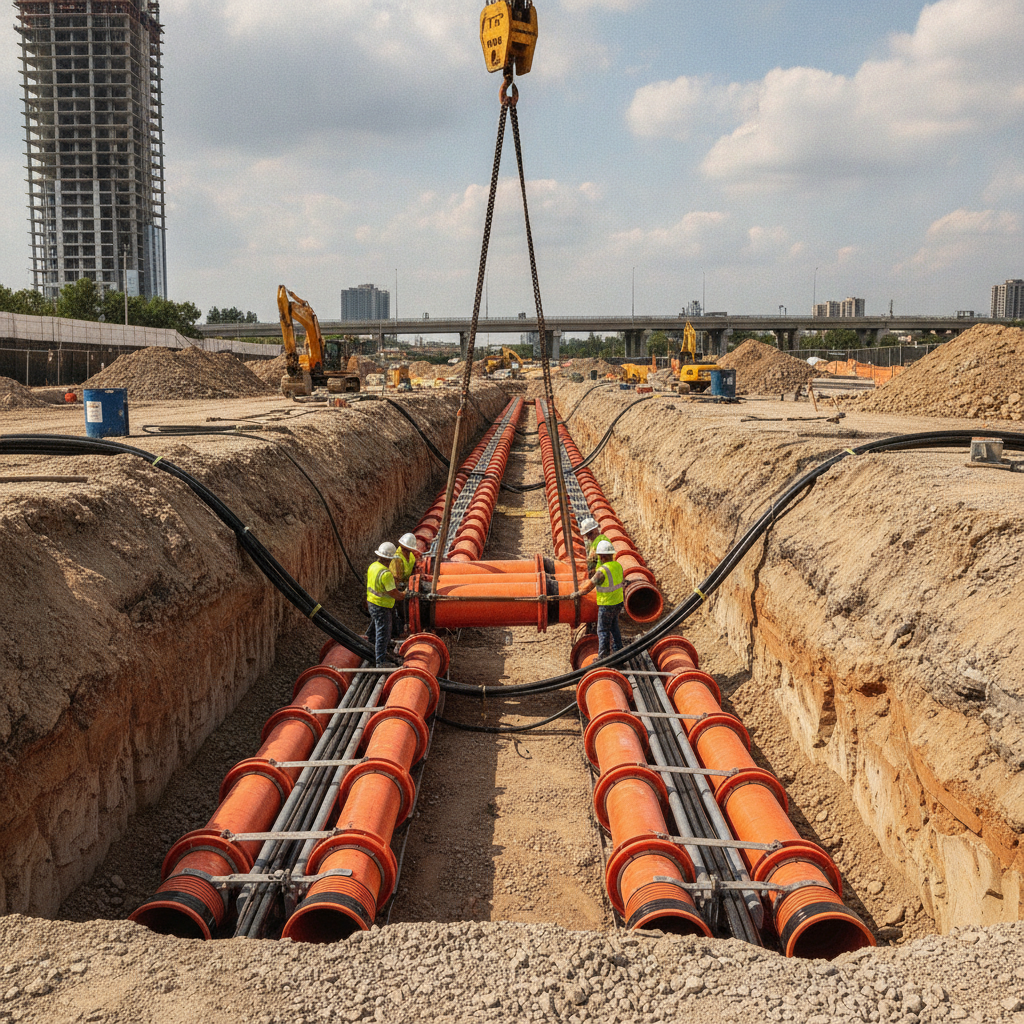
The single most critical utility for any data center is a massive, reliable, and redundant power supply. These facilities consume electricity on a scale comparable to small cities, measured in megawatts. The primary civil engineering task is to design the infrastructure that delivers this power. This involves close utility coordination with power companies like FPL, Duke Energy, or TECO to plan for dual, independent power feeds originating from separate substations. This redundancy is non-negotiable and forms the basis of the site’s reliability. Our role as Civil Engineers involves designing the physical pathways for this power. This includes extensive underground duct banks—concrete-encased bundles of conduits—that protect high-voltage cables from physical damage. The design must account for proper spacing, bending radii, and thermal considerations. Furthermore, we plan the site layout to accommodate large-scale backup generators, diesel fuel storage tanks with secondary containment, and the associated switchgear. This requires careful consideration of zoning compliance, fire codes, and environmental regulations governing fuel storage.
Water and Wastewater Systems for Mission-Critical Cooling
Data Center Utility Redundancy Planning Matrix
| Utility System | Primary Path Requirement | Redundancy Strategy | Key Civil Engineering Task |
|---|---|---|---|
| Electrical Power | Primary feed from a dedicated substation (e.g., 25 MW). | Second, independent feed from a different substation; on-site diesel generators with 72-hour fuel supply. | Underground duct bank design, generator pad layout, fuel tank permitting, and utility easement coordination. |
| Chilled Water / Cooling | Connection to a high-capacity municipal water main. | Secondary connection to a separate water main; on-site water storage tanks. | Water main extension design, hydraulic modeling, and securing utility connection permits. |
| Fiber Optic / Telecom | Multiple carrier fiber entry points into the building. | Physically separate and diverse path routing for conduits entering from different property boundaries. | Design of telecom conduit routes, manhole systems, and intense utility coordination with multiple providers. |
| Potable Water | Standard connection for domestic use (restrooms, offices). | Often tied to the primary cooling water source, but with backflow prevention. | Design of on-site water distribution network and coordination for fire protection services. |
| Sanitary Sewer | Gravity or force main connection to the municipal sewer system. | On-site lift station with backup power if gravity connection is not feasible. | Sewer line design, lift station specification, and securing discharge permits from the utility authority. |
While power is paramount, water is essential for cooling the thousands of servers that generate immense heat. Data centers utilizing water-based cooling systems, such as chillers and cooling towers, have a significant and constant water demand. The civil engineering design must ensure a redundant water supply, often by designing connections to two separate public water mains. On-site water storage tanks are also common to provide a buffer during any potential service interruption. A thorough utility capacity analysis is performed early in the design process to confirm the local municipality can support the demand. Equally important is managing the wastewater generated by these cooling systems. Cooling tower blowdown, which contains concentrated minerals and water treatment chemicals, requires specific wastewater discharge permitting. The sanitary sewer system must also be designed to handle the facility’s domestic waste. The drainage design must integrate these systems seamlessly while meeting all local and state environmental codes, ensuring that discharge does not adversely affect municipal treatment facilities or the surrounding environment.
Fiber Optic and Telecommunications Redundancy
A data center is merely a building without robust, high-speed connectivity to the outside world. Achieving true redundancy means providing multiple, physically separate entry points for fiber optic cables from a diverse range of telecommunication carriers. A single backhoe accident should never be able to sever a facility’s connection. This requires the design of what is known as diverse path routing, where telecom conduits enter the property from different directions and follow separate paths to the building’s entry points. The civil engineer’s task is to design these dedicated telecommunication conduits, manholes, and vaults. We work with multiple providers to ensure their infrastructure can be accommodated within the site plan. This utility coordination is a complex logistical exercise that must be integrated with the placement of power, water, and stormwater systems. Protecting these fiber pathways during and after construction is a critical component of the overall site development plan.
Navigating Florida’s Unique Stormwater Management Requirements
Data centers, with their massive building footprints and extensive pavement for access roads and equipment yards, create vast impervious surfaces. In Florida’s rain-intensive climate, managing the resulting stormwater runoff is a major engineering challenge. State and local regulations, enforced by Water Management Districts (e.g., SWFWMD, SFWMD) and the FDEP, mandate that post-development runoff does not exceed pre-development rates and that water quality is protected through treatment. Effective stormwater management is crucial for protecting the facility itself from flooding and for securing an Environmental Resource Permit (ERP). Due to the high value of land, many data center sites utilize underground detention or retention systems to manage runoff without consuming surface area. These complex systems require detailed hydraulic modeling and a robust drainage design. As a leading civil engineering firm near me, we specialize in creating these efficient systems, ensuring full compliance with NPDES permitting and local codes.
Site Grading, Security, and Access Roadway Engineering
The physical security and operational integrity of a data center begin with fundamental site engineering services. Proper site grading is essential to direct surface water away from the building foundation and critical infrastructure, providing the first line of defense against flooding. The finished floor elevation is typically raised well above the 100-year floodplain to mitigate risk. The site plan must also incorporate extensive security measures, such as perimeter fencing, secure access gates, and clear zones, all of which have civil design implications. Furthermore, the roadway engineering must accommodate the delivery of heavy and oversized equipment during construction and operation, including generators, chillers, and server racks. Pavement sections must be designed for heavy loads, and turning radii must be sufficient for large trucks. All pedestrian pathways and access to administrative portions of the building must adhere to strict ADA compliance standards, ensuring accessibility for all personnel.
The Complex Permitting and Agency Review Gauntlet
A data center project is a high-stakes endeavor that triggers a rigorous and multi-layered permitting process. Success hinges on navigating the requirements of numerous local, state, and sometimes federal agencies. The permit submittals are extensive and require a deep understanding of the regulatory framework. Key approvals often include local zoning compliance and site plan approval, county health department permits for water and sewer, an Environmental Resource Permit (ERP) for stormwater, and potentially specific air permits for backup generators. Early and continuous engagement with regulatory bodies is critical. Pre-application meetings with planning departments and utility providers can identify potential roadblocks long before they impact the schedule. A thorough understanding of the Florida Building Code and local land development regulations is essential. The agency review process can be lengthy, and a well-prepared, comprehensive submittal package, managed by an experienced Professional Engineer, is the best tool for minimizing delays and costly requests for additional information.
RSP Engineers’ Approach to Critical Infrastructure Planning
At RSP Engineers, we approach data center projects with a clear understanding that there is no margin for error. Our process begins with an exhaustive due diligence phase, where we assess a site’s viability from a utility, zoning, and permitting perspective. We analyze utility maps, model available capacity, and identify potential constraints before significant capital is invested. This proactive approach is a hallmark of our work as one of the top Civil Engineering Firms in Florida. Our team excels at integrated site development, where every decision—from grading to utility routing—is made with the overall project goals in mind. We serve as the central hub for utility coordination, managing complex communications between the client, power companies, water authorities, and telecom providers. During construction, our Construction Management Services ensure that the design is implemented precisely as planned, verifying the correct installation of critical underground infrastructure and providing solutions to unforeseen field conditions.
Common Pitfalls in Data Center Site Development
Even with careful planning, data center projects can encounter significant challenges. One of the most common pitfalls is underestimating the lead time required by utility providers to design and construct high-capacity services; securing a new substation feed can take years, not months. Another frequent issue is discovering unforeseen underground conditions, such as rock or a high water table, due to an insufficient Geotechnical Engineering investigation. A proper soil boring test is essential early on. Failure to secure necessary utility easements across adjacent properties early in the process can halt a project indefinitely. On the regulatory side, an incomplete or inaccurate ERP application can lead to months of delays during agency review. Finally, a design that fails to fully integrate the site’s security requirements with its operational and civil engineering needs can result in costly post-construction modifications.
Partner with RSP Engineers for Your Mission-Critical Project
Data center development demands a level of precision, foresight, and technical expertise that goes far beyond typical commercial projects. The stakes are too high for anything less than a proven engineering partner. The team at RSP Engineers has the experience to navigate the complexities of these mission-critical facilities, from initial feasibility studies to final construction oversight. Contact us today to discuss your project’s unique challenges. Our team provides expert site development, comprehensive utility coordination, and strategic permitting services to ensure your critical infrastructure is designed for maximum resilience and reliability. Let us help you build the foundation for your digital future.
Conclusion: Engineering for Uptime and Reliability
In conclusion, the successful construction of a data center is fundamentally a story of expert civil engineering. The reliability measured in server uptime is a direct result of the redundancy and resilience designed into the underground utilities and site infrastructure. Every aspect, from the power duct banks to the stormwater system, plays a vital role in the facility’s operational integrity. Achieving this requires a holistic approach that balances the immense demands for power and water with the stringent requirements of Florida’s regulatory environment. Meticulous utility coordination, a forward-thinking permitting strategy, and a robust site development plan are the essential ingredients for success. Ultimately, a successful data center is built upon a foundation of exceptional engineering, ensuring it can meet the demands of our connected world.
FAQs
-
You should engage a civil engineer during the site selection phase. Early involvement allows for critical due diligence on utility availability, zoning compliance, potential environmental constraints, and preliminary stormwater management strategies. This upfront investment can save millions by helping you choose a viable site from the start.
-
The dual challenge of securing adequate, redundant power and navigating Florida’s complex water use and discharge permitting is often the most significant hurdle. The sheer scale of the power demand requires extensive lead time and coordination with utility providers, while water regulations for both supply and stormwater management are among the strictest in the nation.
-
The primary difference is scale and the need to maximize usable land. The vast impervious area of a data center requires a highly efficient stormwater management system. This often leads to the use of costly but space-saving underground detention or retention vaults, which require more complex drainage design and structural engineering than typical surface ponds.