
Data Center Roadway Design: A Civil Engineering Guide for Safe and Efficient Site Access
A guide by RSP Engineers on the civil engineering principles for data center roadway design in Florida, covering traffic studies, heavy vehicle loads, stormwater management, and permitting.
Foundational Site Analysis and Traffic Impact Studies
Before any earth is moved, the first critical step is a comprehensive site analysis, anchored by a formal Traffic Impact Study (TIS). This study is a non-negotiable requirement for most large-scale developments in Florida and serves as the data-driven foundation for all roadway design decisions. The TIS evaluates the existing transportation network’s capacity, analyzing current traffic volumes and calculating the existing Level of Service (LOS) on adjacent roadways. It then projects the traffic that will be generated by the data center during both its intense construction phase and its long-term operational phase. The findings of the TIS directly inform the design of access points, the need for turn lanes, and potential off-site improvements mandated by the Florida Department of Transportation (FDOT) or the local county. A thorough study provides the necessary justification for permit submittals to these agencies, demonstrating that the project will not unduly burden public infrastructure. This early-stage analysis is a critical part of site development planning, preventing costly redesigns and significant delays during the agency review process.
Designing for Heavy Construction Vehicle Loads
Roadway Design Parameters by Vehicle Type
| Design Parameter | Construction Haul Truck (e.g., WB-67) | Employee / Visitor Vehicle | Emergency Fire Apparatus (e.g., Ladder Truck) |
|---|---|---|---|
| Pavement Section | Heavy-duty with stabilized subgrade; 12-18 inch base, 3-4 inch asphalt | Standard-duty; 6-8 inch base, 1.5-2 inch asphalt | Heavy-duty, designed to support 75,000+ lbs; often reinforced concrete in key areas |
| Minimum Centerline Turning Radius | 45-55 feet | 25-30 feet | 40-50 feet (per local Fire Code) |
| Lane Width | 12-14 feet | 10-12 feet | 20-26 feet (unobstructed width for EVA lanes) |
| Access Point Controls | Separate construction entrance, temporary gate, wheel wash station | Security gatehouse, card readers, visitor queuing lanes | Unobstructed access, potential for Opticom system, Knox Box |
| Typical Design Guidance | FDOT Design Standards, Geotechnical Report | Local Land Development Code, ITE Parking Generation Manual | Florida Fire Prevention Code (NFPA 1), Local Fire Marshal Directives |
The construction of a data center is an immense logistical operation involving a constant flow of heavy vehicles, from concrete trucks and cranes to tractor-trailers delivering generators and cooling equipment. Standard-duty pavement sections are simply not sufficient. The roadway design must account for these extreme loading conditions to prevent premature failure and ensure site safety. This begins with a detailed Geotechnical Engineering investigation to understand the subgrade soil conditions. Based on the geotechnical report, the civil engineering team designs a robust pavement section. This often includes a thicker limerock or crushed concrete base, specific asphaltic concrete thicknesses, and potentially subgrade stabilization techniques for areas with poor soil. The design must also consider wide turning radii to accommodate oversized vehicles without them running over curbs or into drainage swales. Proper pavement design is a long-term investment that minimizes maintenance costs and supports the demanding construction administration phase of the project.
Segregating Traffic Flows for Security and Operations
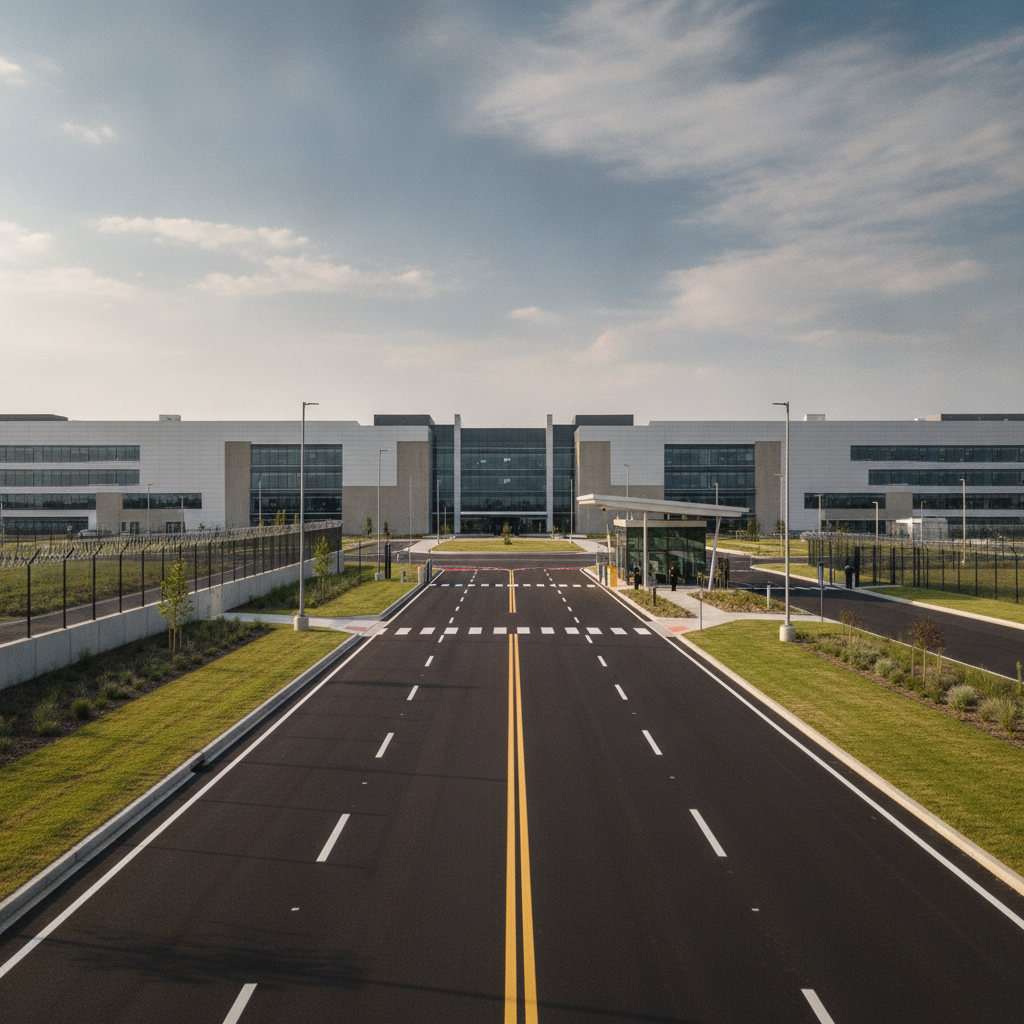
Security is paramount for data centers. The site’s roadway network must be designed to enforce strict access protocols and segregate different types of traffic. A common and effective strategy is to create distinct, physically separated access points and circulation routes for construction traffic, employee and visitor vehicles, and secure service/delivery vehicles. This prevents construction vehicles from interfering with daily operations and ensures that only authorized personnel can approach sensitive areas of the facility. This design philosophy extends to internal site circulation. The layout should include adequate queuing analysis for security checkpoints to prevent traffic from backing up onto public roads. It also requires strategically placed turnarounds for large trucks and clear wayfinding signage. Integrating the roadway layout with the facility’s security plan, including gate locations, fencing, and surveillance, is a key aspect of a holistic site development strategy that enhances both safety and operational efficiency.
Critical Emergency Vehicle Access (EVA) Requirements
In an emergency, every second counts. Data center site plans must provide clear, unobstructed, and compliant access for fire trucks, ambulances, and other emergency responders. The design of Emergency Vehicle Access (EVA) lanes is governed by strict codes, including the Florida Building Code and specific requirements from the local Fire Marshal. These requirements dictate minimum lane widths (typically 20 feet or more), vertical clearance to accommodate ladder trucks, and maximum grade percentages. A crucial element of EVA design is ensuring adequate turning radii at all corners and intersections, often based on AASHTO standards for a large fire apparatus. The access route must be designed to bear the full weight of a loaded fire truck and provide a direct path to critical infrastructure like primary entrances, fire hydrants, fire department connections (FDCs), and exterior equipment yards. Failure to meet these standards is a common reason for plan rejection during agency review, making meticulous attention to fire lane compliance essential.
Integrating Stormwater Management with Roadway Design
In Florida, water is a primary design consideration. The vast paved surfaces of access roads and parking lots create significant stormwater runoff that must be managed in accordance with state and local regulations. The roadway’s grading and layout are intrinsically linked to the site’s overall stormwater management system. The drainage design must be developed in parallel with the roadway plan, not as an afterthought. Effective designs often incorporate roadside swales, curb and gutter systems that direct flow to storm drain inlets, and strategically located retention or detention ponds. The goal is to collect, treat, and attenuate runoff on-site to meet the stringent water quality and quantity requirements of Florida’s Water Management Districts. A successful Environmental Resource Permit (ERP) application depends on a cohesive design where the roadway and drainage design work together seamlessly, demonstrating a comprehensive approach to environmental protection and zoning compliance.
Utility Coordination and Right-of-Way (ROW) Permitting
Data centers are massive consumers of utilities, requiring redundant power feeds, high-capacity fiber optic lines, and substantial water and sewer services. The roadway design must carefully navigate and accommodate this complex web of underground and overhead infrastructure. Proactive utility coordination is one of the most challenging aspects of data center site development, involving extensive communication with multiple utility providers. The design process includes identifying existing utilities through methods like Subsurface Utility Engineering (SUE) to avoid costly and dangerous conflicts during construction. It also involves planning new utility corridors within or adjacent to the roadway, often requiring easement acquisition. Any work that extends into the public Right-of-Way (ROW), such as creating a new driveway connection or extending a water main, requires separate right-of-way permitting from the controlling government agency. This parallel permitting track must be managed diligently to keep the project on schedule.
RSP Engineers’ Approach to Data Center Access Design
At RSP Engineers, we approach data center roadway design with a comprehensive, phased methodology. Our process begins with a thorough due diligence and feasibility study to identify all potential site constraints, from zoning issues to utility conflicts. We then move into detailed site development design, where our roadway engineering and drainage design teams work concurrently to create an integrated and efficient plan. We manage the entire agency review process, preparing and submitting all necessary applications and responding to comments from planning departments, utility providers, and environmental agencies. Finally, our construction administration services ensure that the design is executed correctly in the field, providing support from groundbreaking to final project closeout.
Common Pitfalls in Data Center Roadway Planning
Even experienced developers can encounter significant setbacks in data center projects. One of the most common issues is underestimating the volume and impact of construction traffic, leading to premature pavement failure or conflicts with neighboring properties. Another frequent pitfall is failing to initiate utility coordination and off-site improvement permitting early in the process, which can cause major schedule delays. Overlooking ADA compliance for sidewalks and pedestrian paths associated with employee parking and building access can trigger costly rework. Finally, an incomplete or poorly justified stormwater management plan is a primary cause of permit denial in Florida, highlighting the need for expert engineering from the outset.
Your Partner for Mission-Critical Site Development
Planning a data center in Florida? Secure your investment with expert civil engineering. The complexities of site access, from traffic management to environmental permitting, demand a specialized skill set. Contact RSP Engineers today to ensure your site development plan addresses critical roadway engineering, utility coordination, and permitting challenges from day one. Our team is ready to help you build a foundation for success.
Conclusion
The design of a data center’s roadway system is far more than a simple matter of paving. It is a critical discipline of civil engineering that directly impacts a project’s budget, timeline, security, and long-term viability. A successful design seamlessly integrates the demands of heavy construction, secure operations, emergency access, and Florida’s unique environmental regulations. By prioritizing a comprehensive approach that includes detailed traffic analysis, robust pavement design, and proactive permitting strategy, developers can mitigate risk and lay the groundwork for a resilient, high-performing facility.
FAQs
-
The first and most critical step is a dual analysis: a Traffic Impact Study (TIS) to understand the project’s effect on the public road network and a Geotechnical Engineering investigation to determine the site’s soil conditions. These two reports provide the foundational data needed for all subsequent roadway engineering and pavement design.
-
We design an integrated stormwater management system that complies with Florida’s stringent environmental regulations. This typically involves a network of inlets, pipes, and swales that convey runoff to an on-site retention or detention pond. The system is designed to manage water quantity to prevent flooding and treat the water to remove pollutants before it is discharged off-site, a key component of the permitting process.
-
Absolutely. The construction phase requires robust, often temporary, haul roads designed for extreme loads. The operational phase focuses on permanent pavement for lighter employee vehicles, defined circulation patterns, and integration with security systems. A well-planned project includes a phasing plan that transitions smoothly from the heavy construction network to the final operational layout.