
Data Center Earthwork Planning: Best Practices for Site Preparation
Expert insights from RSP Engineers on data center earthwork planning in Florida. Learn best practices for geotechnical analysis, mass grading, utility trenching, and stormwater management to ensure a
The Critical Role of Geotechnical Investigation for Data Center Sites
Before any dirt is moved, a comprehensive Geotechnical Engineering investigation is non-negotiable. Data centers house billions of dollars in sensitive equipment, and even millimeters of differential settlement can sever fiber optic connections, misalign cooling infrastructure, or compromise the structural integrity of the building. A thorough Geotechnical soil report, based on extensive soil boring tests, provides the essential data needed to design a stable foundation and site plan. This investigation determines the soil bearing capacity, identifies the location of the groundwater table, and flags the presence of unsuitable materials like organic muck or clay, which are common in Florida. The findings from the Soil Test directly influence the entire earthwork strategy. For instance, if the report reveals weak, compressible soils, the civil engineering plan may need to incorporate advanced ground improvement techniques. The report will provide recommendations for the building pad, pavement subgrade, and utility trench backfill, forming the basis of the project’s technical specifications. Ignoring or under-scoping this initial step is a primary cause of costly change orders and long-term structural problems. A qualified Geotechnical engineer is a critical partner to the civil engineer from the earliest stages of site development.
Mass Grading and Site Balancing Strategies
Comparison of Common Soil Stabilization Techniques
| Technique | Best Use Case | Key Engineering Consideration | Relative Cost |
|---|---|---|---|
| Lime Stabilization | Wet, high-plasticity clay soils (common in Florida) | Requires proper moisture content and mixing for chemical reaction to occur. Curing time is needed. | Low to Moderate |
| Cement Stabilization | Sandy or silty soils with low plasticity | Creates a more rigid, soil-cement base. Prone to cracking if not designed correctly. | Moderate |
| Surcharge Loading | Compressible silts and organic soils where deep ground improvement is not feasible | Requires significant time (months) for consolidation to occur. Settlement must be monitored. | Low (if on-site fill is available) |
| Geogrid Reinforcement | Very soft subgrades or to reduce aggregate base thickness over stable subgrade | Proper geogrid selection (biaxial vs. triaxial) and installation are critical for performance. | Moderate |
| Vibro-compaction / Stone Columns | Deep, loose granular soils or to improve bearing capacity in poor soils | Requires specialized equipment and contractors. Vibration can impact adjacent structures. | High |
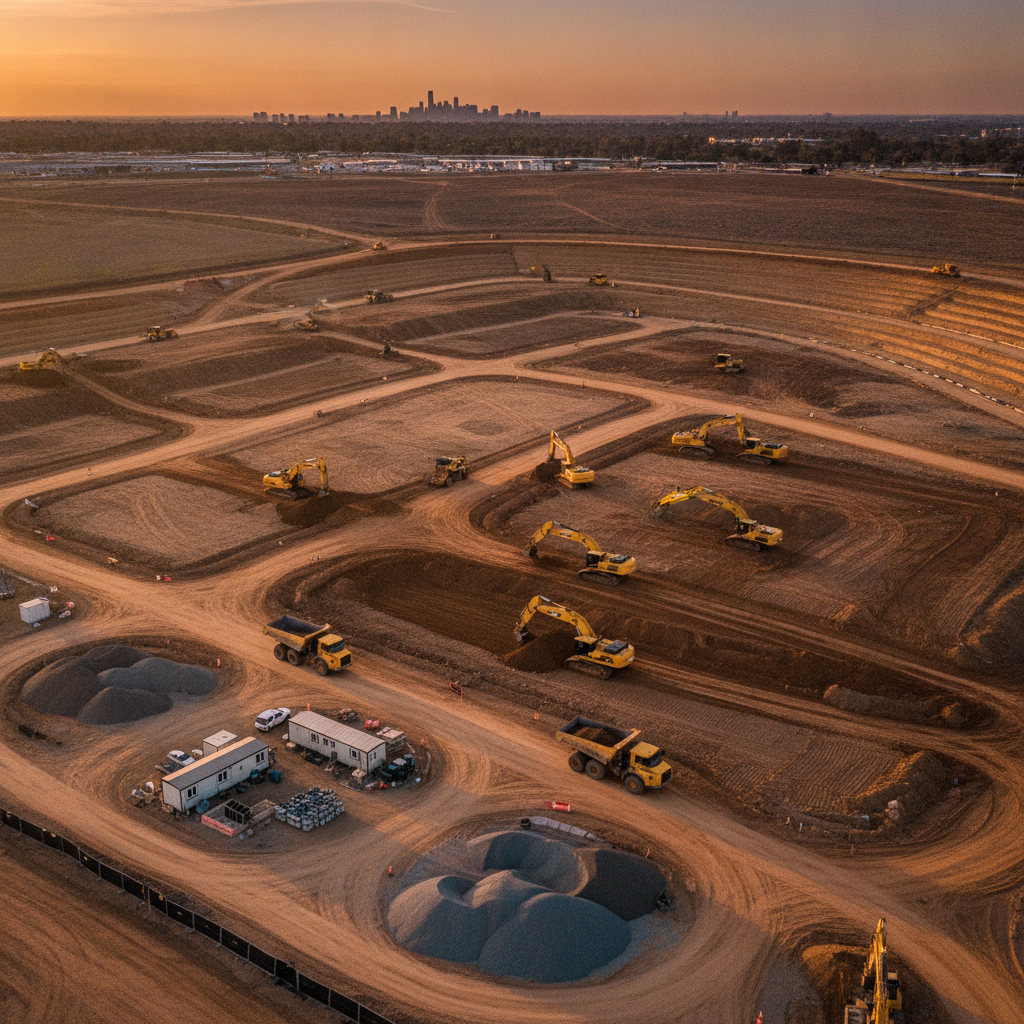
Once the subsurface conditions are understood, the process of mass grading begins. The primary goal is to reshape the entire site to create a stable, level building pad at the precise finish floor elevation (FFE) while ensuring positive drainage away from all structures. This involves a calculated process of ‘cut and fill,’ where soil is excavated from high areas and used to build up low areas. The ideal scenario is a ‘balanced site,’ where the amount of cut material equals the required fill, minimizing the costly need to import or export soil. This requires a sophisticated grading plan developed using 3D modeling software. The grading plan must also account for the creation of stormwater management facilities, such as retention or detention ponds, which often provide a significant source of fill material. During this phase, topsoil is stripped and stockpiled for later use in landscaped areas, while any unsuitable materials identified in the geotechnical report are removed. For sites with particularly poor soils, techniques like surcharge loading—placing a temporary mound of soil on the building pad area to pre-compress the underlying ground—may be required. All fill must be placed in controlled lifts and compacted to strict specifications to prevent future settlement.
Utility Infrastructure Trenching and Backfill Compaction
Data centers are defined by their immense utility requirements, including redundant power feeds, fiber optic duct banks, cooling water lines, and sanitary sewer systems. The earthwork phase must accommodate extensive and often deep trenching for this critical infrastructure. Effective utility coordination is paramount to prevent clashes between different systems and to ensure that installation pathways are logical and maintain required separation distances. These utility corridors are often the most congested areas of the site, demanding careful planning in the initial site plan design. The integrity of the utilities depends entirely on the quality of the trench backfill. All backfill material must be suitable, free of debris, and placed in thin, mechanically compacted lifts. The standard specification for utility trenches under pavement or structures is typically 95% to 98% of the maximum dry density as determined by a Modified Proctor test. Failure to achieve proper compaction densities can lead to trench line settlement, causing pavement to sag or, in the worst case, shearing a critical power or data conduit. This makes quality control, including regular field density testing by a certified technician, an essential part of the construction administration process.
Stormwater Management and Subgrade Stabilization
In Florida, managing stormwater is a primary design driver. The earthwork plan is fundamentally linked to the stormwater management system. Large-scale excavation is required for wet detention ponds or the installation of extensive underground exfiltration or attenuation systems. These systems must be integrated into the overall grading plan to function correctly and meet the stringent requirements of Florida’s Water Management Districts. The drainage design must handle the runoff from vast roofs and parking areas, preventing flooding and protecting downstream water bodies. Beyond drainage, the stability of the building and pavement subgrade is critical. The subgrade is the layer of native soil prepared to support the foundation and pavement structure. If the native soils are weak or overly moist, they must be stabilized before any structures are built. Common methods for soil stabilization in Florida include mixing the soil with lime or cement to increase its strength and reduce plasticity. This process creates a rigid, stable platform that can support the immense loads of the data center building and heavy truck traffic, ensuring the long-term performance of the entire site development.
Precision Tolerances for Slab-on-Grade Foundations
The concrete slab-on-grade for a data center is not a typical floor. It must be exceptionally flat and level to accommodate rows of heavy server racks and sensitive equipment. The performance of this slab is directly dependent on the quality of the subgrade and aggregate base course beneath it. The final few feet of the earthwork process involve preparing this foundation with extreme precision. The subgrade must be graded to a tight tolerance, typically within a fraction of an inch of the design elevation. After the soil subgrade is prepared and passes compaction tests, a layer of aggregate base course (such as crushed stone) is placed and compacted. This layer provides a uniform, stable platform for the concrete slab and acts as a capillary break to reduce moisture migration. The final surface is often graded using laser-guided equipment to achieve the required flatness. Before the concrete is poured, the entire building pad is typically ‘proof-rolled’ with a heavy, loaded truck to identify any remaining soft or unstable spots, ensuring the foundation for the multi-million-dollar facility is flawless.
Navigating Permitting for Large-Scale Earthwork in Florida
Large-scale earthwork is a highly regulated activity that requires multiple permits before a single bulldozer can start work. A civil engineering firm plays a central role in navigating this complex process. The most significant permit is often the Environmental Resource Permit (ERP) from the regional Water Management District, which governs stormwater management, wetland impacts, and drainage. This requires a detailed set of construction plans and supporting calculations demonstrating compliance with state regulations. In addition to the ERP, local municipalities require land disturbance or site work permits. These permit submittals include detailed grading plans, erosion and sediment control plans, and sometimes tree removal permits. The agency review process can be lengthy, with multiple rounds of comments that must be addressed by the design engineer. Proactive communication with regulators and a thorough, well-prepared application package are key to keeping the project on schedule. Starting earthwork without the necessary approvals can result in stop-work orders and significant fines, making expert permitting assistance invaluable.
RSP Engineers’ Approach to Data Center Site Preparation
At RSP Engineers, we approach data center site preparation with a rigorous, phased methodology designed to mitigate risk and ensure precision from the ground up. Our process begins with in-depth due diligence, where we work alongside a Geotechnical engineer to thoroughly analyze the site’s subsurface conditions and identify potential constraints early. Next, our Civil Engineers develop a detailed earthwork design using advanced 3D modeling software. This allows us to optimize the mass grading plan, balance cut/fill volumes to control costs, and seamlessly integrate the stormwater management and utility infrastructure. We prepare comprehensive construction documents that form the basis for our meticulous permit submittals to all required local and state agencies. During construction, we provide robust Construction Management Services, including on-site observation, review of contractor submittals, and verification of critical quality control metrics like compaction densities, to ensure the final product perfectly matches the design intent.
Common Pitfalls in Data Center Earthwork
Even with careful planning, data center earthwork projects can encounter significant challenges. One of the most common issues is an inadequate Geotechnical Engineering investigation, which leads to the discovery of unforeseen soil conditions during construction, causing major delays and cost overruns. Another frequent pitfall is poor management of topsoil and unsuitable materials; failing to properly segregate and stockpile these materials can dramatically increase disposal and import costs. During construction, failure to achieve the specified compaction densities in the building pad or utility trenches is a critical error that can introduce long-term settlement risks. We also often see conflicts arise from a lack of thorough utility coordination, where deep utility trenches interfere with building foundations or other buried infrastructure. Finally, insufficient implementation or maintenance of erosion and sediment control measures can lead to regulatory violations, fines, and project shutdowns, especially during Florida’s rainy season.
Partner with RSP Engineers for Your Data Center Project
The success of your mission-critical facility depends on the expertise of your engineering team. At RSP Engineers, we provide the comprehensive site engineering services needed to navigate the complexities of data center development in Florida. Our team excels at delivering precise site plan design, robust utility coordination, and efficient permitting strategies. We manage the entire site preparation process, from initial geotechnical review to final construction closeout, ensuring your project is built on a foundation of quality and precision. Contact us today to discuss how our civil engineering expertise can bring your data center project to life.
A Foundation of Precision: The Key to Data Center Success
Ultimately, the massive investment in a data center is only as secure as the ground it stands on. Meticulous earthwork planning is not a preliminary step to be rushed; it is the fundamental activity that dictates the project’s outcome. A successful approach integrates a thorough geotechnical analysis, a precise mass grading strategy, and a resilient stormwater management system from the very beginning. By prioritizing these foundational elements, developers can mitigate risks, control costs, and ensure the long-term stability and performance of their facility. This commitment to precision, guided by expert civil engineering, is the true cornerstone of any successful data center project.
FAQs
-
The depth of a Soil boring test depends on the anticipated building loads and subsurface soil profile. For a heavily loaded data center, borings may extend 50 to 100 feet or more below the ground surface to ensure all compressible soil layers are identified and the foundation design is based on a complete understanding of the site’s Geotechnical conditions.
-
Site balancing is the process of designing the mass grading plan so that the volume of soil excavated (‘cut’) on-site equals the volume of soil needed for fill. A balanced site avoids the significant costs associated with hauling away excess dirt or importing new fill material, which can be one of the largest variables in a site development budget.
-
Generally, no. Starting major earthwork, such as mass grading or pond excavation, before receiving an approved Environmental Resource Permit (ERP) and local land disturbance permits is a major compliance violation. Some jurisdictions may allow limited preliminary activities like installing silt fence, but any significant grading without approved permitting can result in stop-work orders and hefty fines.