
Data Center Stormwater Retrofit Strategies
Explore expert strategies for retrofitting data center stormwater systems on constrained, live sites in Florida. Learn about permitting, water quality, and construction sequencing.
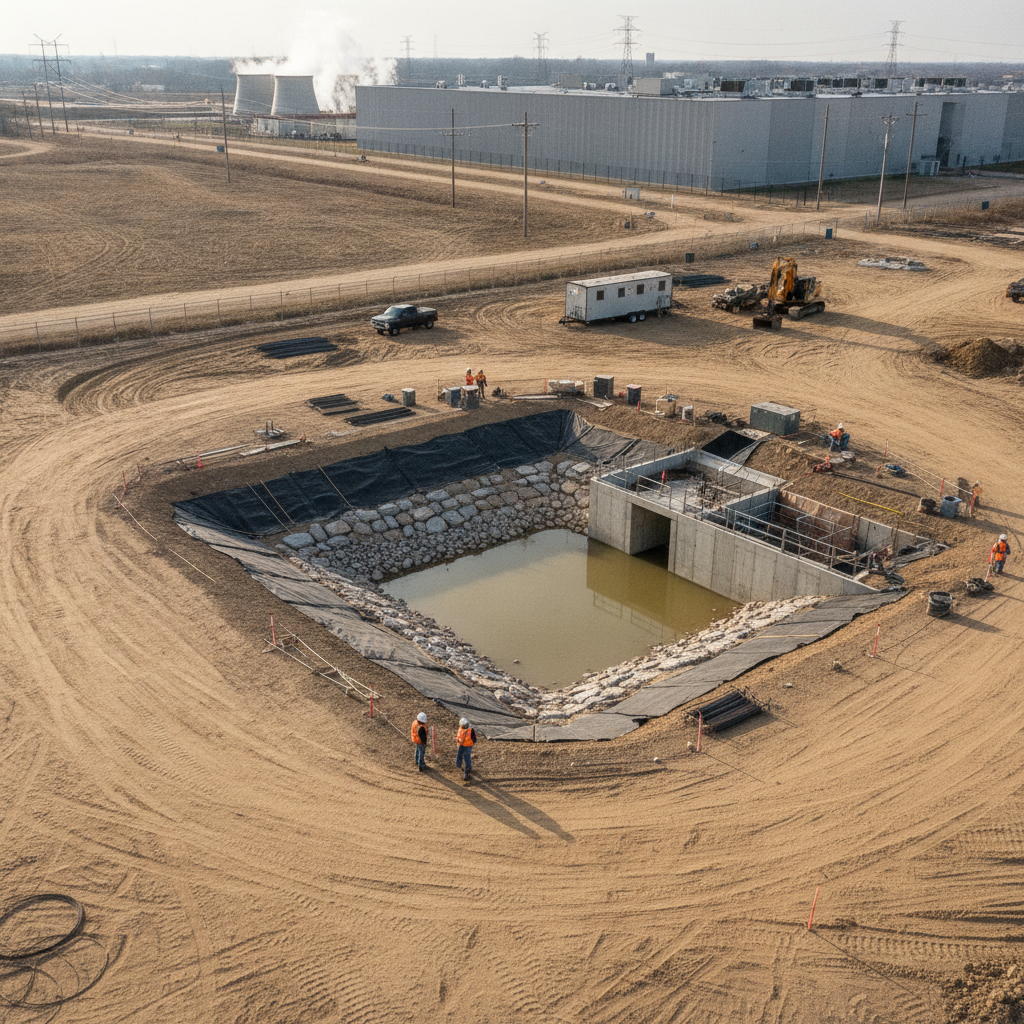
Assessing Legacy Stormwater Systems on Existing Campuses
The first step in any retrofit project is a comprehensive assessment of the existing infrastructure. This due diligence phase goes beyond a simple visual inspection. It requires a deep dive into historical records, including original construction plans, as-built surveys, and existing Environmental Resource Permits (ERP). Our engineers conduct detailed hydrographic analysis and field investigations to verify pipe inverts, pond dimensions, and outlet control structure configurations. This data is used to build an accurate existing-conditions stormwater model. This model is then run against current rainfall data and the design storm criteria mandated by the local Water Management District (WMD) and municipality. The analysis quickly reveals deficiencies in water quantity control (peak discharge rates) and water quality treatment. We identify specific gaps in permit compliance, such as insufficient treatment volume or a lack of nutrient removal capabilities required to meet modern Total Maximum Daily Load (TMDL) standards. This initial assessment forms the basis of the entire retrofit strategy, defining the scope and scale of the necessary improvements.
Strategies for Increasing Storage Volume on Constrained Sites
Comparison of Stormwater Retrofit Technologies
| Technology | Primary Function | Key Considerations for Data Centers | Relative Cost & Footprint |
|---|---|---|---|
| Underground Detention Vaults | Water Quantity Control | Excellent for constrained sites; can be placed under parking/non-critical areas. Requires careful structural design and long-term maintenance access. | High Capital Cost / Zero Surface Footprint |
| Wet Detention Pond Conversion | Quantity Control & Quality Treatment | Highly effective for nutrient removal. Requires sufficient area for littoral shelves and may involve significant earthwork and dewatering. | Moderate Capital Cost / High Surface Footprint |
| Permeable Pavement | Runoff Reduction & Pretreatment | Best for low-traffic areas like employee parking. Not suitable for heavy truck routes or areas with potential for chemical spills. Requires specialized maintenance. | Moderate-High Capital Cost / Zero Additional Footprint |
| Baffle Box / Nutrient Separator | Water Quality Treatment | Can be retrofitted into existing pipes or ponds as a pretreatment device. Excellent for targeting sediment and gross pollutants. | Low-Moderate Capital Cost / Low Footprint |
| Green Roof (Extensive) | Runoff Reduction | Reduces runoff volume at the source. Adds structural load to the building and requires coordination with architects and structural engineers. | High Capital Cost / Zero Ground Footprint |
One of the most common challenges on established data center sites is the lack of available land for expanding surface ponds. With every square foot dedicated to server halls, cooling infrastructure, and security buffers, finding space for additional stormwater storage is a significant constraint. A Professional Engineer must therefore consider alternative and space-efficient solutions. One of the most effective strategies is the implementation of underground detention systems. These systems, often consisting of large-diameter pipes or modular chambers installed beneath parking lots or other non-critical areas, can store massive volumes of water without consuming valuable surface real estate. Another powerful strategy is a wet detention conversion. Many older sites feature dry retention or detention basins that offer limited treatment and storage. By re-grading these basins and modifying the outlet structure to maintain a permanent pool of water, we can significantly increase both the treatment efficiency and the available storage volume within the same footprint. In select applications, such as employee parking areas, the use of permeable pavement can also reduce runoff and alleviate the burden on the primary collection system, though its use must be carefully evaluated to avoid areas with heavy truck traffic or potential for spills.
Upgrading Water Quality Treatment to Meet Modern Standards
Florida’s environmental regulations have evolved significantly over the past few decades. While older stormwater systems were primarily designed for flood control, modern criteria place a heavy emphasis on water quality treatment, particularly nutrient removal (nitrogen and phosphorus). Legacy systems on data center sites are almost always deficient in this regard. Retrofitting for water quality requires integrating modern Best Management Practices (BMPs) into the existing drainage network. This can involve installing devices like baffle boxes or nutrient-separating baffle systems within existing ponds or as inline pretreatment units. These structures are designed to capture sediment, debris, and associated pollutants before they enter the main water body. For sites subject to strict Total Maximum Daily Loads (TMDLs), more advanced solutions may be necessary, such as incorporating littoral shelves and desirable wetland vegetation into a wet detention pond to facilitate natural nutrient uptake. The goal is to achieve the required pollutant removal efficiencies mandated by the FDEP and WMD through a carefully selected and engineered series of drainage design improvements.
Navigating the Complexities of Florida’s Permitting for Retrofits
Any modification to a stormwater management system requires approval from multiple regulatory bodies, a process that demands deep expertise in Florida’s environmental regulations. The primary permit is typically an Environmental Resource Permit (ERP) modification from the governing Water Management District (e.g., SFWMD, SWFWMD, SJRWMD). This process involves submitting a detailed engineering report, updated calculations, and revised construction plans that demonstrate full compliance with current standards. The agency review process is rigorous and often involves multiple rounds of comments and revisions. In addition to the WMD, approvals are often required from the local municipality (city or county) and sometimes the Florida Department of Environmental Protection (FDEP). Effective utility coordination with public works departments is also essential if the project involves tie-ins to the municipal storm sewer system. A successful permit submittal package anticipates agency concerns, clearly documents the design intent, and provides robust supporting data to streamline the review and approval timeline, which is critical for meeting the data center’s expansion schedule.
Phasing and Construction Sequencing to Maintain Uptime
For a mission-critical data center, construction cannot interfere with operations. This makes construction sequencing the most critical planning element of a stormwater retrofit. The entire project must be phased to ensure the site’s power, cooling, and fiber optic infrastructure are never compromised. This often begins with installing temporary measures, such as bypass pumping systems, to route stormwater around an active construction zone, ensuring the existing campus remains protected from flooding during the work. The construction of new infrastructure, like an underground vault or a modified pond, is carefully scheduled in stages. We work closely with the facility’s operations team to coordinate excavation, dewatering, and heavy equipment movements to avoid sensitive areas and operational schedules. This level of utility coordination and logistical planning is paramount. The goal is a seamless execution where the new system is brought online without a moment of unplanned downtime, a core requirement for any site development project in the mission-critical sector.
Integrating New Expansions with Existing Drainage Infrastructure
Stormwater retrofits are frequently triggered by a planned campus expansion. The new building, parking, and access roads will generate additional runoff that the legacy system cannot handle. The retrofit strategy must therefore be a holistic one, creating a unified system that serves both existing and future development. This is achieved through a master stormwater model that accounts for the entire campus at full build-out. This comprehensive model ensures that the retrofitted ponds and conveyance systems are sized appropriately for the total impervious area. The drainage design for the new expansion is engineered to integrate seamlessly with the upgraded master system. This involves careful planning of pipe networks, inlets, and grading to ensure positive flow and efficient interconnectivity. By designing the retrofit with the future expansion in mind, we create a cohesive and compliant stormwater management plan that supports the client’s long-term growth strategy, avoiding the need for another costly and disruptive retrofit in the future.
RSP’s Approach to Data Center Stormwater Retrofits
At RSP Engineers, our process is built around mitigating risk and ensuring operational continuity for our mission-critical clients. We begin with a meticulous due diligence and modeling phase to precisely quantify system deficiencies and establish clear project goals. From there, we develop a conceptual design report that presents multiple retrofit options, analyzing the pros, cons, and costs of each. This allows our clients to make an informed decision that aligns with their budget and operational constraints. Once a path is chosen, our team executes the detailed engineering design and navigates the complex permitting process with all relevant Florida agencies. We prepare comprehensive construction documents that include rigorous phasing and sequencing plans. During the build phase, we provide construction administration and oversight to ensure the work is performed to specification and that all temporary measures are functioning correctly. Our proactive communication and collaboration with the client’s facility team are key to a successful project outcome.
Common Issues in Data Center Retrofit Projects
Even with careful planning, retrofit projects on developed sites can present surprises. One of the most common issues is encountering unforeseen underground utilities that were not documented on as-built plans. This requires quick field redesigns and close utility coordination to avoid costly delays and service interruptions. Another challenge is soil suitability; poor soil conditions discovered during excavation may require over-excavation and backfill, impacting the project budget and schedule. A preliminary Geotechnical Engineering investigation can help mitigate this risk. Dewatering during construction, especially when modifying a pond or installing an underground system in Florida’s high water table, can be a significant challenge. A robust dewatering plan is essential to keep the work area dry and prevent instability. Finally, navigating conflicting agency review comments from different departments (e.g., public works vs. environmental protection) can delay permit submittals. An experienced engineering firm can anticipate these conflicts and facilitate communication between agencies to find a resolution.
Contact RSP Engineers for Your Mission-Critical Project
Navigating a stormwater retrofit for a mission-critical data center in Florida requires a specialized engineering partner who understands the stakes. At RSP Engineers, we combine deep expertise in Florida’s complex regulatory environment with a proven track record in complex site development. Our team is ready to assist with every phase of your project, from initial due diligence and stormwater management design to navigating permitting and providing construction-phase support. Protect your investment and ensure your expansion stays on schedule.
Conclusion
Retrofitting a data center’s stormwater system is far more than a compliance exercise; it is a strategic necessity for enabling growth and ensuring the long-term resilience of a mission-critical facility. The process is a complex interplay of advanced civil engineering, rigorous regulatory navigation, and meticulous construction planning. By addressing legacy deficiencies with modern solutions like underground detention and enhanced water quality treatment, data center operators can unlock the full potential of their sites. Proactive stormwater management and a carefully executed retrofit are foundational to supporting the future of data infrastructure in Florida.
FAQs
-
The process begins with a professional civil engineering assessment. This involves gathering all existing documentation (as-builts, permits), conducting a topographic and hydrographic survey, and building a detailed stormwater model to identify specific performance and compliance gaps against current regulations.
-
Generally, no. Regulatory agencies will require the stormwater management system to be permitted and often fully constructed or bonded before they will issue a certificate of occupancy for the new expansion. The permit for the new construction is contingent on demonstrating a viable, compliant stormwater solution for the entire site.
-
The primary risk is unplanned operational disruption. This could be caused by accidentally cutting a utility line (power, fiber), causing localized flooding due to inadequate temporary drainage, or obstructing critical access routes. Meticulous construction sequencing and planning are essential to mitigate these risks.