
Data Center Stormwater Inlet Design
A technical guide to stormwater inlet design for data centers in Florida. Learn about inlet types, spacing, heavy-duty grates, and permitting from RSP Engineers.
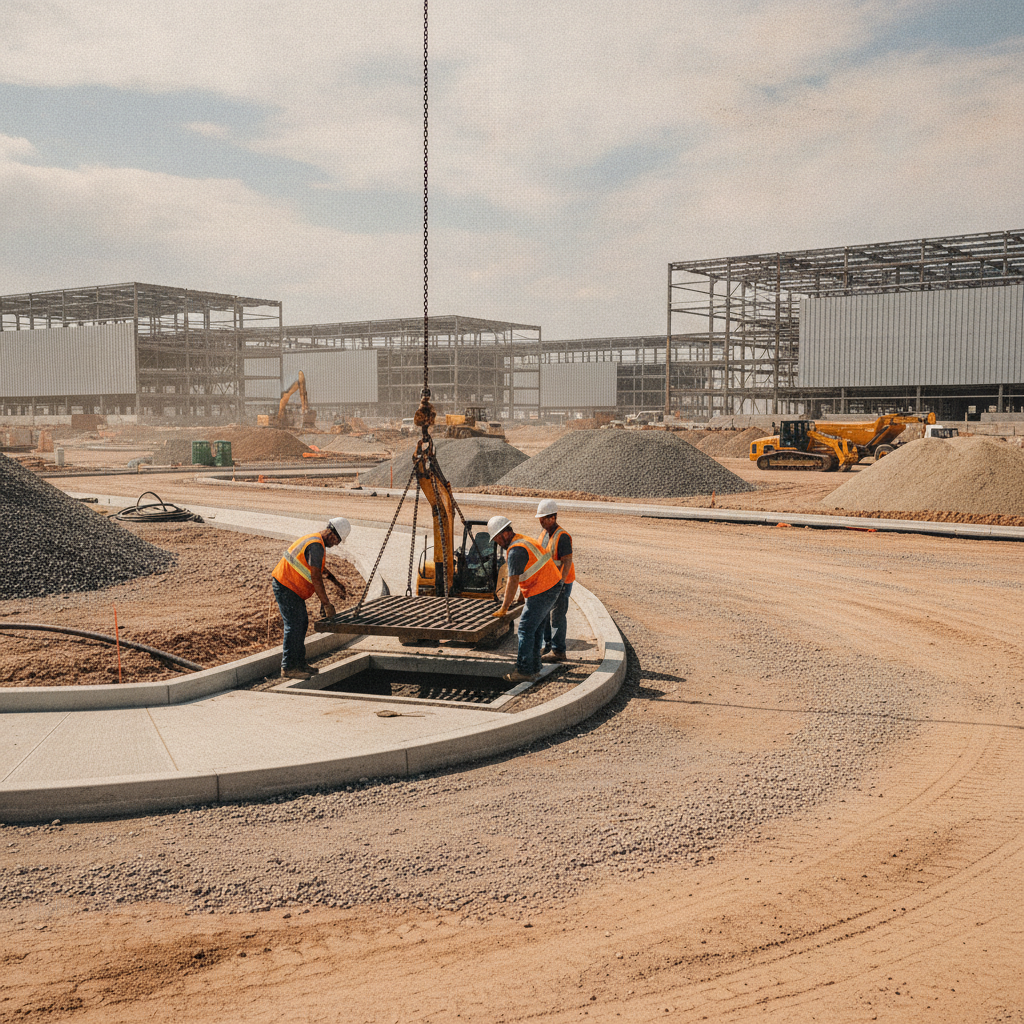
Inlet Types and Selection for Data Center Applications
The first step in a resilient drainage plan is selecting the appropriate inlet types for different zones across the data center campus. The three primary types are curb inlets, grate inlets, and combination inlets, each with specific hydraulic characteristics and applications. For a data center, the selection is driven by efficiency, safety, and durability. Curb inlets are ideal for long, continuous stretches of roadway where sheet flow is consistent, as they are less prone to clogging from surface debris. However, their hydraulic capacity can be limited in very flat areas, a common feature of data center sites. Grate inlets offer high-capacity interception in sumps or low points but can be a maintenance concern and a potential hazard for pedestrian or small-wheeled traffic if not properly specified. Combination inlets provide the benefits of both, offering high efficiency and a degree of redundancy. For data center sites, we often specify combination inlets along primary access roads and heavy-duty grate inlets in paved equipment yards. The material selection, whether precast concrete or cast-in-place, is also a critical part of the site development process, ensuring longevity under constant, heavy use.
Hydraulic Design Criteria: Inlet Spacing and Gutter Spread
Inlet Selection Criteria for Data Center Zones
| Zone / Application | Recommended Inlet Type | Key Design Consideration | Grate Specification |
|---|---|---|---|
| Main Access Drive & Internal Roads | Combination (Curb & Grate) | Control gutter spread to maintain traffic safety; manage bypass flow. | AASHTO H-20 Traffic-Rated |
| Equipment Delivery Route | Heavy-Duty Grate or Combination | Extreme load capacity for heavy transport vehicles; structural integrity of inlet box. | AASHTO H-20 or Airport-Rated |
| Loading Dock Area | Trench Drain or Area Drain | Prevent all water intrusion into the building; precise grading is critical. | Forklift-Rated, Heavy-Duty |
| Pedestrian Walkways & Plazas | Slotted Drain or Small Grate Inlet | ADA compliance (grate openings); aesthetic integration; pedestrian safety. | ADA-Compliant, Pedestrian-Rated |
| Generator Yard Perimeter | Grate Inlet or Trench Drain | Isolate critical equipment from runoff; ensure maintenance access. | AASHTO H-20 (if accessible by service vehicles) |
| Large Paved Storage Yards | Multiple Grate Inlets in Sumps | High-volume capture for large impervious areas; strategic placement at low points. | AASHTO H-20 Traffic-Rated |
The core of inlet design lies in the hydraulic calculations that determine spacing and performance during a specific design storm. In Florida, this often means designing for a 10-year or 25-year storm event, as stipulated by the local municipality or Water Management District. The primary goal is to control the gutter spread—the width of water flow along the curb line. Excessive spread can lead to hydroplaning risks for vehicles and can overtop curbs, threatening adjacent critical infrastructure. Our Florida civil engineering team uses hydraulic modeling software to calculate the precise inlet spacing needed to capture runoff efficiently and keep the spread within allowable limits, typically no more than half a travel lane. These calculations are not static; they must account for the site’s specific topography, pavement cross-slope, and the Manning’s roughness coefficient of the surface. For large, flat data center pads, achieving positive flow to inlets is a challenge that requires careful grading design in conjunction with the inlet placement strategy. Every calculation is a balance between performance, cost, and regulatory compliance, ensuring the final drainage design is both effective and permittable.
Managing Bypass Flow and Clogging Factors
No inlet is 100% efficient. The water that flows past an inlet during a storm is known as bypass flow. On a large, interconnected site like a data center, unmanaged bypass flow from one inlet can overwhelm the next one downstream, creating a cascading failure that leads to significant ponding. A key aspect of resilient stormwater management is to strategically account for and direct this bypass flow. This might involve using a series of inlets where the final one in the series is oversized or located in a sump condition to capture all remaining runoff before it can reach a critical area. Furthermore, real-world conditions involve debris. To account for this, engineers apply a clogging factor to design calculations, typically assuming an inlet is 25% to 50% blocked. This conservative approach provides a crucial factor of safety, ensuring the system functions even when not perfectly maintained. Neglecting clogging factors is a common oversight that can lead to an under-designed system that fails during the very storm events it was designed to handle, making it a critical consideration for any Professional Engineer.
Heavy-Duty Grates for Mission-Critical Traffic Routes
Data center sites are not typical commercial properties. They are industrial facilities that receive regular deliveries of extremely heavy equipment, including multi-ton generators, chillers, and electrical switchgear. Standard-duty grates used in parking lots would fail catastrophically under these loads. Therefore, all inlets located in equipment delivery routes, loading zones, and primary drive aisles must feature heavy-duty traffic-rated grates. The standard specification is typically AASHTO H-20 or HS-20 loading, which is designed to withstand the weight of a fully loaded semi-trailer. In some cases, where specialized transport vehicles are expected, airport-rated (FAA) grates may be necessary. The specification of these grates is a critical coordination point between the civil engineer and the structural engineer. The inlet structure itself must be designed to support these loads without failure. This level of detail in site engineering services is non-negotiable for ensuring the long-term structural integrity and safety of the facility’s infrastructure.
Strategic Inlet Placement: Loading Docks and Generator Yards
Certain areas of a data center are more vulnerable than others. Loading docks are a primary point of entry and must be kept free of ponding water to ensure uninterrupted logistics and prevent water intrusion into the building. Inlets, often in the form of trench drains, must be placed directly in front of dock doors. The surrounding pavement must be meticulously graded to create a localized low point at the drain, ensuring all water is intercepted before it reaches the building threshold. This requires close utility coordination to avoid conflicts with underground conduits and foundations. Similarly, generator yards are mission-critical zones. Ponding water can compromise fuel systems, electrical connections, and access for maintenance personnel. The drainage design for these areas often involves a perimeter system of inlets or trench drains to isolate the equipment pads from surrounding runoff. The goal is to create a ‘dry zone’ around this essential backup infrastructure, a critical task for any Civil Engineer near me working on these projects.
Permitting and Agency Review for Data Center Drainage Systems
A technically sound design is only effective if it can be permitted. In Florida, stormwater permitting is a rigorous process involving multiple agencies, including local municipalities, counties, and regional Water Management Districts (WMDs). The permit submittals must include detailed drainage calculations, plans, and a report demonstrating full compliance with all applicable regulations. This includes criteria for water quality (treatment) and water quantity (peak discharge rate and flood control). The drainage plans must clearly show inlet locations, types, pipe sizing, and grading. The supporting calculations must validate every aspect of the design, from gutter spread to the performance of the downstream conveyance and detention systems. A thorough and well-documented submittal, prepared by experienced Florida Licensed Engineers, is crucial for a smooth agency review process, minimizing requests for additional information (RAIs) and keeping the project on schedule.
Our Approach to Data Center Inlet Design
At RSP Engineers, our process for designing data center stormwater systems is built on a foundation of risk mitigation and precision. We begin with a thorough site analysis and a deep dive into the client’s operational requirements. Our team then develops a comprehensive hydraulic model to simulate storm events and optimize the drainage design. This includes meticulous planning for inlet placement, type, and specification, ensuring every component contributes to the site’s overall resilience. We produce detailed construction documents that leave no room for ambiguity, covering everything from grading to grate specifications. Throughout the permitting process, we act as a proactive partner, interfacing with agencies to secure approvals efficiently. Finally, our construction administration services ensure that the design is implemented exactly as specified, safeguarding the integrity of the final build.
Common Issues in Data Center Stormwater Design
Even with careful planning, several common issues can arise. One of the most frequent is underestimating the true loading conditions, leading to the specification of inadequate grates that fail prematurely. Another is poor utility coordination, where stormwater lines conflict with dense underground electrical and communication conduits, requiring costly redesigns during construction. Failing to properly account for clogging factors can lead to a system that looks good on paper but fails in reality. Lastly, a design that doesn’t consider future expansion can create significant challenges later, forcing expensive retrofits to the drainage infrastructure. Proactive planning and experienced engineering are the best defense against these preventable problems. Frequently Asked Questions How does Florida’s intense rainfall affect data center inlet design? Florida’s rainfall is characterized by high-intensity, short-duration events that can quickly overwhelm undersized systems. Our drainage design must account for these rainfall patterns by using conservative design storm criteria, ensuring inlets have sufficient capacity, and planning for efficient conveyance to stormwater management ponds. The goal is rapid removal of surface water from critical areas. What is the difference between gutter spread and ponding width? Gutter spread refers to the width of water flowing along a curb or edge of pavement as it travels towards an inlet. It’s a measure of flow in motion. Ponding width refers to the extent of standing water that accumulates in a low point or sump area before it can enter an inlet. Both are critical metrics that must be kept within strict limits defined by local regulations to ensure site safety and functionality. Why can’t we use standard residential or light commercial grade inlets? Standard inlets and grates are not designed to withstand the unique demands of a data center. The primary reasons are loading and resilience. Data centers require AASHTO H-20 or higher rated grates to handle heavy equipment deliveries. Furthermore, the financial and operational cost of a drainage failure is so high that a more conservative and robust design approach, including safety factors like clogging factors, is essential. How do you account for future site expansion in the initial drainage design? We work with the client to understand the master plan for the site. The initial stormwater management system, including main conveyance pipes and detention ponds, is often sized to accommodate future phases. We may also stub out connections and design the initial grading and inlet locations in a way that facilitates seamless integration with future development, saving significant time and money later. What kind of documentation is needed for a stormwater permit submittal? A typical permit submittal package for a Florida Water Management District includes signed and sealed construction plans, a detailed drainage report with hydraulic and hydrologic calculations, geotechnical information, and completed application forms. The report must demonstrate how the site plan design meets all criteria for water quality treatment and peak flow attenuation.
Your Partner for Mission-Critical Site Engineering
Protecting a multi-million dollar data center investment starts with a resilient and reliable site design. Don’t leave your facility’s operational integrity to chance. Partner with the experts at RSP Engineers for specialized data center site development, robust stormwater management solutions, and streamlined permitting in Florida. Our team of experienced Civil Engineers is ready to ensure your project is built on a foundation of engineering excellence. Contact us today to discuss your project requirements.
Conclusion
In conclusion, stormwater inlet design for data centers is a highly specialized discipline within civil engineering that goes far beyond standard commercial practices. It demands a rigorous focus on hydraulic performance, structural durability, and the protection of mission-critical infrastructure. By carefully selecting inlet types, applying conservative design criteria like clogging factors, and specifying heavy-duty components, engineers can create a drainage design that provides the resilience necessary to support 24/7 operations. For developers and operators in Florida, partnering with an engineering firm that understands these unique challenges is the first step toward a secure and successful project.
FAQs
-
Data Center Stormwater Inlet Design requires careful planning, qualified engineering, and compliance with the applicable codes and permits.
-
Getting Data Center Stormwater Inlet Design right protects safety, supports regulatory compliance, and avoids costly redesigns or delays.
-
RSP Engineers provides licensed expertise and end-to-end support for Data Center Stormwater Inlet Design, from early planning through permitting.