
Data Center Stormwater Design: Civil Engineering Best Practices
A technical guide for data center developers on civil engineering best practices for stormwater design in Florida, covering permitting, drainage, and rate control.
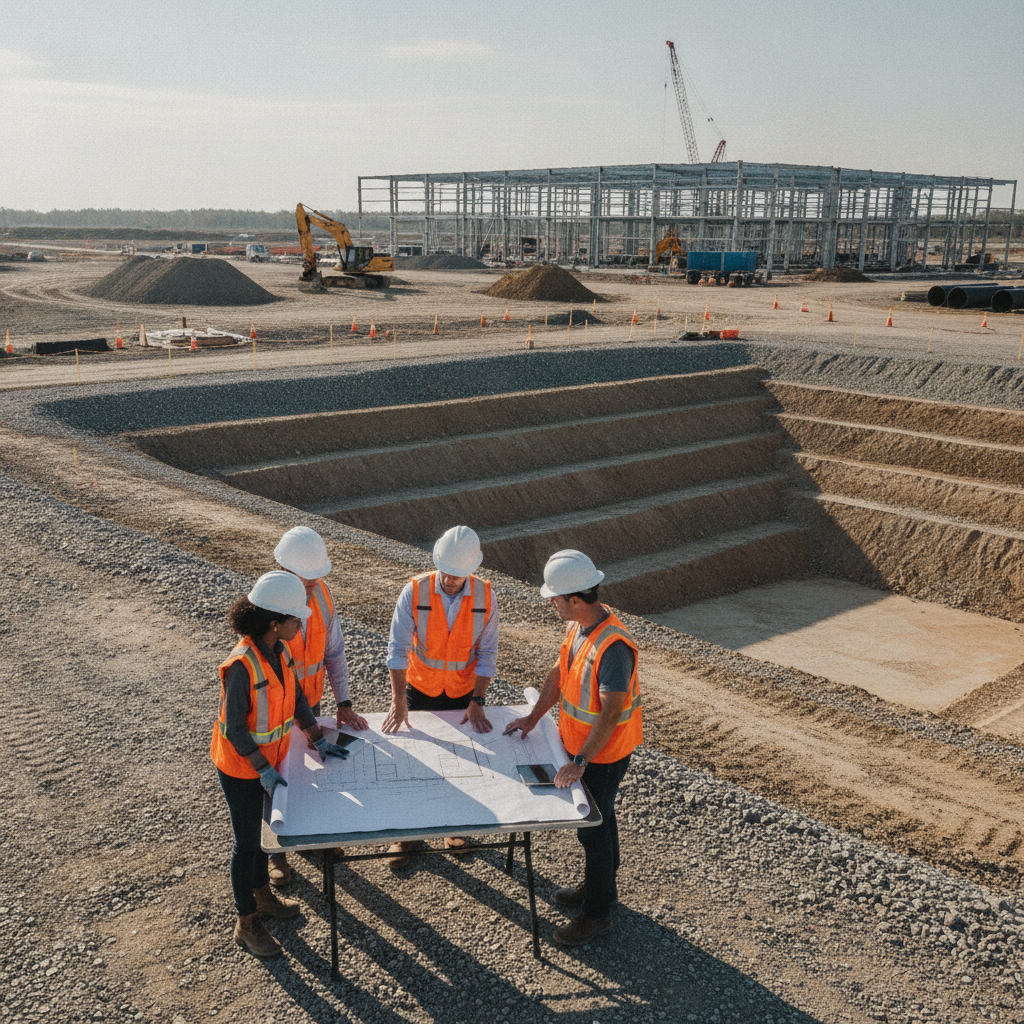
Quantifying Impervious Surfaces and Runoff Volume
The first step in any data center stormwater management plan is to accurately quantify the increase in impervious cover. Unlike typical commercial projects, data center campuses often approach near-total site coverage with non-porous materials. Our Civil Engineers meticulously analyze site plans to calculate the total impervious area, which is a critical input for determining runoff volume. We use established hydrological models, such as the NRCS TR-55 method or the Rational Method, to compare pre-development runoff characteristics with the post-development scenario. This analysis involves defining key parameters like the runoff curve number (CN), the time of concentration for the basin, and the specific rainfall data for various design storm events (e.g., 25-year, 24-hour storm). The goal is to create a precise hydrograph showing the volume and rate of water that will shed from the developed site. This data forms the baseline for all subsequent drainage design and permitting efforts, ensuring the system is sized to handle anticipated flows without causing off-site impacts.
Peak Flow Attenuation and Rate Control Strategies
Data Center Stormwater Design Component Comparison
| Component | Primary Function | Key Design Considerations (Florida) |
|---|---|---|
| Detention Basin (Dry Pond) | Peak flow rate attenuation | Requires large land area; must drain completely within 72 hours; outlet control structure design is critical for meeting discharge rate targets. |
| Retention Basin (Wet Pond) | Water quality treatment and peak flow attenuation | Requires a permanent pool and a vegetated littoral shelf; must demonstrate nutrient removal efficiency; often the preferred BMP for WMD permitting. |
| Underground Attenuation System | Peak flow rate attenuation in land-constrained areas | High cost; complex installation; requires pre-treatment for water quality; maintenance access and long-term inspection are major considerations. |
| Bioswale / Vegetated Swale | Conveyance and supplemental water quality treatment | Effective for treating runoff from smaller areas like parking lots; relies on appropriate soil media and vegetation; limited attenuation capacity. |
| Proprietary Water Quality Unit | Targeted pollutant removal (sediment, oils) | Used as pre-treatment or in ultra-urban settings; requires a specific maintenance plan; manufacturer specifications must be approved by the reviewing agency. |
A core requirement of Florida’s Water Management Districts (WMDs) is that the post-development peak discharge rate cannot exceed the pre-development rate. This is known as peak flow attenuation. For data center sites with massive impervious footprints, achieving this requires significant engineering intervention. The primary tools for rate control are detention and retention basins. A detention basin is designed to temporarily store stormwater runoff and release it slowly through a carefully designed outlet control structure, thus shaving the peak off the discharge hydrograph. Sizing these facilities is a complex task involving storage routing calculations and hydrograph analysis. The design must account for the total required storage volume while ensuring the basin drains within a specified timeframe to be ready for subsequent storm events. This phase of site development is critical for regulatory approval and requires sophisticated modeling to demonstrate compliance. The effectiveness of the drainage design directly impacts the project’s ability to secure an Environmental Resource Permit (ERP).
Water Quality Treatment for Data Center Campuses
Beyond managing quantity, stormwater management systems in Florida must also address water quality. Runoff from parking lots and rooftops can carry pollutants like hydrocarbons, heavy metals, and nutrients (nitrogen, phosphorus) into receiving water bodies. State and local regulations mandate the implementation of Best Management Practices (BMPs) to treat a specific volume of runoff, often the first inch of rainfall. For data centers, the most common and effective BMP is a wet detention pond, also known as a retention basin. These ponds maintain a permanent pool of water that allows sediments and associated pollutants to settle out. Biological processes within the pond further break down nutrients, providing a high level of treatment. The design must include a littoral zone planted with native aquatic vegetation to enhance nutrient uptake. Demonstrating compliance with water quality standards is a non-negotiable part of the permitting process and is heavily scrutinized during the agency review.
Conveyance System Design: Pipes, Culverts, and Channels
An effective stormwater system relies on a network of conveyance elements to safely transport runoff from impervious surfaces to the treatment and attenuation facilities. This network includes storm sewer pipes, inlets, manholes, culverts, and open channels or swales. The drainage design for this infrastructure involves detailed hydraulic calculations, often using Manning’s equation, to ensure pipes are sized correctly to handle flow from major design storm events without surcharging or causing localized flooding. A critical aspect of this work is intensive utility coordination. Data center sites are congested with a web of critical utilities, including high-voltage power conduits, redundant fiber optic lines, and water and sewer mains. The storm sewer system must be designed to avoid conflicts with these existing and proposed utilities, requiring careful planning and collaboration among all engineering disciplines. A failure in utility coordination can lead to costly redesigns and construction delays.
Navigating Florida’s Environmental Resource Permitting (ERP)
Securing the necessary permits is arguably the most critical path item for any data center project in Florida. The primary permit governing stormwater is the Environmental Resource Permit (ERP), issued by either the Florida Department of Environmental Protection (FDEP) or one of the five regional Water Management Districts. The ERP application is a comprehensive package that includes detailed engineering plans, drainage calculations, hydrological models, and often a Geotechnical soil report. The agency review process is rigorous. Reviewers scrutinize every aspect of the stormwater management system to ensure it complies with state statutes and local criteria for water quality, water quantity, and floodplain management. Successful permit submittals require not only technical excellence but also a clear, well-documented narrative that demonstrates how the design meets all regulatory requirements. Experienced Civil Engineering Firms are adept at anticipating reviewer comments and proactively addressing potential issues to streamline the approval process.
Floodplain Management and Site Resiliency
Given their mission-critical nature, data centers demand the highest level of resiliency. A key part of the site development process is a thorough analysis of flood risk. This begins with reviewing FEMA Flood Insurance Rate Maps (FIRMs) to determine if the site is within a designated special flood hazard area. The design must ensure that all critical infrastructure and building finished floor elevations (FFEs) are set safely above the base flood elevation (BFE), often with additional freeboard as required by the Florida Building Code. Beyond regulatory minimums, robust civil engineering for data centers involves designing for extreme weather events. This includes ensuring the stormwater system can handle rainfall beyond the typical design storm and that emergency access routes remain passable during a major flood event. Protecting a multi-million dollar facility from downtime requires a proactive approach to floodplain management and a design that prioritizes long-term operational resilience.
RSP Engineers’ Approach to Data Center Site Design
At RSP Engineers, our process is built on a foundation of proactive planning and technical precision. We begin with a comprehensive due diligence and feasibility study to identify potential site constraints, from utility conflicts to environmental concerns. This informs our preliminary engineering report, which outlines the proposed stormwater management strategy. We then proceed to detailed design, utilizing advanced modeling software to optimize the drainage design for performance and cost-effectiveness. Our deep experience with Florida’s regulatory agencies allows us to manage the permitting process efficiently, preparing thorough permit submittals designed to minimize review cycles and secure approvals on schedule. During construction, we provide construction administration to ensure the built system conforms to the approved plans.
Common Challenges in Data Center Stormwater Permitting
Even with expert planning, data center projects can face hurdles. A common issue is encountering unsuitable soil conditions or a high seasonal water table, which can complicate pond construction and performance, often identified in the Geotechnical soil report. Another challenge is addressing stringent nutrient loading requirements in watersheds with established Total Maximum Daily Loads (TMDLs), which may require more advanced treatment systems. Responding to agency Requests for Additional Information (RAIs) is a standard part of the process; a prompt and technically sound response is crucial to keeping the project timeline intact. Finally, unforeseen conflicts with major off-site utilities during the design of discharge structures can require significant redesign and coordination efforts.
Your Partner for Mission-Critical Site Development
Developing a data center in Florida demands a civil engineering partner with proven expertise in large-scale site development and a masterful understanding of the state’s complex regulatory environment. The success of your project hinges on a meticulously planned and executed stormwater management system. At RSP Engineers, we specialize in navigating the technical and regulatory challenges of mission-critical facilities. Our team is ready to manage your project’s permitting, design, and construction phases with the precision and foresight you need.
Conclusion
In conclusion, the design of stormwater systems for data centers is a highly specialized discipline within civil engineering. It requires a holistic approach that balances the need for massive peak flow attenuation, stringent water quality treatment, and uncompromising site resiliency. Success depends on accurate hydrologic modeling, a robust drainage design, and a strategic approach to navigating Florida’s permitting landscape. Partnering with an experienced engineering firm is the most critical step a developer can take to ensure their facility is protected and their investment is secure.
FAQs
-
The primary difference is scale and criticality. Data centers have a much higher percentage of impervious cover, leading to massive runoff volumes that require very large and efficient stormwater management facilities. Furthermore, the mission-critical nature of the facility means the design must provide a higher level of flood protection and system resiliency than a typical commercial site.
-
We design stormwater systems with a master plan in mind. The initial phase of development includes a master stormwater system, often a large regional pond, that is sized to accommodate the runoff from all future phases. This master permitting approach provides the developer with long-term certainty and streamlines the approval process for subsequent expansions, as the primary drainage design is already approved.
-
A Geotechnical soil report is absolutely critical. It provides essential data on soil permeability (for infiltration), the depth of the seasonal high water table (which dictates pond depth), and the structural stability of soils for constructing pond banks. Without an accurate geotechnical investigation, the stormwater pond design is based on assumptions that can lead to system failure or costly construction changes.