
Data Center Stormwater Best Practices
Explore essential stormwater best practices for data center development. Learn about hydrologic due diligence, redundancy, permitting, and avoiding costly delays with expert civil engineering
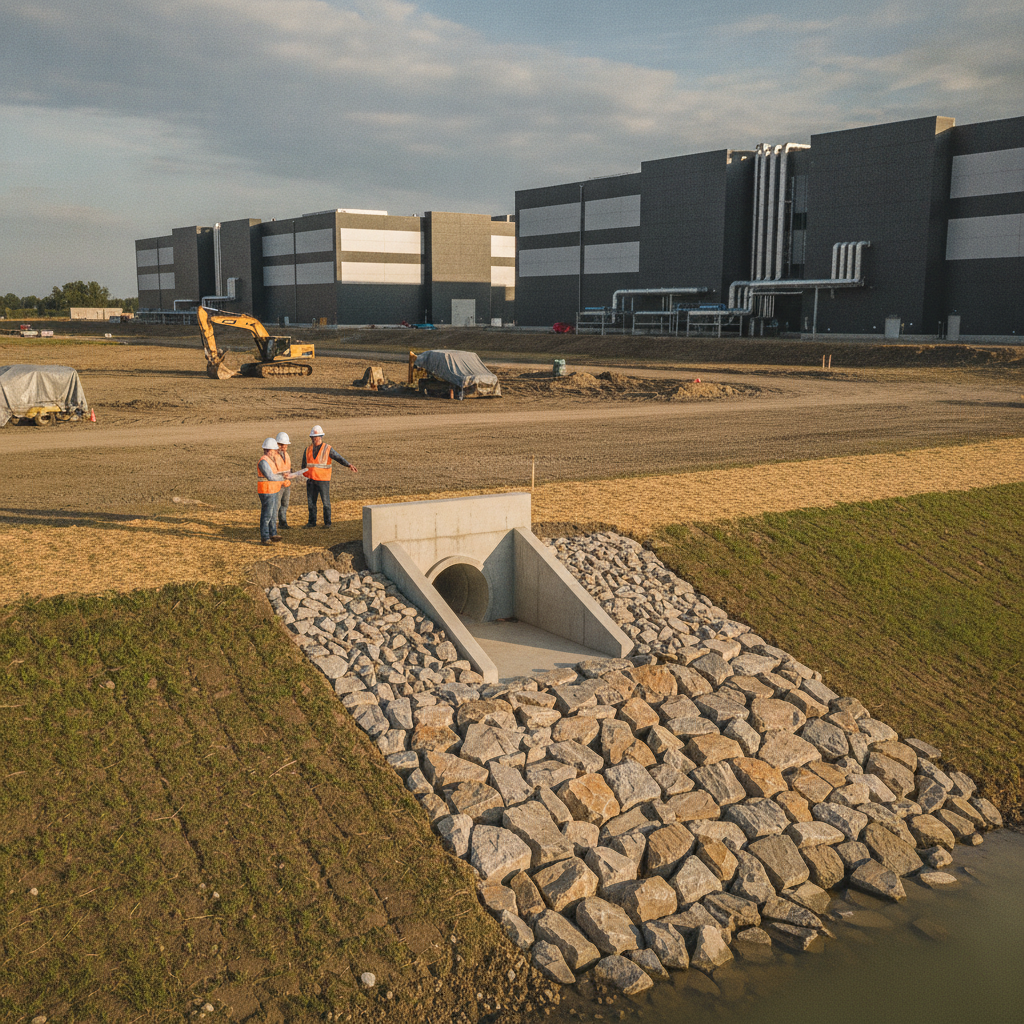
Early Hydrologic Due Diligence: The Foundation of Uptime
The most critical phase for de-risking a data center project happens before the first plan is drawn. A comprehensive hydrologic analysis during the due diligence period identifies potential site-level threats that could compromise the facility. This goes far beyond a simple review of FEMA flood maps. Our engineers conduct a detailed study of historical rainfall data, upstream and off-site drainage patterns, and existing topographical constraints to understand how water will behave on and around the property during a major storm event. This early investigation must include a thorough geotechnical investigation to assess soil permeability and the seasonal high water table. In many parts, high groundwater can severely limit the effectiveness of infiltration-based stormwater solutions and dictate the need for lined retention ponds or exfiltration systems. Identifying these constraints early informs site selection, influences the preliminary site plan design, and prevents costly redesigns during the permitting phase. Ignoring this step is a common source of significant project delays and budget overruns.
Right-Sizing Storage for Extreme Weather Events
Data Center Stormwater Design Feature Comparison
| Feature | Land Footprint | Redundancy Potential | Maintenance Complexity |
|---|---|---|---|
| Surface Retention Pond | High | Moderate (multiple cells, overflow weirs) | Low (easy visual inspection and access) |
| Underground Chamber System | Very Low (located under pavement) | High (can be designed in parallel banks) | High (requires confined space entry, specialized cleaning) |
| Oversized Pipe Storage | Low (linear footprint) | Moderate (can be looped or manifolded) | Moderate (requires jetting and vactor access) |
| Exfiltration Trench System | Low to Moderate | Low (performance is soil-dependent) | High (prone to clogging, difficult to rejuvenate) |
| Pervious Pavement | Very Low (integrated into surface) | Low (supplemental system always required) | High (requires regular vacuum sweeping to prevent clogging) |
Data centers cannot afford even minor flooding. Therefore, the drainage design must be engineered to handle extreme weather events, often exceeding the minimum standards required by local municipalities or Local’s Water Management Districts (WMDs). While a 25-year or 100-year storm frequency is a common design benchmark, mission-critical facilities may warrant analysis of more severe scenarios to ensure total site stability. This involves sophisticated stormwater modeling to accurately calculate peak runoff rates and required storage volumes. Maximizing usable land is a key objective for any data center campus. To achieve this, engineers often turn to underground storage solutions. These can include large-diameter pipes, concrete vaults, or modular plastic chamber systems installed beneath parking lots or other non-critical areas. While these underground detention systems have a higher initial cost than traditional surface ponds, they free up valuable real estate for future building expansion or electrical substation placement. The selection process involves a careful trade-off analysis of cost, maintenance accessibility, and the overall site development strategy.
Designing for Redundancy in Mission-Critical Systems
The principle of redundancy, central to a data center’s power and cooling infrastructure, must be applied with equal rigor to its stormwater system. A single point of failure, such as a clogged outfall pipe or a collapsed structure, could have devastating consequences. Best practices dictate the inclusion of multiple, independent discharge points, redundant control structures, and clearly defined emergency overflow pathways. An emergency overflow weir or spillway, for example, is a critical feature that provides a controlled release path for water if the primary system is overwhelmed, preventing catastrophic flooding of buildings and equipment pads. The design should ensure that these overflow paths direct water away from sensitive areas. This level of system redundancy provides a crucial safety factor, ensuring that even during a system failure within an extreme storm event, the core mission-critical functions of the data center remain protected.
Integrating Stormwater with Grading and Utility Coordination
A successful stormwater design is not created in a silo. It is intrinsically linked to the site’s overall grading plan and utility layout. The required depths and slopes of large stormwater pipes often dictate the finished floor elevations of buildings and the grading of the entire property. Early and continuous utility coordination is essential to avoid costly conflicts between the gravity-fed storm sewer and other critical underground infrastructure like power conduits, communication ducts, and water mains. For instance, a deep stormwater trunk line crossing the path of a primary electrical duct bank can create significant construction challenges and require expensive structural solutions. A proactive civil engineering approach involves creating a composite utility plan early in the design process. This plan maps out all proposed infrastructure in three dimensions, allowing the design team to identify and resolve potential clashes long before construction begins, ensuring a smooth and efficient construction administration phase.
Navigating Complex Stormwater Permitting Process
Securing the necessary permits for a large-scale data center is a complex undertaking. The primary approval is the Environmental Resource Permit (ERP), typically issued by one of the state’s five Water Management Districts. This permit governs all aspects of the stormwater management system, from water quality treatment (nutrient removal) to flood control. In addition, developers must secure an NPDES permit for construction activities and navigate the specific requirements of the local city or county. A successful permitting strategy relies on submitting a complete, well-documented application that proactively addresses potential agency concerns. This includes clear and defensible stormwater calculations, detailed construction plans, and a robust maintenance and operation plan. Incomplete permit submittals are a leading cause of project delays, as they often trigger multiple rounds of review and requests for additional information. Engaging a civil engineering firm near me with extensive experience in a specific WMD’s jurisdiction is critical for anticipating reviewer comments and streamlining the approval process.
Constructability and Long-Term Maintenance Planning
A theoretically perfect design is useless if it cannot be built efficiently or maintained effectively. A thorough constructability review is a critical step to ensure the proposed stormwater system is practical. This involves considering factors like the availability of materials, access for heavy equipment, and potential conflicts with construction sequencing. For example, specifying an underground chamber system that requires a massive excavation adjacent to a building foundation can create logistical and safety challenges. Furthermore, the design must account for long-term maintenance from day one. This includes providing adequate access points (manholes and cleanouts) for inspection and cleaning of underground pipes and structures. For surface ponds, access roads must be designed to support vactor trucks and other heavy maintenance vehicles. A comprehensive operation and maintenance plan, often required as part of the ERP application, should be a living document that guides the facility’s staff for the life of the project, ensuring the stormwater management system functions as designed for decades.
The RSP Engineers Approach to Data Center Site Development
As one of the leading Civil Engineering Firms, RSP Engineers employs a phased, risk-mitigation approach to mission-critical projects. Our process begins with exhaustive due diligence to identify and quantify site constraints. We then move into collaborative conceptual design, working with the client’s team to optimize the site layout for operational efficiency and resilience. Our deep experience with regulatory agencies allows us to manage the permitting process proactively, anticipating comments and minimizing review cycles. Throughout the detailed design and construction document phases, we focus on creating clear, biddable, and constructible plans. We believe that meticulous utility coordination and a focus on long-term maintainability are non-negotiable. During construction, our Construction Management Services team provides responsive support, helping clients navigate unforeseen field conditions and ensuring the final product is built in strict accordance with the design intent and regulatory approvals.
Common Pitfalls That Cause Delays and Budget Overruns
Even with a strong team, data center projects can encounter obstacles. Awareness of common pitfalls is the first step in avoiding them. Key issues we frequently see include: Underestimating Off-Site Flows: Failing to properly account for stormwater runoff from adjacent properties can lead to an undersized system. Late Geotechnical Discovery: Discovering unsuitable soils or a high water table late in the design process can force a complete redesign of the stormwater and foundation systems. Utility Conflicts in the Field: Inadequate utility investigation and coordination during design often leads to costly and time-consuming conflicts during construction. Incomplete Permit Submittals: Submitting an application with missing information or flawed calculations is the fastest way to get stuck in months of regulatory delays. Value Engineering Core Redundancy: Attempting to cut costs by eliminating redundant outfalls or emergency overflows is a short-sighted decision that exposes the entire facility to unnecessary risk.
Partner with Data Center Civil Engineering Experts
Ready to de-risk your next mission-critical project? The complexities of data center development in demand specialized expertise. Contact RSP Engineers to discuss your site development needs, from initial feasibility studies and permitting strategy to final construction administration. Our team of experienced Civil Engineers is dedicated to ensuring your infrastructure is resilient, compliant, and built for continuous uptime. Let us help you lay the groundwork for success.
Conclusion: Resilient Stormwater Design is Non-Negotiable
For data center developers and operators, treating stormwater management as a mere regulatory hurdle is a critical error. it is a core component of risk management and operational resilience. A successful project hinges on early and thorough due diligence, a design philosophy rooted in redundancy, and seamless integration with the overall site development plan. By prioritizing these best practices, developers can protect their significant investment, ensure continuous uptime, and build facilities prepared for the most extreme weather conditions. A proactive and expert-led civil engineering approach is the only way to achieve the certainty that mission-critical infrastructure demands.
FAQs
-
The most significant mistake is insufficient upfront due diligence. Many developers rush into site acquisition without a full understanding of the property’s hydrologic constraints, such as high groundwater, poor soils, or significant off-site drainage contributions. This can lead to the discovery that a site requires an extremely expensive or complex stormwater management system, jeopardizing the project’s budget and timeline.
-
A high seasonal water table, common in Florida, severely restricts the use of infiltration-based stormwater solutions. It forces the design toward lined wet retention ponds to prevent groundwater mounding or exfiltration systems that sit above the water table. This can also increase construction complexity and costs, potentially requiring dewatering operations during the installation of deep pipes and underground structures.
-
Absolutely. Underground systems are an excellent strategy for maximizing developable area. However, the decision involves trade-offs. They have a higher initial capital cost compared to surface ponds and require a more rigorous long-term maintenance plan. The design must also account for the structural loading of the system, ensuring it can support overlying pavement and traffic from heavy vehicles like fire trucks or maintenance cranes.