
Data Center Slope Stability Analysis
A technical guide for data center developers on slope stability analysis, factor of safety, failure modes, and mitigation. Learn how RSP Engineers ensures site integrity in Florida.
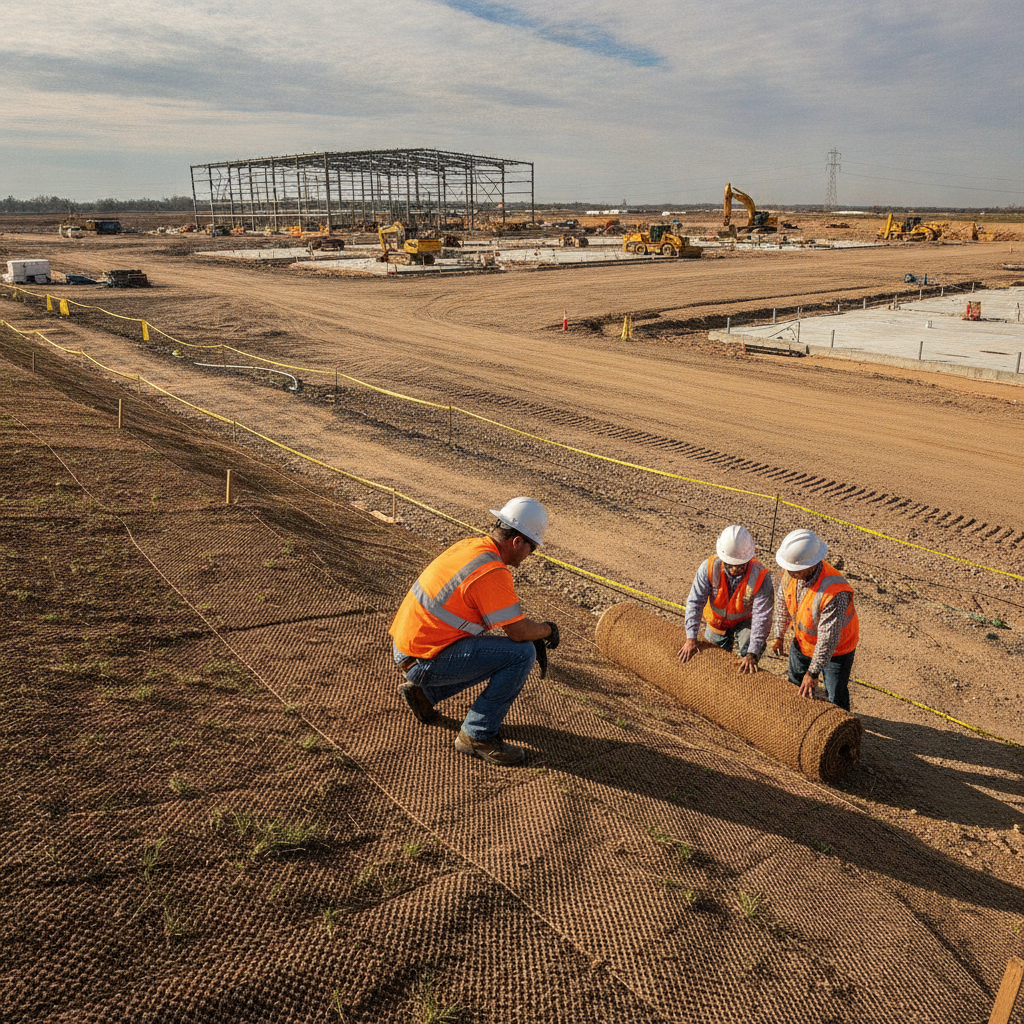
Defining the Factor of Safety for Mission-Critical Infrastructure
The core output of a slope stability analysis is the Factor of Safety (FS). This value is a calculated ratio of the soil’s shear strength (resisting forces) to the shear stress acting along a potential failure surface (driving forces). An FS of 1.0 indicates a state of limit equilibrium, where the forces are perfectly balanced and the slope is on the verge of failure. For any civil engineering project, the design must achieve an FS significantly greater than 1.0 to account for uncertainties in soil properties, groundwater conditions, and analytical methods. For typical commercial projects, a minimum FS of 1.5 for permanent slopes is a common standard. However, for mission-critical facilities like data centers, a more conservative approach is often warranted. The immense cost of failure justifies a higher standard of care, potentially pushing the required FS to 1.75 or higher depending on the criticality of the slope and the risks involved. This determination is a key part of the initial site plan design and is heavily influenced by the findings of a comprehensive geotechnical investigation.
Common Slope Failure Modes and Their Impact on Data Center Operations
Slope Stabilization and Mitigation Technique Comparison
| Technique | Primary Mechanism | Ideal Application | Relative Cost |
|---|---|---|---|
| Slope Flattening / Regrading | Reduces driving forces by decreasing the slope angle. | Sites with available real estate where a larger footprint is acceptable. | Low to Moderate |
| Engineered Buttress / Berm | Increases resisting forces by adding weight at the toe of the slope. | Stabilizing the base of a potential failure mass; effective in preventing rotational slides. | Moderate |
| Soil Nail / Rock Anchor Reinforcement | Increases resisting forces by installing tensile elements into the soil/rock mass. | Stabilizing steep cut slopes, especially in constrained areas where regrading is not feasible. | High |
| Geogrid / Geosynthetic Reinforcement | Increases soil shear strength by layering tensile reinforcement within a fill slope. | Constructing steep Mechanically Stabilized Earth (MSE) walls or reinforcing fill over weak soils. | Moderate to High |
| Subsurface Drainage System | Reduces pore water pressure, thereby increasing the soil's effective stress and shear strength. | Slopes with high groundwater tables or significant seepage issues. | Moderate |
Slope failures can manifest in several ways, each with distinct implications for a data center facility. A thorough analysis must evaluate the potential for multiple failure modes. The most common include rotational slides, where failure occurs along a curved surface, often in cohesive soils like clay. Translational slides involve a failure mass moving along a planar surface, typically a weak layer of soil or the interface between soil and bedrock. These can be particularly damaging to linear infrastructure like utility corridors or access roads. Other modes include block or wedge failures, which are more common in rock but can occur in heavily over-consolidated soils, and flows, which involve the rapid movement of saturated, loose granular soils. Any of these events could undermine building foundations, damage underground conduits essential for utility coordination, or block critical access points. A detailed Geotechnical soil report is the first line of defense, identifying soil stratigraphy and properties that could be susceptible to these types of foundation integrity issues.
Limit Equilibrium Methods: The Foundation of Stability Calculations
To calculate the Factor of Safety, engineers employ Limit Equilibrium Methods (LEM). These analytical techniques involve dividing a potential sliding mass into vertical slices and analyzing the forces acting on each slice to determine overall stability. While the calculations are complex, they are the industry standard for most practical applications and are executed using specialized civil engineering software like GeoStudio’s SLOPE/W or Slide. Several specific methods exist, such as the Ordinary Method of Slices, Bishop’s Modified Method, and Spencer’s Method, each with different assumptions about interslice forces. The choice of method depends on the specific geometry and soil conditions. The analysis inputs are critical and include soil unit weight, shear strength parameters (cohesion and friction angle) derived from laboratory testing, and the location of the water table, which dictates the pore water pressure. These calculations are a core component of professional site engineering services.
Drained vs. Undrained Conditions: Understanding Soil Behavior Over Time
Soil behavior under load is heavily influenced by the ability of water to move out of its pore spaces. This leads to two primary analytical scenarios: undrained and drained. An undrained analysis models short-term conditions, such as those occurring immediately after a new fill slope is constructed. In this case, pore water pressures build up because the water has no time to escape, which can significantly reduce the soil’s effective stress and strength. This is critical for assessing stability during the construction phase. A drained analysis, conversely, represents the long-term, permanent condition where excess pore water pressures have dissipated, and the groundwater table has reached a steady state. This analysis governs the final, operational stability of the slope. For data centers, both analyses are essential. The site must be stable during the rapid loading of construction (undrained) and remain secure for its entire operational lifespan (drained), especially considering Florida’s frequent, intense rainfall events that can impact long-term stormwater management and saturation levels.
The Critical Role of Groundwater and Seepage Analysis
Groundwater is often the single most critical factor in slope stability. The presence of water within a slope’s soil matrix exerts pore water pressure, which counteracts the normal stress between soil particles. This reduces the frictional component of the soil’s shear strength, effectively lubricating potential failure surfaces and lowering the Factor of Safety. Therefore, accurately identifying the phreatic surface (the water table) is a primary objective of the geotechnical investigation, often accomplished using monitoring wells or piezometers installed during soil boring tests. Furthermore, groundwater seepage out of a slope face can cause localized erosion and instability. A comprehensive analysis includes modeling seepage to predict flow paths and pore pressure distribution. The results directly inform the drainage design, often leading to the inclusion of mitigation measures like horizontal drains, trench drains, or drainage blankets to intercept seepage and depressurize the slope, thereby increasing its stability. This integration is a hallmark of quality site development.
Designing Stable Cut and Fill Slopes for Data Center Pads
Creating a large, level pad for a data center on a site with existing topography requires the design of engineered cut slopes (where material is excavated) and fill slopes (where material is placed and compacted). The design of these slopes must be based on the stability analysis. This includes specifying maximum slope angles (e.g., 2H:1V or 3H:1V), which are determined by the soil properties and the required Factor of Safety. For taller slopes, the design often incorporates slope benches—flat, terrace-like steps cut into the slope face. Benches serve multiple purposes: they break up the slope length to control surface water runoff and erosion, catch minor sloughing material, and provide access for maintenance. For fill slopes, the design specifications must include strict requirements for material type, lift thickness, and soil compaction levels. Verification of these parameters through field testing during construction is a critical task of construction administration to ensure the as-built condition matches the design intent.
Our Approach to Slope Stability at RSP Engineers
At RSP Engineers, we treat slope stability as an integral part of a holistic site design process. Our approach is systematic and phased to mitigate risk at every stage. Comprehensive Geotechnical Investigation: We begin with a robust subsurface exploration program, including soil boring tests, sample collection, and advanced laboratory testing to accurately characterize the site’s soil and groundwater conditions. This forms the basis of our Geotechnical soil report. Detailed Modeling and Analysis: Using industry-standard software, our engineers model potential failure surfaces under various loading and groundwater scenarios. We analyze both short-term and long-term stability to determine the governing Factor of Safety for all proposed slopes. Integrated Civil Engineering Design: The results of the stability analysis are not delivered in a vacuum. We integrate them directly into the overall site plan design, ensuring that grading plans, drainage design, and utility layouts are fully coordinated with the geotechnical requirements. Permitting and Agency Coordination: We prepare clear, defensible geotechnical reports for submission to regulatory agencies. Our experience with Florida’s jurisdictions helps us anticipate and address potential agency review comments efficiently, streamlining the permitting process. Construction Administration: We provide oversight during construction to verify that fill materials, compaction efforts, and slope geometries conform to the design specifications, ensuring the long-term stability envisioned in our plans is achieved in the field.
Common Challenges in Data Center Slope Design and Permitting
Even with a thorough plan, developers can encounter challenges. One common issue is discovering unforeseen subsurface conditions, such as a localized weak soil layer or a perched water table that was not intercepted by the initial soil borings. This can require rapid redesign and analysis. Another challenge involves navigating agency review comments during the permitting process. A reviewer may request a more conservative analysis or question soil strength parameters, requiring additional justification or modeling to secure approval. During construction, deviations from the design are a significant risk. A contractor might over-excavate a cut slope or fail to achieve the specified soil compaction in a fill slope, compromising the design’s Factor of Safety. Finally, value engineering proposals that aim to reduce upfront costs by scaling back the geotechnical investigation or opting for less robust stabilization methods can introduce substantial long-term risk. Proactive management and experienced construction administration are key to overcoming these hurdles.
Secure Your Mission-Critical Investment with Expert Geotechnical Design
The long-term success of your data center depends on the ground it’s built on. Ensuring slope stability is a complex but essential task that protects your investment from preventable geotechnical failures. The team at RSP Engineers provides the integrated expertise needed to navigate these challenges, from initial site assessment and geotechnical engineering to detailed site plan design and navigating the complexities of Florida’s permitting process. We deliver designs that are safe, compliant, and built for the resilience that mission-critical infrastructure demands. Don’t leave the foundation of your digital operations to chance. Contact RSP Engineers today to discuss how our comprehensive site development services can secure your next data center project.
Conclusion: Stability as the Bedrock of Digital Infrastructure
In conclusion, a rigorous slope stability analysis is not a peripheral task but a core requirement for successful data center development. It is the process that quantifies risk and provides a clear engineering pathway to mitigation, ensuring that the final constructed site is robust and reliable. By understanding the Factor of Safety, potential failure modes, and the critical influence of groundwater, developers can make informed decisions that safeguard their assets. Ultimately, a proactive approach that combines a thorough geotechnical investigation, sound civil engineering design, and diligent construction administration is the best way to build a data center with the resilience to guarantee uptime for decades to come.
FAQs
-
While a Factor of Safety of 1. 5 is a common minimum for permanent slopes in general civil projects, data centers often require a higher standard due to their mission-critical nature. Depending on the specific risks and consequences of failure, a design Factor of Safety of 1. 75 or greater may be specified to ensure long-term, resilient performance.
-
Florida’s geology presents unique challenges, including karstic limestone terrain prone to sinkholes, loose sandy soils, and a characteristically high groundwater table. The analysis must carefully consider the potential for soil variability, the significant influence of pore water pressure, and the effects of intense rainfall on soil saturation and drainage design.
-
Yes. If a desirable site has pre-existing slopes with marginal stability, various mitigation techniques can be employed. These range from regrading the slope to a shallower angle, constructing a stabilizing buttress at the toe, or installing reinforcement like soil nails or geogrids. A detailed geotechnical investigation is required to design the most effective and economical solution.