
Data Center Site Plan Approval Requirements
Navigate the complex data center site plan approval process. Our guide covers civil engineering drawings, agency reviews, permitting, and utility coordination for mission-critical facilities nationwid
The Core Components of a Data Center Site Plan Submittal Package
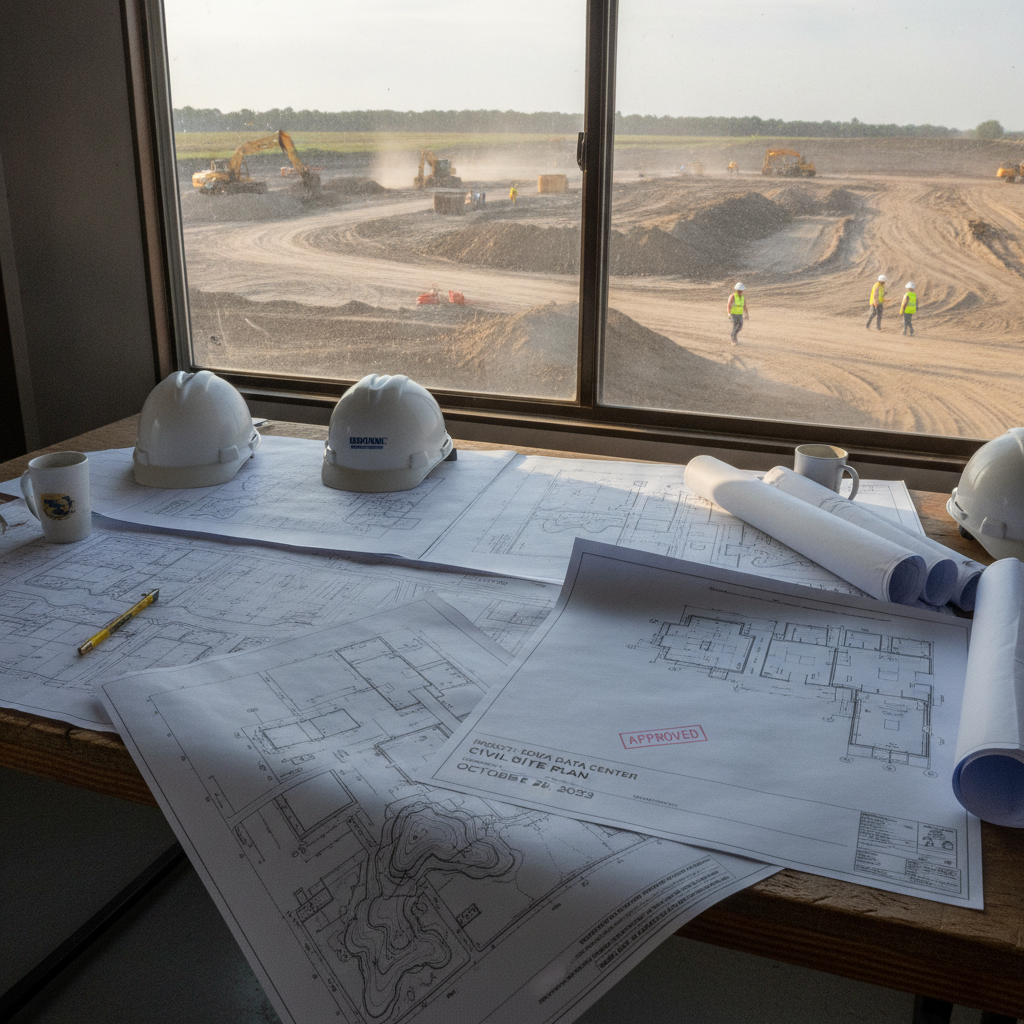
A site plan approval application is more than just a drawing; it’s a comprehensive package of documents that collectively demonstrate a project’s compliance with all applicable codes and standards. The core of the package is the civil engineering drawing set, which provides a detailed technical blueprint of the proposed site development. This typically includes sheets for existing conditions and demolition, site geometry and layout, grading and drainage design, utility plans (water, sewer, and reuse), erosion and sediment control, and site details. Beyond the drawings, a robust submittal package includes numerous supporting studies and reports. A stormwater management report is fundamental, detailing how the design will handle runoff quantity and quality in compliance with local and federal regulations like the NPDES Construction General Permit. Other critical documents often include a traffic impact analysis, a Geotechnical soil report to inform foundation and pavement design, an environmental assessment to identify wetlands or protected species, and a photometric plan for exterior lighting. The quality and completeness of this initial package directly influence the efficiency of the entire review process.
Navigating the Agency Review Cycle: Completeness vs. Substantive Review
Site Plan Submittal and Review Timeline Comparison
| Phase / Element | Key Deliverables | Typical Review Focus |
|---|---|---|
| Due Diligence & Feasibility | Feasibility Study, ALTA Survey, Geotechnical soil report, Phase I ESA | Zoning verification, identification of major site constraints (wetlands, floodplains), preliminary utility availability. |
| Preliminary Site Plan / Entitlement | Conceptual site plan design, preliminary stormwater calculations, traffic letter | Land use compatibility, major variances, overall site layout, access points, primary utility corridors. |
| Final Engineering & Permitting | Complete Civil Drawing Set, Final Stormwater Report, Traffic Impact Analysis, Landscape/Lighting Plans | Detailed compliance with all development codes, grading and drainage, utility connection designs, fire access, ADA compliance. |
| Construction Document Submittal | Signed & Sealed Plans, Permit Applications, Performance Bond Estimates | Final technical check, verification of all prior conditions of approval, issuance of construction permits. |
| Post-Approval Compliance | As-Built Surveys, Final Certifications, Bond Release Requests | Verification that construction matches approved plans, final inspection for public infrastructure acceptance. |
Once submitted, the application enters a formal review process that typically begins with a completeness check. This is an administrative review to ensure all required forms, fees, drawings, and reports have been provided. If the package is deemed incomplete, it is returned with a list of missing items, immediately delaying the project timeline. After passing the completeness check, the project moves into substantive review, where various municipal and regional departments scrutinize the technical details of the design. This multi-departmental routing is a critical phase where experts from planning, zoning, public works, environmental protection, utilities, and the fire marshal’s office review the plans for compliance with their specific codes. Permitting requirements vary by jurisdiction, and every project team should confirm the applicable standards with the local, state, regional, and federal authorities that hold review authority over the site. Effective utility coordination and clear communication during this phase are essential for addressing inter-departmental comments and avoiding conflicting requirements. The goal is to receive a consolidated set of comments that can be addressed systematically in a subsequent resubmittal.
Key Civil Engineering Design Considerations for Approval
Review agencies focus intensely on several key areas of civil engineering design that have significant public impact. A successful site plan design must demonstrate technical excellence and regulatory compliance across all these domains. Stormwater Management and Drainage Design Data centers create vast impervious surfaces (roofs, parking lots, access roads), dramatically increasing stormwater runoff. A compliant drainage design must manage this increase to prevent downstream flooding and erosion. This involves designing systems for detention or retention, implementing water quality treatment measures (like bioretention basins or hydrodynamic separators), and ensuring the design meets the stringent criteria of the authority having jurisdiction and federal programs like the Clean Water Act. Utility Infrastructure and Coordination Data centers have immense power and water demands. The site plan must demonstrate that adequate utility infrastructure is available or will be constructed to serve the facility without negatively impacting existing community services. This requires early and intensive utility coordination with power, water, and wastewater providers to secure capacity commitments and design necessary on-site and off-site improvements. The plans must clearly show utility routing, connection points, and any required easements. Site Access, Circulation, and ADA Compliance Safe and efficient site access is a primary concern for reviewers. The design must accommodate large truck deliveries, provide adequate fire apparatus access, and ensure safe circulation for employees and visitors. This includes proper roadway geometry, turning radii analysis, and sufficient parking. Furthermore, all pedestrian pathways, parking spaces, and building access points must adhere to the standards of the Americans with Disabilities Act (ADA), a critical component of ADA compliance that is closely reviewed.
The Resubmittal Process and Addressing Review Comments
It is rare for a complex project like a data center to gain approval on the first submittal. The standard process involves at least one resubmittal cycle. After the initial agency review, the project’s Professional Engineer will receive a consolidated list of comments from all reviewing departments. The engineering team must then meticulously address each comment with design revisions, written responses, or additional calculations. A successful resubmittal includes a detailed response letter that clearly explains how each comment was resolved, referencing specific changes on the plan sheets. In some cases, a meeting with agency staff may be necessary to clarify complex issues or negotiate alternative solutions. This iterative process of review and revision continues until all agency concerns are satisfied, demonstrating full building code compliance and adherence to local ordinances. This is a critical step in the permitting process.
From Site Plan Approval to Construction: Conditions and Bonding
Receiving site plan approval is a major milestone, but it is not the final green light for construction. The approval is often granted with a list of “conditions of approval.” These are specific requirements that must be met before, during, or after construction, such as obtaining permits from other agencies (e.g., a state environmental permit), dedicating easements, or paying impact fees. The civil engineering team must carefully track and satisfy these conditions. Furthermore, if the project includes the construction of public infrastructure like new roads or utility lines, the developer will likely be required to post a performance bond or other financial surety. This guarantees that the improvements will be completed to agency standards. Only after the site plan is approved, all conditions are addressed, and other necessary permits (like building permits) are secured can construction truly begin. This phase often requires ongoing construction administration services from the engineer.
How RSP Engineers Streamlines the Site Plan Approval Process
At RSP Engineers, we understand that a successful data center project hinges on an efficient and predictable permitting and approval timeline. Our approach is built on proactive strategy and technical diligence. We begin with comprehensive due diligence to identify potential site constraints and regulatory hurdles before they become costly delays. We facilitate pre-application meetings with agency staff to build consensus and clarify expectations early in the design process. Our integrated team of Civil Engineers provides comprehensive site engineering services, from initial layout and grading to complex stormwater management and utility design. By managing the entire site development process and serving as a single point of contact with review agencies, we streamline communication, effectively address comments, and keep the project moving forward. We are one of the leading Civil Engineering firms for mission-critical projects nationwide.
Common Pitfalls in Data Center Site Plan Submittals
Even experienced developers can encounter delays in the site plan approval process. Some of the most common pitfalls include submitting an incomplete application package, which results in an immediate rejection without substantive review. Another frequent issue is underestimating utility requirements; failing to secure firm commitments for power and water early can derail a project. Other common mistakes include unresolved zoning compliance issues, providing an inadequate traffic impact analysis, and proposing a stormwater management system that doesn’t meet the jurisdiction’s specific criteria. A proactive civil engineering partner helps identify and mitigate these risks from day one.
Partner with RSP Engineers for Your Data Center Development
Navigating the site plan approval process for a mission-critical data center requires specialized expertise and a proactive approach. The team at RSP Engineers provides the comprehensive site development and civil engineering services needed to manage complex regulatory landscapes. We specialize in detailed permitting strategies, robust utility coordination, and diligent project management to secure timely approvals and keep your project on schedule. Contact us today to discuss how we can support your next data center project from due diligence through construction.
Conclusion
Securing site plan approval is a foundational step in the data center development lifecycle. The process demands a thorough understanding of regulatory requirements, meticulous preparation of technical documents, and strategic communication with review agencies. By focusing on key areas like stormwater management, utility capacity, and site access, and by partnering with an experienced civil engineering firm, developers can successfully navigate this complex process. A well-managed approval strategy is essential for achieving the speed to market that is critical in the competitive data center industry and ensuring a successful site development outcome.
FAQs
-
The timeline varies significantly based on project complexity and the jurisdiction’s review capacity, but it can range from six months to well over a year. Factors include the number of required variances, the extent of environmental permitting, and the number of resubmittal cycles needed to address agency review comments.
-
Zoning compliance confirms that the proposed land use (e. g. , a data center) is permitted on the property. Site plan approval is a much more detailed technical review of the specific engineering and architectural design, ensuring it complies with all development codes related to aspects like drainage design, access, and utilities.
-
Generally, no. Most jurisdictions prohibit any land-disturbing activities until the site plan and associated erosion control plans are fully approved and a grading permit is issued. Some jurisdictions may allow limited early work, such as demolition or clearing, under a separate permit, but this is not universal.