
Data Center Sediment Control During Construction
A technical guide to sediment and erosion control for data center construction in Florida. Learn about SWPPP, sediment basins, BMPs, and permitting from RSP Engineers.
The Foundation: The Stormwater Pollution Prevention Plan (SWPPP)
Every effective erosion control strategy begins with the Stormwater Pollution Prevention Plan (SWPPP). This is not a static document but a living site-specific plan that details how a construction project will manage stormwater and control sediment runoff. Mandated under the National Pollutant Discharge Elimination System (NPDES) Construction Generic Permit, the SWPPP is the operational playbook for the entire construction team. It identifies potential pollution sources and outlines the specific Best Management Practices (BMPs) that will be implemented to mitigate them. A comprehensive SWPPP for a data center project includes detailed site maps illustrating drainage patterns, locations of all erosion and sediment controls, and areas of soil disturbance. It also establishes a clear schedule for inspection and maintenance, defines responsibilities for implementation, and provides procedures for updating the plan as construction phases evolve. For a large-scale land development project, the SWPPP is the central document that ensures compliance and coordinates the efforts of the civil engineer, contractor, and site inspectors.
Perimeter Controls: The First Line of Defense
BMP Selection for Data Center Site Conditions
| BMP Type | Primary Application | Key Design/Maintenance Consideration | Typical Florida Challenge |
|---|---|---|---|
| Silt Fence / Super Silt Fence | Perimeter control for sheet flow from disturbed areas. | Must be trenched in, properly staked, and inspected for tears or undercutting after storms. | High-intensity rainfall can overtop or undercut improperly installed fences. |
| Sediment Basin | Captures and detains runoff from large drainage areas (>5 acres) to allow sediment to settle. | Requires 3,600 CF/acre storage, a stable outlet (skimmer), and regular sediment clean-out. | Rapid sediment accumulation during rainy season requires frequent and costly clean-outs. |
| Stabilized Construction Entrance | Prevents tracking of mud and sediment onto public roads by construction vehicles. | Requires a thick pad of large aggregate over geotextile; must be top-dressed with fresh stone as it fills with mud. | Constant heavy truck traffic and muddy conditions require diligent, daily maintenance. |
| Inlet Protection (Filter Fabric Type) | Surrounds storm drain inlets to filter sediment from runoff before it enters the pipe system. | Must be inspected and cleaned after every storm to prevent clogging and localized flooding. | Can be easily damaged or displaced by construction traffic if not clearly marked and protected. |
| Dewatering Filter Bag | Filters sediment from water pumped from excavations before discharge. | Ensure bag is placed on a stable, vegetated area; monitor for tears and manage discharge velocity to prevent erosion. | High groundwater tables can lead to large volumes of water requiring multiple bags or other treatment methods. |
Establishing a strong site perimeter is the first line of defense against off-site sediment discharge. The most common perimeter control is the silt fence, a geotextile fabric barrier designed to intercept and detain sediment-laden sheet flow, allowing sediment to settle out. For areas with higher flow concentrations or on steeper slopes, a super silt fence or reinforced options may be required. Proper installation—including trenching the fabric into the ground and using appropriate stake spacing—is paramount to its effectiveness. In addition to fencing, a stabilized construction entrance is a critical BMP at every access point. This consists of a pad of large aggregate (e.g., FDOT No. 1 stone) underlain with geotextile fabric, designed to remove mud and sediment from the tires of construction vehicles before they enter public roadways. Other perimeter controls like construction wattles (fiber rolls) can be used to break up slope length, slow runoff velocity, and trap sediment, providing versatile protection around the site boundary and sensitive areas.
Sediment Traps and Basins: Managing Large-Scale Runoff
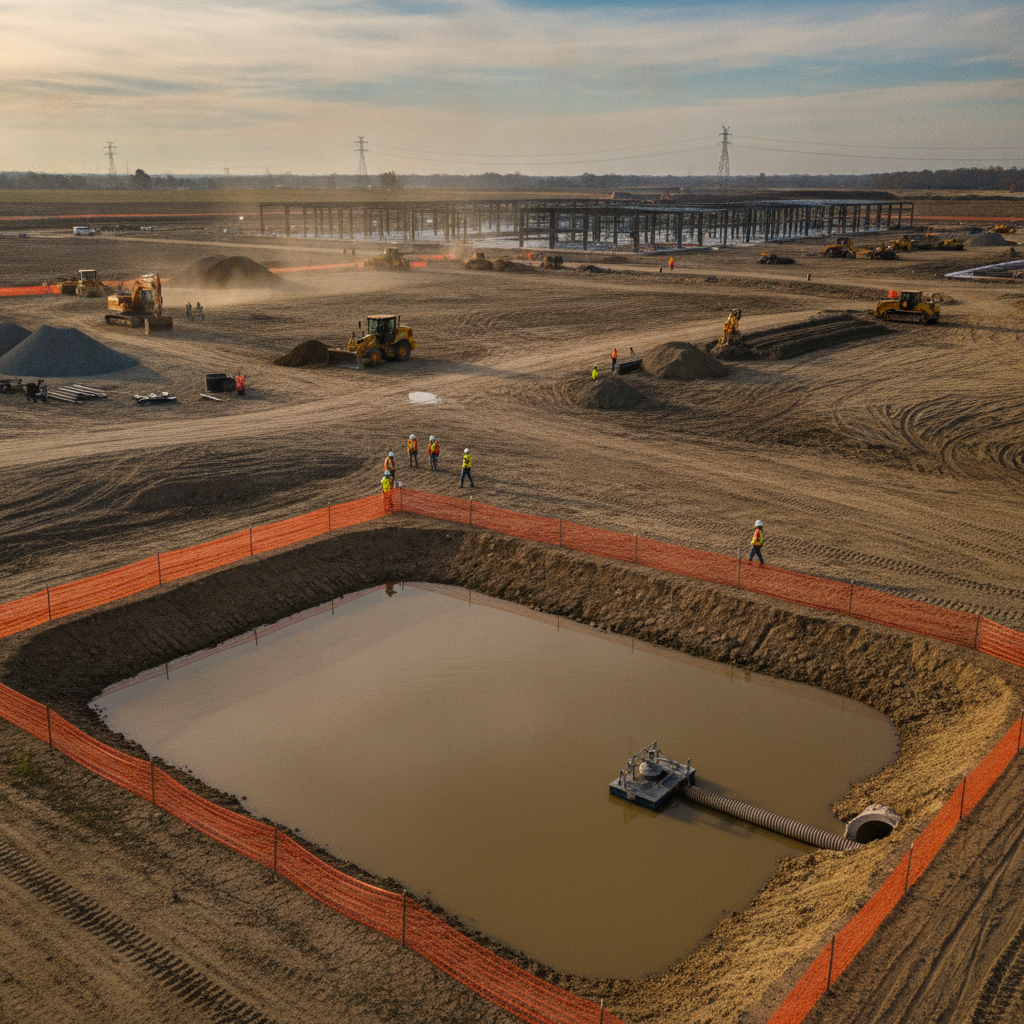
Given the massive disturbed areas on a data center site, managing concentrated runoff requires more than just perimeter controls. This is where sediment traps and sediment basins become essential. A sediment trap is typically a smaller impoundment used for drainage areas of less than five acres, while a sediment basin is a larger, more engineered structure designed for drainage areas greater than five acres. These structures are critical components of the temporary stormwater management system. The design of a sediment basin is governed by specific volume and dimensional requirements, often mandating 3,600 cubic feet of storage per acre of drainage area. Key features include a stable emergency spillway and a dewatering outlet, such as a skimmer or riser pipe, designed to drain the basin slowly from the surface, where the water is cleanest. The goal is to maximize the detention time of stormwater, allowing suspended soil particles to settle before the water is discharged from the site. This level of drainage design is crucial for handling Florida’s high-intensity storm events.
Inlet and Culvert Protection Strategies
As the on-site storm sewer system is installed, every inlet becomes a direct conduit to downstream water bodies. Protecting these inlets is a non-negotiable aspect of sediment control. A variety of inlet protection devices are used, ranging from filter fabric barriers staked around an inlet to block-and-gravel filters or prefabricated inserts. The choice of device depends on the type of inlet (e.g., curb, drop) and the expected flow conditions. These devices require frequent, diligent maintenance. A clogged inlet protector can cause localized flooding on site, while a failed one can allow a surge of sediment to overwhelm the permanent drainage design infrastructure. Inspections must be performed before and after every significant rainfall event to ensure these devices are functioning as intended and to clear accumulated sediment, which is a key part of active construction administration.
Phased Grading and Temporary Stabilization
One of the most effective yet often overlooked principles of erosion control is minimizing the extent of disturbed soil at any given time. A phased disturbance or phased grading plan sequences construction activities to limit exposure. Instead of clearing and grading the entire 100-acre site at once, the plan might call for stabilizing one phase before moving to the next. This approach significantly reduces the total sediment load that the BMPs must handle. In areas that will be inactive for a period (typically 7-14 days), temporary stabilization is required. This can be achieved through methods like temporary seeding and mulching, applying hydroseed, or installing erosion control blankets on steeper slopes. These measures protect bare soil from raindrop impact and sheet erosion, preserving the soil structure and reducing the burden on downstream controls like sediment basins and silt fences. This proactive strategy is a cornerstone of effective erosion control.
Managing Construction Dewatering Discharges
Florida’s high water table often necessitates dewatering activities to excavate for foundations and deep utilities. The pumped groundwater is frequently laden with fine sediments that cannot be discharged directly off-site. This water must be treated before release to meet strict state and local turbidity standards, a process that requires specific permitting and controls. Common methods for treating dewatering discharge include pumping the water into a geotextile filter bag (often called a “dirt bag”), which traps sediment while allowing filtered water to pass through. For larger volumes or finer sediments, a series of settling tanks (such as frac tanks) may be used to provide sufficient residence time for particles to settle. In some cases, environmentally safe flocculants may be introduced to help aggregate fine particles and speed up the settling process. Proper management of dewatering is a critical component of the overall SWPPP.
RSP Engineers’ Approach to Erosion Control Planning
At RSP Engineers, our process for developing a robust sediment and erosion control plan is integrated and proactive. We begin with a thorough site assessment to understand the unique topography, soil types, and proximity to sensitive water bodies. This informs a tailored SWPPP that goes beyond boilerplate templates. Our approach involves: Integrated Design: We develop the erosion control plan in parallel with the overall site plan design, ensuring that temporary controls work in harmony with the final grading and stormwater management system. Agency Coordination: We manage the permitting process with all relevant agencies, including the FDEP and local water management districts, ensuring the SWPPP meets or exceeds all regulatory standards for agency review. Constructability Review: We design BMPs that are not only effective but also practical to install and maintain, considering construction sequencing and site logistics. Construction Phase Support: We provide ongoing construction administration services, including site inspections, SWPPP modifications, and support for responding to regulatory inquiries, ensuring the plan remains effective from groundbreaking to final stabilization.
Common Pitfalls in Data Center Sediment Control
Even with a solid plan, execution is key. Several common issues can undermine a data center’s sediment control efforts. Improper BMP installation, such as failing to trench in a silt fence or using the wrong stone for a construction entrance, is a frequent problem. Another is inadequate maintenance; a sediment basin that is never cleaned out or an inlet filter clogged with debris is ineffective. Failing to adapt the SWPPP as the site changes is also a major risk. A plan designed for mass grading is not suitable for the utility installation phase without modification. Finally, underestimating the sheer volume and velocity of runoff from Florida’s intense thunderstorms can lead to catastrophic, system-wide failure of controls. Frequently Asked Questions (FAQ) How often must our SWPPP be inspected in Florida? According to the NPDES Construction Generic Permit, inspections must be conducted at least once every seven calendar days and within 24 hours of the end of a storm event that is 0.5 inches or greater. This frequency underscores the importance of having a dedicated and qualified inspector responsible for the SWPPP documentation. What’s the biggest difference between a sediment trap and a sediment basin? The primary difference is scale. A sediment trap is a simpler impoundment used for smaller drainage areas, typically under 5 acres. A sediment basin is an engineered structure for larger areas (5+ acres) with more stringent design requirements for volume, dimensions, and outlet structure to ensure adequate settling of suspended particles. Can we phase our erosion control measures to save costs? Yes, and it’s highly recommended. A phased disturbance plan is a core principle of effective and cost-efficient erosion control. By stabilizing one area of the site before disturbing the next, you reduce the total amount of active erosion and can concentrate your Best Management Practices (BMPs) where they are needed most, often reducing overall material and maintenance costs. What happens if a regulator finds our site non-compliant? A notice of non-compliance from an agency like the FDEP or a local municipality can result in a stop-work order until the issues are corrected. It can also lead to significant financial penalties that accrue daily. Proactive compliance and diligent maintenance are far less expensive than reacting to an enforcement action. Proper permitting and adherence to the plan are critical. How does the permanent stormwater management system interact with temporary controls? The permanent system (e.g., detention ponds, underground vaults) is often constructed early and can sometimes be used as a temporary sediment basin, provided it is designed for this dual purpose and will be fully cleaned out and restored to its final design specifications before the project is completed. This requires careful planning during the drainage design phase.
Your Partner for Mission-Critical Site Development
Ensuring regulatory compliance and protecting Florida’s environment during a large-scale data center build requires specialized expertise. The team at RSP Engineers provides comprehensive civil engineering services to navigate the complexities of site development for mission-critical facilities. From initial due diligence and SWPPP development to agency permitting and construction-phase support, we are your trusted partner. Contact us to discuss how we can help ensure your project’s success from the ground up.
Conclusion
Effective sediment and erosion control for data center construction is a complex but manageable challenge. It hinges on a proactive, well-engineered Stormwater Pollution Prevention Plan (SWPPP) that is diligently implemented and maintained throughout the project lifecycle. By prioritizing proper BMP selection, phased grading, and rigorous construction administration, developers can mitigate regulatory risk, avoid costly delays, and demonstrate responsible stewardship. Ultimately, a successful site development project is one that is built not only on a solid foundation but also with a deep respect for the surrounding environment.
FAQs
-
Data Center Sediment Control During Construction requires careful planning, qualified engineering, and compliance with the applicable codes and permits.
-
Getting Data Center Sediment Control During Construction right protects safety, supports regulatory compliance, and avoids costly redesigns or delays.
-
RSP Engineers provides licensed expertise and end-to-end support for Data Center Sediment Control During Construction, from early planning through permitting.