
Data Center Regional Stormwater Systems
Explore the civil engineering complexities of connecting data centers to regional stormwater systems. Learn about impact fees, capacity agreements, and permitting from RSP Engineers.
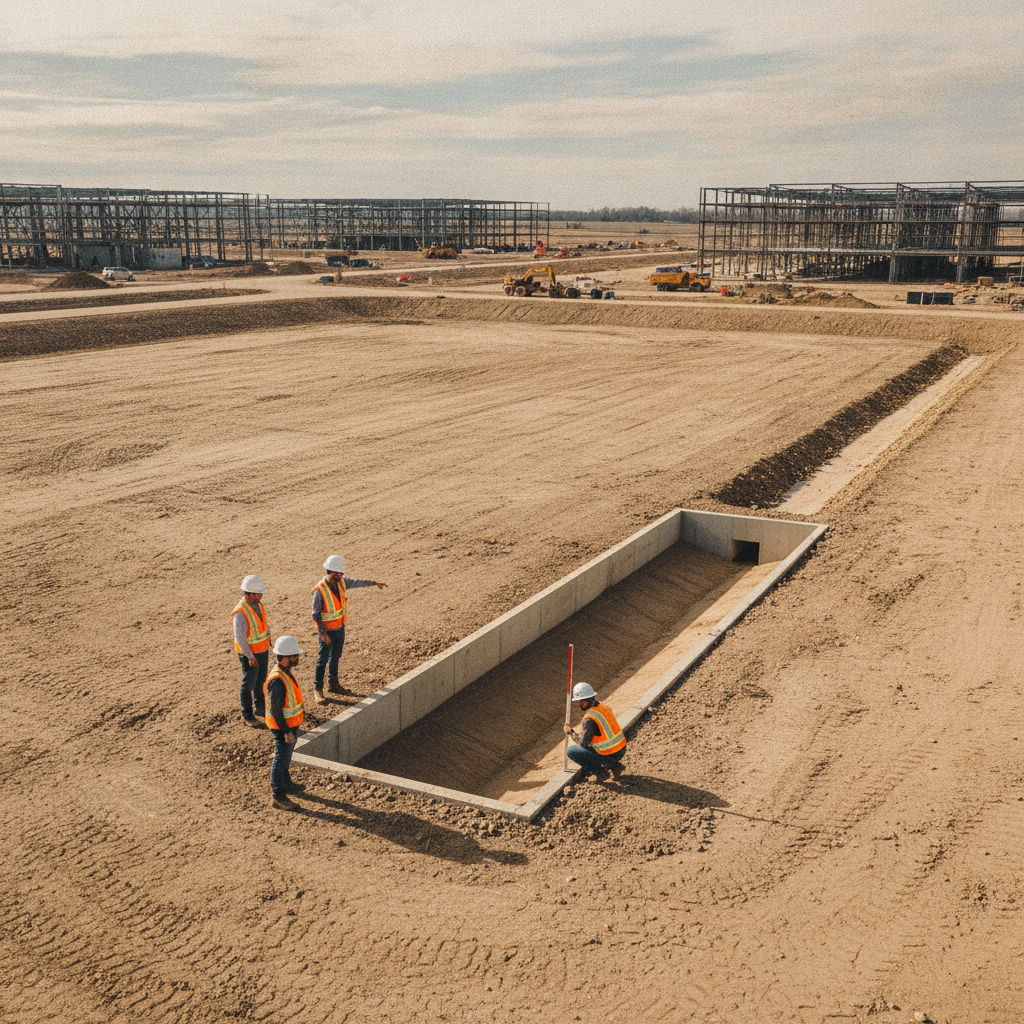
The Impervious Footprint Challenge of Modern Data Centers
Data centers are defined by their scale. A single campus can cover dozens of acres with buildings and infrastructure, creating a massive impervious footprint. Every square foot of roof or pavement prevents rainwater from infiltrating the ground, converting it into surface runoff. In intense rainfall events, this runoff volume can be immense, demanding robust stormwater management solutions to prevent flooding and environmental degradation. The primary goals are to control the peak discharge rates to pre-development levels and provide adequate water quality treatment before the water leaves the site, as mandated by Water Management Districts. A traditional on-site approach requires dedicating a significant portion of the property—often 10-15% or more—to a retention or detention pond. For a land-intensive facility like a data center, this is a major business constraint. The land occupied by a pond cannot be used for server halls, cooling infrastructure, or future expansion. This land-use conflict is a primary driver for developers to seek alternatives, making regional stormwater integration a highly attractive option if available and feasible.
Understanding Regional and Master Stormwater Systems
On-Site vs. Regional Stormwater System Comparison for Data Centers
| Feature | On-Site System (Isolated Pond) | Regional System Connection |
|---|---|---|
| Land Use Efficiency | Requires significant land dedication (10-15% of site) for a pond, reducing developable area for buildings and infrastructure. | Maximizes usable land by eliminating the need for a large on-site pond, allowing for denser development or future expansion. |
| Permitting Complexity | Requires a standalone Environmental Resource Permit (ERP) with detailed pond design, hydraulic calculations, and water quality analysis. | Often ties into a master ERP, requiring proof of capacity, an allocation agreement, and compliance with the master permit's conditions. |
| Long-Term Maintenance | Responsibility of the property owner, including mowing, sediment removal, structural repairs, and periodic agency recertification. | Managed and maintained by the public entity (e.g., municipality, drainage district), funded by impact fees and tax assessments. |
| Initial Capital Cost | Includes costs for earthwork, liner, control structures, and landscaping. Can be high, especially with complex site constraints. | Involves payment of a one-time impact fee or CIL. May also include costs for off-site conveyance improvements to connect. |
| Development Timeline | Design and permitting can be time-consuming. Construction is part of the overall site work package. | Timeline is dependent on agency coordination for capacity verification and securing allocation agreements, which can be lengthy. |
| Scalability | Pond must be sized for the ultimate build-out, potentially overbuilding for initial phases and tying up capital. | Capacity can often be allocated in phases, aligning infrastructure costs more closely with the development schedule. |
A regional stormwater system is a large-scale facility designed to manage runoff from multiple properties or an entire basin. These systems are typically planned, constructed, and maintained by a public entity like a municipality, a county, or a special drainage district. They are governed by a master drainage plan that outlines the infrastructure, capacity, and service area. Development within this area can often connect to the system rather than building standalone facilities. This approach promotes more efficient land use and often provides a higher level of flood protection and water quality treatment through professionally managed, large-scale infrastructure. These systems are often permitted through a comprehensive Environmental Resource Permit (ERP) held by the governing entity. A developer seeking to connect must demonstrate that their project complies with the master permit’s conditions. This involves proving that sufficient capacity exists within the system to accept the new flow and that any specific site design or pre-treatment requirements are met. This process requires close coordination with the governing agency and a thorough review of the master permit documents and supporting hydraulic modeling.
Navigating Downstream Capacity and Allocation Agreements
Connecting to a regional system is not an automatic right. The most critical step in the due diligence process is verifying that the downstream infrastructure has adequate capacity to handle the proposed data center’s runoff without causing adverse impacts. This involves a detailed downstream capacity analysis, where a civil engineer models the existing conveyance system (pipes, channels, culverts) and the regional facility itself under various storm event scenarios. The analysis must account for the data center’s full build-out, ensuring the system can accommodate future phases. If capacity is confirmed, the developer must secure formal approval from the system’s owner. This is often documented through an allocation agreement or a formal letter of capacity. This legal document reserves a specific amount of stormwater capacity (measured in flow rate or volume) for the project. Securing this agreement is a crucial milestone for permit submittals to agencies like the Department of Environmental Protection (DEP) or the local Water Management District. Without it, a permit to connect will not be issued, forcing the project back to an on-site design.
Stormwater Impact Fees vs. On-Site Controls
One of the primary mechanisms for funding regional systems is through stormwater impact fees or a contribution-in-lieu-of (CIL) construction. Instead of bearing the full cost of designing, permitting, and building an on-site pond, a developer can pay a one-time fee to the governing entity. This fee represents the project’s proportional share of the cost of the regional infrastructure. The funds are used for the construction of new regional facilities, the expansion of existing ones, and long-term maintenance, ensuring the system remains effective for all users. The decision to pay an impact fee versus building on-site is a financial and logistical calculation. While the fee can be substantial, it often pales in comparison to the value of the developable land it frees up. Furthermore, it transfers the long-term maintenance, liability, and recertification burden from the property owner to the public entity. This is particularly advantageous for data center operators who want to focus on their core mission-critical operations, not pond maintenance and zoning compliance inspections.
Off-Site Conveyance Improvements: The Hidden Cost of Connection
In some cases, a direct connection to the regional system is not immediately available at the property line. The existing storm sewer may be undersized, or the regional facility may be located some distance away. This scenario requires the developer to design and construct off-site improvements to establish a connection. These improvements can range from upsizing a few hundred feet of pipe in a public right-of-way to constructing miles of new channels or storm sewers to reach the regional pond. The need for off-site work introduces significant complexity. It requires extensive utility coordination with other franchise utilities, securing easements from adjacent property owners, and obtaining separate right-of-way permitting from transportation authorities. These tasks can add considerable time and cost to a project’s front end. A thorough feasibility study performed by an experienced civil engineering firm is essential to identify these potential requirements early in the site selection process, preventing costly surprises during development.
RSP Engineers’ Approach to Regional Stormwater Integration
At RSP Engineers, we guide data center developers through the complexities of stormwater management with a systematic, risk-mitigation approach. Our process is designed to provide clarity and confidence from site selection through construction. Due Diligence & Feasibility Study: We begin by identifying available regional systems and conducting a preliminary analysis of connection feasibility. This includes reviewing master drainage plans, agency regulations, and identifying potential red flags like downstream capacity issues or the likely need for extensive off-site improvements. Agency Coordination & Capacity Verification: Our team engages directly with the governing entities to formally inquire about available capacity. We manage the entire process of submitting project data and securing the critical letter of capacity or allocation agreement. Hydraulic Modeling & Design: We perform detailed hydraulic and hydrologic modeling to design the on-site conveyance system and demonstrate full compliance with the regional system’s requirements. This includes designing any necessary off-site infrastructure and coordinating with other utilities. Permitting & Documentation: We prepare and manage all permit submittals, ensuring the application package clearly documents the right to connect and adherence to all master permit conditions, facilitating a smoother agency review. Construction Administration: During construction, we provide oversight to ensure all stormwater infrastructure, both on-site and off-site, is built according to the approved plans and specifications, facilitating a seamless project closeout and certification.
Common Hurdles in Regional System Tie-Ins
While advantageous, pursuing a regional connection is not without potential challenges. A primary issue is a simple lack of available capacity. In rapidly developing areas, regional systems can become fully allocated, forcing new projects to build on-site. Another common problem is encountering poorly documented or maintained downstream infrastructure, where the as-built conditions do not match the original plans, requiring costly field investigations and design revisions. The legal and administrative processes can also be a hurdle. Negotiating allocation agreements can be time-consuming, and interlocal agreements between different jurisdictions can add layers of complexity to the permitting process. Finally, the cost of required off-site improvements can sometimes be so prohibitive that it negates the financial benefit of connecting, making an on-site system the more economically viable, albeit less land-efficient, option.
Partner with RSP Engineers for Your Data Center Site Development
Making the right stormwater management decision is fundamental to the success of your data center project. The expert team at RSP Engineers provides the critical analysis and strategic guidance needed to navigate these complex choices. We specialize in comprehensive site development for mission-critical facilities, including in-depth feasibility studies, robust stormwater management design, and navigating the intricacies of permitting agencies. Whether you are evaluating a new site or planning an expansion, we can help you optimize your land use and de-risk your project timeline. Contact us today to discuss how our civil engineering expertise can support your development goals.
Conclusion: Strategic Stormwater Management for Future-Proof Data Centers
For data center developers, integrating with a regional stormwater system represents a powerful strategy to maximize land efficiency and minimize long-term operational burdens. This approach transforms stormwater from a site-specific liability into a shared, professionally managed utility. However, the path to a successful connection is paved with technical due diligence, including rigorous capacity analysis, careful utility coordination, and proactive agency engagement. By partnering with a knowledgeable civil engineering firm early in the process, developers can confidently make strategic decisions that enhance project value and ensure long-term resilience. Ultimately, a well-executed stormwater management plan is a cornerstone of successful and sustainable site development.
FAQs
-
A letter of capacity is a formal document from the owner of a regional utility system (like stormwater or sanitary sewer) stating that the system has sufficient capacity to serve a proposed project. It is a critical prerequisite for obtaining development permits, as it provides the reviewing agency with assurance that the project’s impact can be safely managed by the existing regional stormwater facility.
-
Yes, this is a significant advantage. Developers can often secure an allocation agreement for the entire planned build-out but pay impact fees in phases as each section of the data center is constructed. This aligns capital expenditure with revenue generation and is more efficient than building a full-sized on-site pond for Phase 1.
-
Typically, yes. While the regional system handles the primary water quantity control (detention) and often regional water quality, you will still need an on-site drainage design. This includes inlets, pipes, and sometimes small pre-treatment systems like swales or baffle boxes to capture coarse sediment and debris before discharging into the regional conveyance system.