
Data Center QA/QC During Geotechnical Construction
A comprehensive guide for developers on the critical geotechnical QA/QC processes in data center construction, from subgrade preparation to foundation certification.
Pre-Construction: Submittal and Method Statement Review
The first step in a successful QA/QC program happens before any earth is moved. It involves a meticulous review of the contractor’s submittals and method statements. This proactive phase ensures that the contractor’s proposed materials, equipment, and procedures align with the project specifications and the recommendations of the Geotechnical engineer. We scrutinize documents detailing the source and properties of import fill materials, the type and size of compaction equipment, and the proposed methodology for everything from excavation to deep foundation installation. This review process is a critical checkpoint. It allows the Professional Engineer to identify potential issues, such as a proposed fill material that doesn’t meet plasticity or gradation requirements, or a compaction method unsuitable for the site’s soil types. Correcting these issues on paper is infinitely more efficient and cost-effective than addressing them once construction is underway. This phase sets the standard for quality and confirms that all parties have a shared understanding of the project’s stringent geotechnical engineering requirements.
Site Preparation: Subgrade Evaluation and Acceptance
Geotechnical QA/QC Verification Checklist
| QA/QC Activity | Key Verification Metric | Typical Acceptance Criteria | Documentation Requirement |
|---|---|---|---|
| Subgrade Proof-Rolling | Surface Deformation | No significant rutting, pumping, or weaving under a loaded dump truck. | Field report noting date, area observed, and acceptance. |
| Structural Fill Compaction | In-Place Dry Density & Moisture Content | ≥95% of Maximum Dry Density (ASTM D698); Moisture within +/- 3% of optimum. | Daily Field Density Test Reports with location map. |
| Shallow Foundation Subgrade | Bearing Stratum & Firmness | Soils match geotechnical report; firm and unyielding under probing. | Foundation Inspection Log signed by inspector. |
| Driven Pile Installation | Blow Count & Tip Elevation | Achieves specified driving resistance (blows/inch) at or below minimum tip elevation. | Individual Pile Driving Record for each pile. |
| Drilled Shaft Installation | Concrete Volume & Reinforcement | Actual concrete volume ≥ theoretical volume; rebar cage centered with proper cover. | Drilled Shaft Installation Log for each shaft. |
| Nonconformance Reporting | Deviation from Specification | Identified, documented, and resolved per approved corrective action. | Signed Nonconformance Report (NCR) with disposition. |
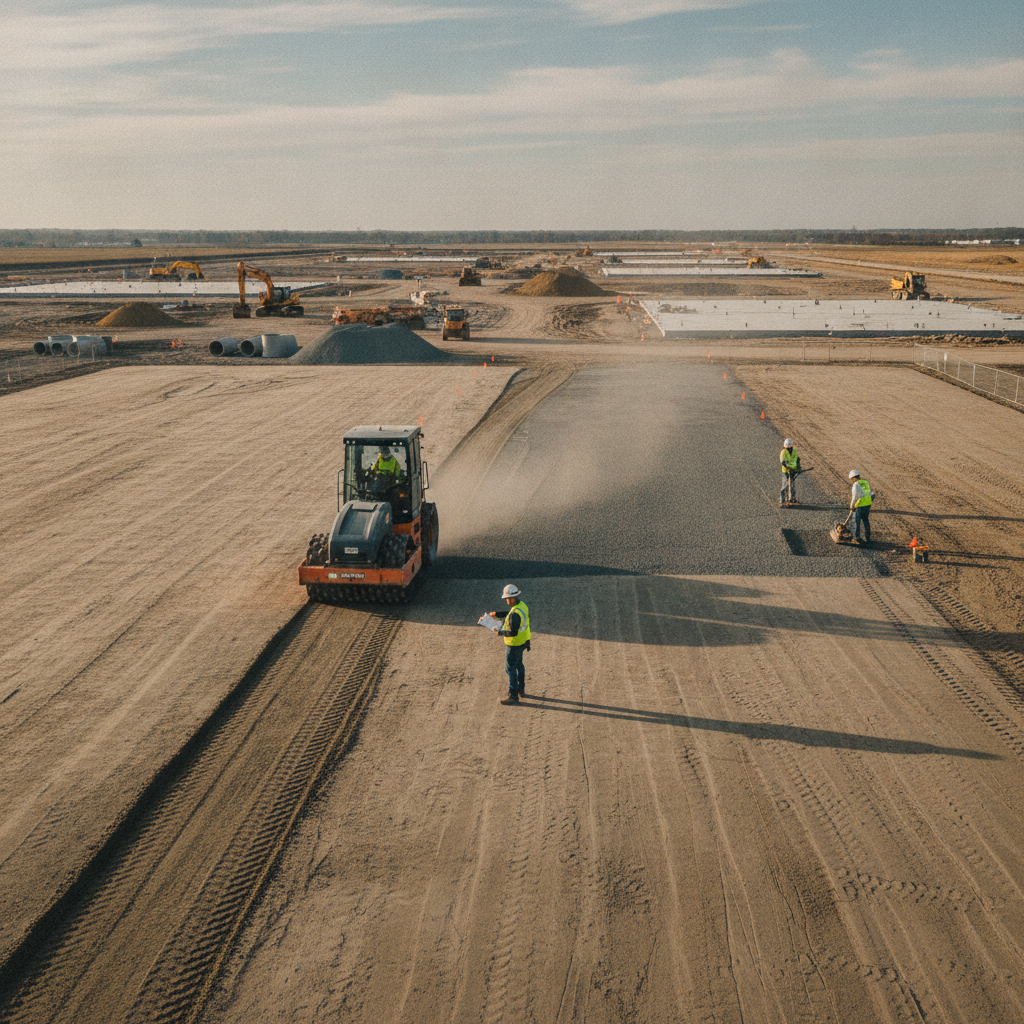
Once submittals are approved, site work begins with the preparation of the native subgrade. This process involves clearing, grubbing, and stripping topsoil to expose the soil stratum intended to support the structure. The QA/QC role here is to verify that all unsuitable materials, such as organic soils, debris, or undocumented fill, have been completely removed. The exposed subgrade is then evaluated for stability and uniformity, typically through a process called proof-rolling. During proof-rolling, a heavy, loaded vehicle like a tandem-axle dump truck is driven over the entire subgrade under the observation of the geotechnical inspector. The inspector watches for rutting, pumping, or weaving, which indicate soft, unstable soils. Any areas that fail the proof-roll must be remediated, often by over-excavation and replacement with engineered fill. This verification is a fundamental aspect of site development and is crucial for preventing differential settlement that could compromise the data center’s structural frame and sensitive equipment.
Building the Pad: Controlled Fill Placement and Compaction Verification
For sites requiring fill to reach design grades, the process must be rigorously controlled. Structural fill is placed in thin, uniform layers known as lifts, typically 8 to 12 inches thick. Each lift must be moisture-conditioned and compacted to a specified density, usually 95% or greater of the maximum dry density as determined by a laboratory Proctor test (e.g., ASTM D698). The QA/QC inspector’s role is to monitor this entire operation, ensuring lift thicknesses are not exceeded and that compaction efforts are systematic and complete. Verification is performed through in-place density testing, most commonly using a nuclear density gauge. The testing frequency is specified in the project documents, often on a grid basis (e.g., one test per 2,500 square feet per lift). A failed compaction test requires the contractor to re-compact the area and may necessitate adjustments to moisture content or equipment. Meticulous record-keeping of test locations, elevations, and results is essential for the final construction administration documentation.
The Critical Interface: Foundation Subgrade Inspection
Before any concrete is poured for shallow foundations, a final inspection of the foundation subgrade is required. This is one of the most critical hold points in the entire process. The geotechnical inspector verifies that the foundation excavations have reached the design bearing elevation and that the exposed soils are consistent with those anticipated in the Geotechnical soil report. The inspector confirms the soil’s bearing capacity, ensuring it is free of loose or softened material, and verifies that the dimensions of the excavation are correct. This inspection provides the final approval to proceed with rebar and concrete placement. If unsuitable soils are encountered at the foundation bearing level, the Geotechnical engineer must be notified immediately to provide a remediation plan. This could involve further excavation and replacement with crushed stone or lean concrete. Skipping or rushing this step can lead to catastrophic foundation settlement, making it a non-negotiable part of any responsible site engineering services protocol.
Deep Foundations: QA/QC for Piles and Drilled Shafts
Many data centers, especially in areas with poor soils like Florida, require deep foundation systems such as driven piles or drilled shafts. The QA/QC for these systems is highly specialized. For driven piles, the inspector maintains a detailed pile driving log for every pile. This log records the pile type, location, hammer energy, blow counts per foot of penetration, and final tip elevation. This data is used to confirm that the pile has achieved the required capacity, often correlated with a pile load test program. For drilled shafts, the inspector observes the drilling process, verifies the shaft dimensions and verticality, and inspects the bottom of the excavation for cleanliness. During the concrete pour, the volume of concrete is tracked to ensure the shaft is filled completely without voids. The placement of the steel reinforcement cage is also verified. Proper documentation, including installation logs and concrete testing results, is paramount for the permitting agency and the structural engineer of record.
The RSP Engineers Approach to Geotechnical Construction Oversight
At RSP Engineers, our approach to geotechnical QA/QC is built on proactive collaboration and meticulous documentation. We begin by engaging with the project team during the design and pre-construction phases to ensure the specifications are clear and achievable. During construction, our certified field professionals are on-site for all critical geotechnical activities, providing real-time feedback to the contractor and communicating observations to the design team. We act as the developer’s eyes and ears, ensuring that the work conforms to the highest standards. Our process emphasizes clear communication and digital reporting. Daily field reports are transmitted to the project stakeholders, providing a transparent record of activities, testing, and any issues encountered. This rigorous documentation streamlines the construction administration process and provides the necessary backup for payment applications and final project closeout. We understand that our role is to facilitate quality construction, not to hinder progress, and we work collaboratively to solve problems efficiently while upholding the project’s technical requirements.
Common Pitfalls in Data Center Geotechnical Construction
Even with a robust QA/QC plan, challenges can arise. One common issue is encountering unexpected subsurface conditions, such as a pocket of unsuitable soil not identified in the initial Soil boring test. Another frequent problem is the contractor’s failure to properly control the moisture content of fill material, leading to failed compaction tests and costly rework. Inadequate site drainage during construction can also saturate subgrades, compromising their stability and delaying the project schedule. Communication gaps between the geotechnical inspector, the contractor’s foreman, and the structural engineer can also lead to misunderstandings and errors. For example, a foundation may be excavated to the wrong depth, or a pile may be driven in the wrong location. A proactive QA/QC program anticipates these risks and establishes clear communication protocols and hold points to ensure that such mistakes are caught and corrected before they become significant problems.
Partner with RSP Engineers for Mission-Critical Geotechnical Assurance
The success of your data center project depends on the integrity of its foundation. Ensuring quality from the ground up requires specialized expertise and unwavering attention to detail. RSP Engineers provides comprehensive geotechnical observation and materials testing services tailored for the mission-critical sector. Our team of experienced engineers and certified technicians offers expert oversight for every phase of your project, from site plan design review to final certification. We specialize in providing the critical construction administration and QA/QC services that protect your investment. Whether you need third-party inspection, materials testing, or a complete geotechnical program management solution, we are your trusted partner. We ensure your project complies with the Florida Building Code and the highest industry standards. Contact RSP Engineers today to discuss how our site engineering services can ensure the stability and long-term success of your data center development.
The Bedrock of Digital Infrastructure
In conclusion, a rigorous geotechnical QA/QC program is the bedrock upon which a reliable data center is built. It is a systematic process of verification that transforms the design engineer’s intent into a physical reality, ensuring stability for the massive and sensitive infrastructure it will support. From reviewing submittals to certifying foundation subgrades, every step is a critical link in a chain of quality that mitigates risk and protects the owner’s investment. Engaging an experienced Professional Engineer and a qualified inspection team is not an overhead cost; it is a fundamental component of risk management. For developers and operators in the fast-paced world of digital infrastructure, investing in thorough geotechnical engineering oversight and construction administration provides the confidence that their facility is built on a foundation of certainty and strength.
FAQs
-
Quality Assurance (QA) refers to the overall process and procedures established to ensure the final product meets the quality requirements. This includes the project specifications and the inspection plan itself. Quality Control (QC) refers to the specific actions and tests performed during construction to verify that the work meets the standards defined in the QA plan, such as performing a compaction test or inspecting a foundation subgrade.
-
Poor geotechnical work can lead to differential settlement of the foundation. For a data center, this can be catastrophic. It can cause cracks in the slab and walls, misalignments in structural frames, and damage to sensitive utility conduits. Most critically, it can create vibrations and uneven floors that disrupt the performance of server racks and cooling equipment, leading to costly downtime and repairs.
-
Typically, the construction contract specifies that the contractor is responsible for achieving the required compaction. If a test fails, the contractor is responsible for the cost of the rework (e. g. , re-compacting the area) and the cost of the re-test to confirm that the specification has now been met. This incentivizes the contractor to perform the work correctly the first time.