
Data Center Phase I Environmental Site Assessment (ESA)
A comprehensive guide for data center developers on the Phase I Environmental Site Assessment (ESA) process, including ASTM E1527, RECs, and impacts on civil engineering.
Understanding the ASTM E1527-21 Standard for Phase I ESAs
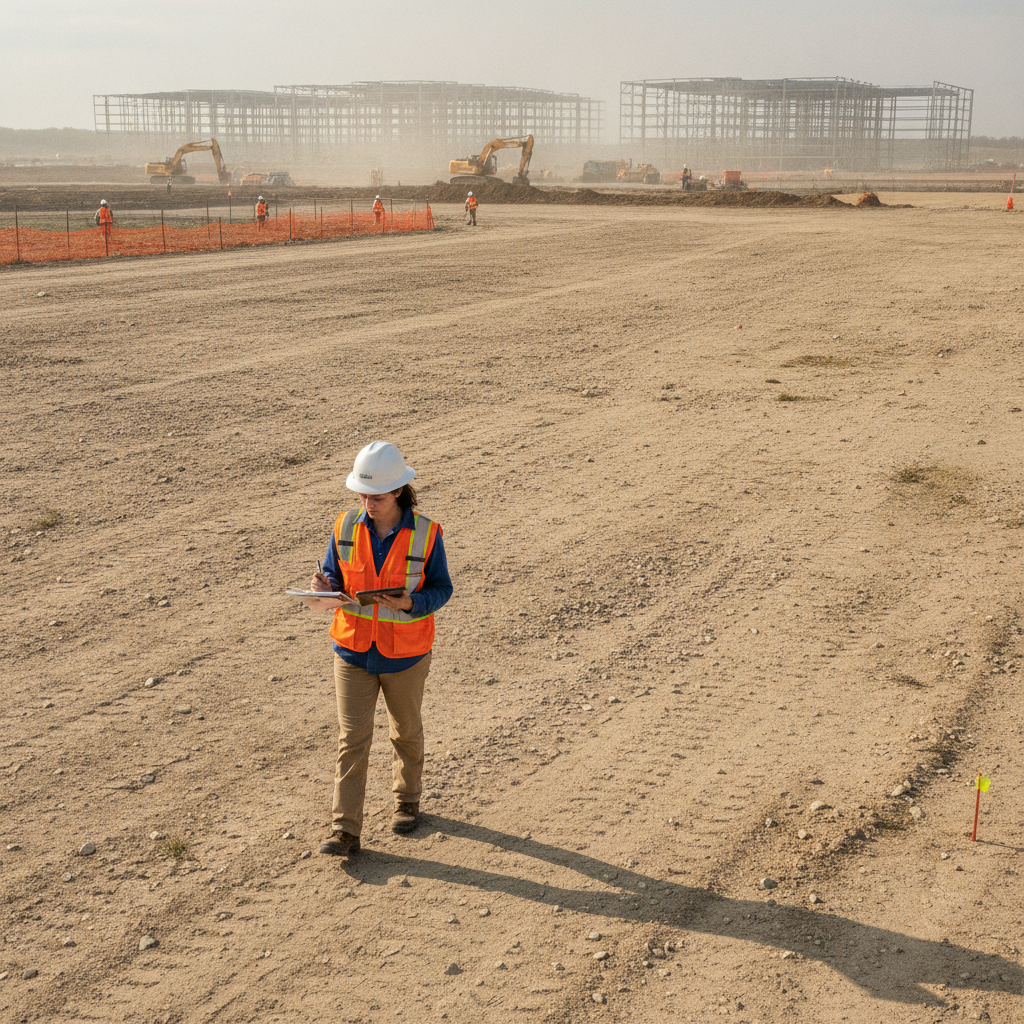
The Phase I ESA is not an arbitrary process; it is governed by a rigorous standard known as ASTM E1527-21. This standard, developed by ASTM International, defines the practices for conducting an ESA to satisfy one of the requirements to qualify for the innocent landowner defense to CERCLA liability. In simpler terms, it’s the industry-accepted playbook for identifying potential environmental risks. The primary goal is to identify Recognized Environmental Conditions (RECs), which indicate the presence or likely presence of any hazardous substances or petroleum products on a property under conditions that indicate a release, a past release, or a material threat of a release. Following this standard is critical for achieving compliance with the EPA’s All Appropriate Inquiries (AAI) Rule. A properly conducted Phase I ESA provides a snapshot of the property’s environmental history and current condition, forming the basis for informed decisions during the site development process. It is a non-intrusive investigation, meaning no soil or water samples are collected at this stage. Instead, it relies on thorough research, observation, and interviews to build a comprehensive picture of the site’s environmental status, which is a foundational step before any detailed civil engineering design can be confidently undertaken.
The Four Core Components of a Phase I ESA Investigation
Phase I ESA Findings: Comparison of Potential Outcomes
| Finding | Implication for Data Center Project | Recommended Next Step |
|---|---|---|
| No RECs Identified | Environmental risk is considered low. The project can proceed with the standard due diligence, financing, and design phases with greater confidence. | Proceed with property acquisition and detailed site engineering services, including geotechnical investigation and utility design. |
| RECs Identified (e.g., On-site UST, historical industrial use) | Potential for soil and/or groundwater contamination. Poses a significant risk to project budget, timeline, and long-term liability. | Initiate a Phase II Environmental Site Assessment to collect and analyze soil and groundwater samples to confirm and quantify the contamination. |
| HRECs Identified (e.g., Past spill with regulatory closure) | A past issue was addressed to regulatory satisfaction. Risk is lower, but the historical condition must be verified and disclosed. | Carefully review all regulatory closure documents. A Phase II is typically not required, but the condition must be noted for lenders and investors. |
| CRECs Identified (e.g., Contamination managed with engineering controls) | Ongoing management and potential land use restrictions are required. This can impact foundation design, excavation, and long-term liability. | Evaluate the impact of the controls on the proposed site plan design, utility coordination, and long-term operational costs. |
| Vapor Encroachment Condition (VEC) Identified | Potential for vapors from an off-site source to migrate into the proposed structure, posing an indoor air quality risk to personnel and equipment. | Recommend a VEC screening or a full Phase II ESA to assess the vapor pathway and determine if a vapor barrier or other mitigation is needed. |
A compliant Phase I ESA is a systematic process broken down into four distinct but interconnected components. Each piece is essential for building a complete and defensible report that lenders, investors, and legal counsel can rely on. The thoroughness of each component directly impacts the quality of the final assessment and its utility in the overall site development plan. Records Review The investigation begins with an exhaustive historical records review. The environmental professional delves into federal, state, and local regulatory databases to find records of reported spills, leaking tanks, or hazardous waste generation at the subject property and surrounding sites. This regulatory database search is supplemented by a review of historical sources like aerial photographs, city directories, and Sanborn Fire Insurance Maps to understand the property’s past uses. Examining the chain-of-title can also reveal past owners whose operations may have involved hazardous materials, providing critical context that isn’t visible on the ground today. Site Reconnaissance The next step is the physical site reconnaissance, where an environmental professional walks the entire property and its perimeter. They are trained to look for visual or olfactory evidence of contamination, such as stained soil, stressed vegetation, chemical odors, or improperly stored drums. The inspection includes identifying evidence of current or former underground storage tanks (USTs), monitoring wells, pits, ponds, or lagoons. This on-the-ground assessment is vital for verifying the information gathered during the records review and identifying potential issues that may not have been officially documented, including the presence of hazardous substances or petroleum products. Interviews and Report Preparation The third component involves interviews with knowledgeable parties. This can include current and past owners, operators, occupants, and even local government officials. The goal is to gather firsthand information about the property’s historical land use, management of hazardous materials, and any known spills or releases. The environmental professional will also inquire about any existing environmental liens or activity and use limitations (AULs) that may be recorded against the property. Finally, all findings are compiled into the Phase I ESA report. This comprehensive document, prepared by a qualified environmental professional (EP), details the methodology, identifies any data gaps, and presents clear conclusions and recommendations regarding the presence of RECs.
Identifying Recognized Environmental Conditions (RECs) at Potential Data Center Sites
The ultimate goal of a Phase I ESA is to identify Recognized Environmental Conditions (RECs). A REC is the lynchpin of the report, signaling a potential liability that requires further attention. The ASTM standard further defines a Historical REC (HREC), which is a past release that has been addressed to the satisfaction of the governing regulatory authority, and a Controlled REC (CREC), which is a past release that has been addressed but includes remaining contamination that is managed with site controls. For a data center, which has zero tolerance for operational disruption, understanding these distinctions is critical. Beyond these, the assessment also looks for a vapor encroachment condition (VEC), which is the potential for volatile chemical vapors to migrate from contaminated soil or groundwater (either on-site or off-site) into a building’s structure. For a data center with extensive sub-floor plenums and sensitive air handling systems, a VEC can pose a significant operational risk. Identifying these conditions early allows the development team to integrate mitigation measures into the site plan design and foundation engineering, preventing costly surprises during or after construction.
How Phase I ESA Results Impact Data Center Site Planning and Civil Engineering
The findings of a Phase I ESA are not just a line item in a due diligence checklist; they have tangible impacts on the entire site development process. If a REC is identified, it can fundamentally alter the site plan design. For example, an area of known soil contamination may become a no-build zone or be designated for non-critical use like parking, influencing the building footprint and layout. This has a cascading effect on other disciplines. The stormwater management plan might need to be redesigned to prevent infiltration in contaminated areas, and excavated soil may require special handling and disposal, adding significant cost. Furthermore, utility coordination becomes more complex. Trenching for power, water, and fiber optic lines must be planned to avoid disturbing contaminated zones. The findings of the Phase I ESA also inform the scope of the geotechnical investigation. Geotechnical engineers need to know about potential subsurface contamination to ensure their soil borings do not create new pathways for contaminants to migrate and to specify appropriate health and safety protocols for their field crews. Integrating ESA findings early is a hallmark of proactive project management by experienced Civil Engineering Firms.
Navigating the Transition from Phase I to Phase II ESA
When a Phase I ESA identifies a REC, it raises a question that can only be answered with physical data. This triggers the need for a Phase II Environmental Site Assessment. Unlike the non-invasive Phase I, a Phase II involves a subsurface investigation where soil and groundwater samples are collected and sent to a laboratory for analysis. The goal is to confirm the presence or absence of hazardous substances, determine the extent of the contamination, and compare the concentrations to state and federal cleanup standards. A Phase II ESA is a critical step in quantifying the risk identified in the Phase I report. The results will determine if remediation is necessary and, if so, what remediation strategies might be employed. For a data center developer, this information is vital for negotiating the purchase price, securing environmental insurance, or even deciding to walk away from a site. While the prospect of a Phase II can be daunting, it provides the concrete data needed to transform an unknown liability into a manageable, quantifiable problem.
Our Approach to Data Center Due Diligence at RSP Engineers
At RSP Engineers, we view the Phase I ESA as an integral part of a holistic site development strategy. We collaborate with trusted environmental partners to ensure the ESA is conducted to the highest standard, but our work doesn’t stop there. We translate the findings of the environmental report into actionable insights for the engineering and design phases. Our team of Civil Engineers uses the data to inform the site plan design, anticipate challenges in permitting, and develop proactive solutions for site grading, drainage, and utility layout. This integrated approach ensures that potential environmental issues are addressed early and efficiently, minimizing surprises during construction. By bridging the gap between environmental due diligence and civil engineering, we help our data center clients navigate the complexities of site selection and development, ensuring their project is built on a solid, environmentally sound foundation. Our expertise in Florida’s unique regulatory landscape allows us to guide clients through the entire process, from initial assessment to final agency review.
Common Pitfalls and Misconceptions in Data Center ESAs
Even with a standardized process, several common pitfalls can undermine the value of a Phase I ESA. One major error is treating the report as a simple checkbox item for a real estate transaction without fully understanding its implications for design and construction. Another is underestimating the potential impact of historical agricultural use, where pesticides and herbicides may have left behind residual contamination. Developers sometimes focus only on the subject property and ignore the risk of migrating contamination from adjacent sites, particularly the threat of a vapor encroachment condition (VEC). Another critical mistake is relying on an outdated report. The ASTM E1527-21 standard specifies that a Phase I ESA has a shelf life of 180 days. If key components are older than one year, they must be updated. Using an old report can lead to missed information and a failure to satisfy the All Appropriate Inquiries rule, exposing the developer to significant liability. A savvy developer understands that a thorough, current Phase I ESA is an investment in risk mitigation, not just an expense.
Partner with RSP Engineers for Comprehensive Site Development
Successfully navigating the complexities of data center development requires a partner who understands the full project lifecycle, from initial due diligence to final construction. At RSP Engineers, we provide the expert civil engineering and site development services needed to turn your vision into reality. We integrate critical findings from the Phase I ESA into our site plan design, ensuring a seamless and proactive approach to permitting and utility coordination. Don’t let environmental uncertainties derail your mission-critical project. Contact RSP Engineers today to discuss how our team of Florida Licensed Engineers can support your next data center development.
Conclusion: A Foundation for Successful Data Center Investment
The Phase I Environmental Site Assessment is more than a procedural step; it is a fundamental risk management tool in the high-stakes arena of data center development. A thorough assessment provides the critical environmental due diligence needed to protect a significant capital investment. By identifying potential RECs and other environmental liabilities early, developers can make informed decisions, negotiate effectively, and create a smarter, more resilient site development strategy. Ultimately, a well-executed Phase I ESA provides the peace of mind and data-driven confidence necessary to build the future of digital infrastructure on solid ground.
FAQs
-
A standard Phase I ESA typically takes two to four weeks to complete. This timeline allows for the necessary time to request and receive government records, conduct the site visit, perform interviews, and compile the final report. The complexity of the site’s history and the responsiveness of record-keeping agencies can influence the final turnaround time.
-
No. A Phase I ESA is a non-invasive assessment designed to identify the potential for contamination based on historical use and current observation. It does not include sampling and cannot definitively rule out the presence of all contaminants. However, a report that identifies no Recognized Environmental Conditions (RECs) provides a strong, defensible basis for concluding that environmental risk is low.
-
If a potential source of contamination is identified on a neighboring property, it is noted as a REC in the Phase I ESA report. The primary concern is the potential for contamination—particularly volatile organic compounds—to migrate onto your property via groundwater or soil vapor. This would likely trigger a recommendation for a Phase II ESA to determine if the migration has occurred.