
Data Center Green Infrastructure Solutions
Explore green infrastructure solutions for data centers. Learn how bioretention, permeable pavement, and vegetated swales meet stormwater regulations and site requirements. A guide by RSP Engineers.
The Regulatory Driver: Stormwater Management Imperative
The primary driver for any stormwater strategy is regulatory compliance. The state’s Water Management Districts (WMDs) enforce strict rules governing both water quality and water quantity through the Environmental Resource Permitting (ERP) program. For a data center’s large impervious footprint, this means the drainage design must demonstrate that post-development runoff will not adversely impact downstream properties or receiving water bodies. This involves attenuating peak discharge rates and providing a specific level of pollutant removal, known as water quality treatment. Green infrastructure provides a powerful toolkit for meeting these ERP requirements. Techniques like bioretention and vegetated swales are highly effective at filtering pollutants and promoting infiltration, which can reduce the required size of traditional ponds and contribute to a more efficient land use plan. Successfully incorporating these elements early in the site development process is key to a streamlined agency review and achieving timely zoning compliance with local landscape and environmental ordinances.
Bioretention and Rain Gardens for High-Volume Runoff
GI Feature Comparison for Data Center Applications
| Feature | Primary Application | Key Design Constraint | Regulatory Benefit |
|---|---|---|---|
| Bioretention Cells | Parking lot islands, landscape buffers, common areas | Placement must not compromise security perimeter or underground utilities. | Excellent water quality treatment and peak flow reduction. |
| Permeable Pavement | Employee/visitor parking, sidewalks, light-duty access roads | Not suitable for heavy truck loads (e.g., generator delivery routes). Requires specialized maintenance. | Reduces effective impervious area, decreasing runoff volume directly at the source. |
| Vegetated Swales | Conveyance along roadways and property perimeters | Requires sufficient space and appropriate grading to ensure proper flow velocity and prevent erosion. | Provides conveyance, water quality treatment, and infiltration in a single system. |
| Green Roofs | Ancillary buildings (offices, security checkpoints) | Structural load capacity of the roof deck; long-term maintenance and leak prevention. | Reduces runoff volume and peak flow from roof surfaces, can provide energy benefits. |
| Tree Canopy & Soil Amendment | Site-wide landscape areas, buffers, and open space | Tree placement must avoid conflicts with security cameras, lighting, and utilities. Soil must be decompacted. | Provides direct stormwater credit in many jurisdictions; improves performance of all other GI features. |
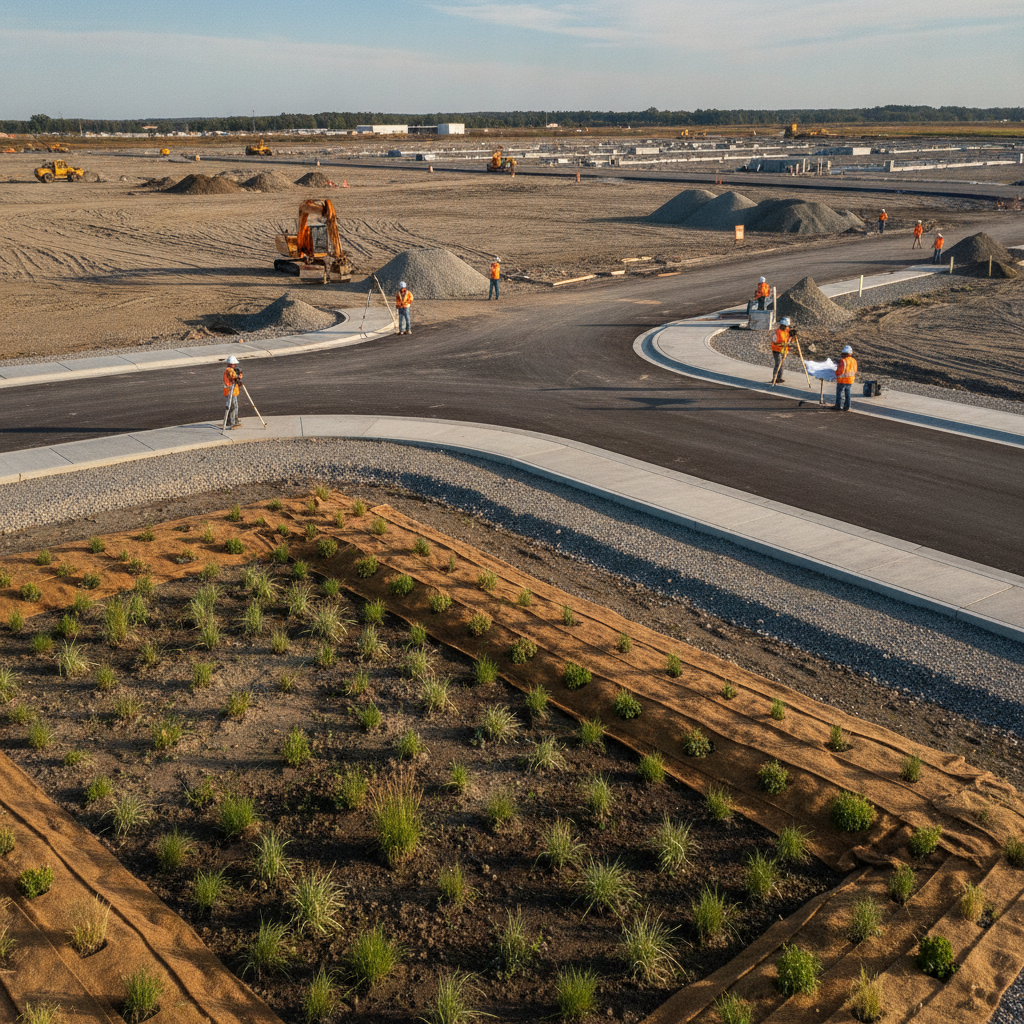
Bioretention areas, often called rain gardens, are engineered depressions in the landscape designed to capture and treat stormwater runoff. They utilize a layered system of engineered soil media, a mulch layer, and specially selected native vegetation to filter pollutants, cool water temperatures, and encourage infiltration. For a data center, these can be strategically placed in landscape islands, along property buffers, or adjacent to parking areas to treat runoff before it concentrates in the primary drainage system. The design of a bioretention system must account for sandy soils and high water table. A key consideration for mission-critical sites is the placement and maintenance of these features. They must be located outside of secure perimeters or designed in a way that does not compromise fence lines or surveillance sightlines. The civil engineering plans must also ensure that infiltration from the bioretention cell does not negatively impact building foundations or underground utility coordination, particularly for sensitive fiber optic and power conduits. Proper specification of plant species is also critical to ensure long-term performance with minimal maintenance.
Permeable Pavement Systems: Balancing Load and Infiltration
Permeable pavements allow stormwater to pass through the surface into an underlying stone reservoir, where it can be stored and slowly infiltrated into the ground. This technology is ideal for reducing runoff from employee parking lots, sidewalks, and other light-duty areas. Common types include permeable interlocking concrete pavers (PICPs), porous asphalt, and pervious concrete. By turning a parking lot into a stormwater management facility, developers can significantly reduce the runoff volume that needs to be managed elsewhere on the site. However, their application on a data center campus requires careful analysis. Permeable pavements are generally not suitable for areas with heavy truck traffic, such as loading docks, equipment yards, or routes used for generator and fuel deliveries. The geotechnical subgrade preparation is also more complex than for standard pavement, requiring a design that ensures both structural stability and hydraulic performance. A successful implementation requires a clear demarcation of traffic zones and a robust long-term maintenance plan to prevent surface clogging, which is a common point of failure for these systems.
Vegetated Swales and Bioswales for Conveyance and Treatment
Instead of traditional concrete-lined ditches or underground pipes, vegetated swales offer a green alternative for conveying stormwater across a site. These are broad, shallow channels planted with dense, erosion-resistant vegetation. As water flows through the swale, the vegetation slows the velocity, allowing sediment and pollutants to settle out while promoting infiltration. A bioswale is an enhanced version that incorporates an engineered soil media and sometimes an underdrain to further improve water quality treatment. On a data center campus, vegetated swales are highly effective along access roads, at the base of berms, or around the perimeter of parking areas. They integrate seamlessly into the landscape plan and contribute to the overall stormwater management calculations submitted for the permit submittals. The drainage design must ensure the swale’s slope and cross-section are adequate to handle design storm events without causing erosion or unwanted ponding, making hydraulic modeling a critical step in the civil engineering process.
Green Roofs and Tree Canopy Credits: Vertical and Horizontal Strategies
While a full-scale green roof on the main data hall is often impractical due to structural load, maintenance access, and warranty considerations, they can be an excellent option for ancillary structures like administrative offices or security buildings. An extensive green roof system (with a shallow soil layer) can absorb a significant amount of rainfall, reducing the runoff volume that the ground-level site development infrastructure must handle. This can provide tangible benefits in meeting overall stormwater management goals. A more universally applicable strategy is leveraging tree canopy credits. Many municipalities have ordinances that require a certain percentage of a site to be covered by tree canopy. By preserving existing mature trees or planting new ones, a project can earn significant credit toward its stormwater management requirements. The civil engineering team must strategically locate trees to maximize these benefits without interfering with security systems, overhead power lines, or critical underground utility coordination pathways.
Soil Amendments and Compaction Mitigation
One of the most overlooked aspects of site development is the impact of construction on soil health. Heavy equipment compacts the ground, destroying its natural structure and ability to absorb water. This is particularly true on large-scale data center projects with extensive earthwork. Soil amendment is the process of incorporating compost or other organic matter into compacted soils to restore their porosity and hydrologic function. This simple step can dramatically improve the performance of all other GI features on site. Implementing a soil management plan during construction is essential. This involves delineating areas for protection, specifying decompaction procedures, and ensuring amended soils are used in all landscaped and vegetated areas. This foundational practice not only supports robust plant growth but also enhances the site’s overall infiltration capacity, a key factor that is scrutinized during the agency review of stormwater management plans. It is a critical component of a truly integrated drainage design.
RSP Engineers’ Approach to Integrated Site Design
At RSP Engineers, we treat green infrastructure as an integral component of the civil engineering design process, not an afterthought. Our approach begins with a comprehensive site analysis to identify opportunities and constraints, including a thorough geotechnical evaluation and utility mapping. We work with the development team to integrate GI features into the initial concept plan, ensuring they align with the facility’s operational and security requirements. Using advanced hydrologic and hydraulic modeling software, we quantify the performance of the proposed GI systems to demonstrate compliance with state and local stormwater management regulations. This data-driven approach is crucial for a successful agency review. Our experience with local’s WMDs allows us to prepare robust permit submittals that clearly articulate the design intent and compliance strategy, facilitating a smoother path to approval for complex mission-critical projects.
Navigating GI Challenges in Mission-Critical Environments
While the benefits are clear, implementing GI on data center sites comes with unique challenges. The foremost is the tension between security and landscape design. Bioretention areas and swales must be designed to prevent unauthorized access or concealment, often requiring specific grading, low-growing vegetation, and integration with security fencing and surveillance systems. A detailed plan for utility coordination is also paramount, as infiltration-based systems must be carefully located to avoid conflicts with sensitive underground power and data conduits. Another common issue is the underestimation of long-term maintenance. Permeable pavements require periodic vacuuming to prevent clogging, and bioretention areas need regular inspections to ensure vegetation is healthy and inlets are clear of debris. A comprehensive Operations and Maintenance (O&M) plan is not just a best practice; it is often a required component of the ERP permit. Proactive planning for these activities is essential for the long-term success of any GI installation.
Optimize Your Site with Expert Civil Engineering
Integrating green infrastructure into a mission-critical data center requires a specialized blend of technical expertise and practical experience. The team at RSP Engineers is adept at designing resilient, compliant, and efficient sites that balance sustainability goals with operational imperatives. If you are planning a data center project, contact us to discuss how our expertise in civil engineering, integrated stormwater management, and complex permitting can bring value to your development. We can guide you from initial feasibility and site development planning through final construction.
Conclusion
For data center developers green infrastructure is more than a trend; it is a critical strategy for navigating a complex regulatory landscape and creating more resilient, cost-effective sites. By moving beyond traditional gray infrastructure, projects can achieve superior stormwater management, enhance site aesthetics, and streamline the permitting process. Success hinges on a thoughtful, integrated approach where GI is a core component of the civil engineering design, carefully tailored to the unique security and operational demands of a mission-critical facility. With proper planning and expert guidance, green infrastructure can provide a decisive competitive advantage.
FAQs
-
When designed correctly and documented thoroughly, green infrastructure can streamline the permitting timeline. By demonstrating superior water quality treatment and runoff reduction, a GI-based design can more easily meet the stringent criteria of Water Management Districts, potentially reducing the number of review cycles and requests for additional information during the agency review process.
-
Generally, no. Standard permeable pavement systems are designed for light-duty vehicles like cars and small trucks. Areas designated for heavy loads, such as access routes for generator delivery, fuel tankers, or fire apparatus, require a conventional heavy-duty pavement section. The site development plan must clearly delineate these zones and use the appropriate pavement type for each.
-
There can be if they are not designed with security in mind. A key part of the civil engineering process is to design these features with gentle side slopes, low-growing vegetation, and strategic placement that maintains clear sightlines from security cameras and patrols. They should not be placed in a way that could conceal individuals or compromise a secure fence line.