
Data Center 2N Infrastructure Planning
A technical guide for data center developers on planning resilient fiber infrastructure. Learn about diverse entrances, carrier coordination, and civil engineering requirements in Florida.
The Strategic Role of Diverse Fiber Entrances
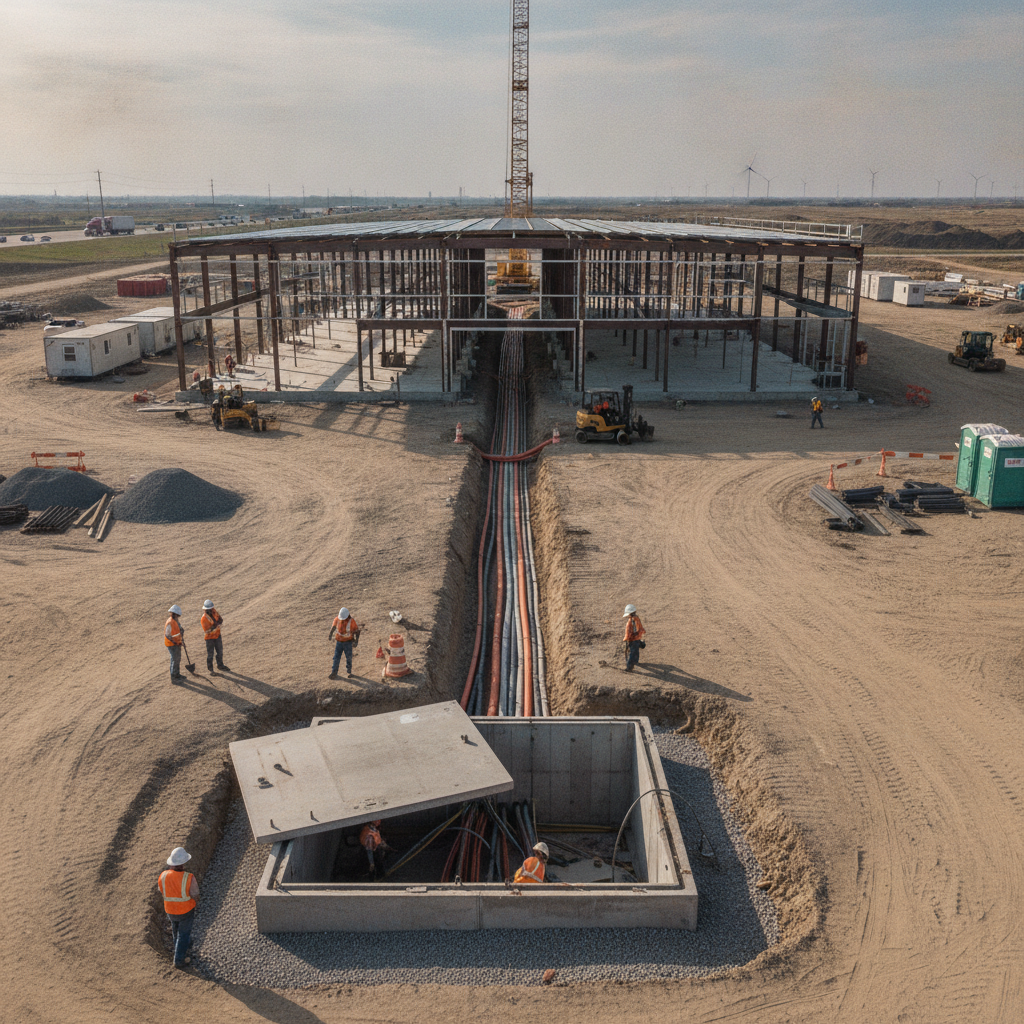
The single greatest point of failure for data center connectivity is the physical entry point of fiber cables into the facility. A single backhoe accident severing a consolidated conduit bank can take an entire facility offline. To mitigate this risk, the industry best practice is to design at least two, and often three or four, physically diverse fiber entrances. This means each entrance route must be separated horizontally and vertically, approaching the building from different directions and entering at distinct locations. A Professional Engineer must ensure these routes avoid crossing at any point on or off the property. This strategy requires careful site development planning from day one. The civil engineer must analyze the property boundaries, existing utility corridors, public rights-of-way, and proposed site improvements like stormwater management ponds and parking lots. The goal is to create pathways that are not only separate but also independently viable. For example, one route might follow a primary roadway easement, while a second, diverse route could traverse a different side of the property, potentially utilizing a utility easement or a dedicated, secured pathway. This level of planning ensures true route diversity and is a critical component of any resilient site plan design.
Civil Engineering for Conduits, Handholes, and Vaults
Fiber Pathway Component Specifications
| Pathway Component | Civil Engineering Specification | Resilience Impact |
|---|---|---|
| Diverse Entrances | Minimum of two geographically separate routes entering the building at different points. No shared manholes or pathways. | Eliminates single point of failure from a localized event (e.g., construction cut, pole down). |
| Conduit Bank | 4-inch or 6-inch Schedule 40/80 PVC or HDPE, encased in concrete for critical routes. Minimum 36-inch cover. | Provides physical protection against excavation damage and crushing. Concrete encasement offers maximum security. |
| Innerducts | Multiple color-coded innerducts (e.g., four 1.25-inch) pre-installed per conduit. | Allows for easy installation of multiple carrier cables in the same conduit without tangling and simplifies future upgrades. |
| Handholes/Vaults | H-20 traffic-rated where applicable. Placed at all turns and every 500-600 feet on straight runs. | Provides necessary access for pulling and splicing cable. Proper rating prevents collapse under vehicle loads. |
| Bend Radius | Long, sweeping bends designed to exceed the minimum bend radius of fiber optic cable (typically 10-20x cable diameter). | Prevents micro-fractures in the glass fiber during installation, which can degrade signal quality and lead to failure. |
| Route Markers | Detectable warning tape buried 12 inches above conduit and permanent above-ground markers at key points. | Reduces the risk of accidental third-party damage (dig-ins) by clearly identifying the underground route. |
The physical protection for fiber optic cables is the conduit system. This network of pipes, handholes, and vaults is a core component of the site’s underground infrastructure. The design must specify the appropriate materials (typically HDPE or PVC), conduit size, and the number of innerducts to accommodate current and future carriers. A key consideration is the bend radius of the conduits; exceeding the manufacturer’s specified bend radius can make pulling fiber impossible or damage the delicate glass strands. This is a critical detail that requires precise civil engineering calculations. Handholes and vaults provide access points for pulling, splicing, and maintaining the fiber. The selection and placement of these structures are critical. They must be located strategically to facilitate cable pulls over long distances and at every change of direction. The design must also account for vehicle loading ratings (e.g., H-20 loading for areas with traffic), drainage to prevent water accumulation, and security features. In Florida, where the water table can be high, proper sealing and drainage design for these subterranean structures are paramount to protect sensitive fiber splice points from water ingress. This is a task for experienced Civil Engineers who understand local conditions.
Coordinating with Carriers and Utility Providers
A data center’s value is directly tied to the number and quality of carriers it can attract. The fiber infrastructure plan must be carrier-neutral, accommodating the specific requirements of multiple service providers. This process begins with extensive utility coordination long before construction. The civil engineer is responsible for identifying all existing telecommunications providers in the vicinity, obtaining their network maps, and establishing points of connection (POCs). This often involves negotiating with multiple entities to bring their networks to the site boundary. This coordination extends to all other utilities. The proposed fiber pathways must be carefully routed to avoid conflicts with water mains, sewer lines, gas pipes, and electrical distribution systems. A comprehensive utility coordination plan, often documented in a composite utility plan, is essential for deconflicting the underground environment. This plan is a critical document for securing permitting from local agencies, as it demonstrates due diligence in preventing costly and dangerous utility strikes during construction. Neglecting this step can lead to significant project delays and budget overruns.
Integrating Fiber Pathways with Site-Wide Plans
Fiber infrastructure cannot be designed in a vacuum. It must be seamlessly integrated with the overall site development plan, including grading, paving, landscaping, and especially the stormwater management system. For instance, conduit banks must be installed at depths that do not conflict with storm drain pipes, swales, or the subgrade of future roadways and parking lots. The location of vaults and handholes must not interfere with ADA-compliant pedestrian pathways or fire access lanes. The civil engineer acts as the central coordinator, ensuring the telecommunications plan aligns with all other design disciplines. This includes coordinating with the structural engineer on the precise location and structural requirements of building entrances and with the electrical engineer on grounding requirements for the telecommunications system. This holistic approach, a hallmark of quality site engineering services, prevents rework and ensures that the fiber infrastructure is a cohesive part of the final built environment, fully compliant with the Florida Building Code.
The Meet-Me Room (MMR) and Internal Pathways
The Meet-Me Room (MMR) is the nerve center of a data center’s connectivity, where external carrier networks interconnect with the facility’s internal cabling. The civil engineer’s role is to ensure the external fiber entrances terminate cleanly and logically at the MMR’s exterior wall. This involves designing multiple, physically separate entrance conduits that penetrate the building foundation or wall at designated points. These penetrations must be core-drilled and sealed to prevent water intrusion, a critical detail in Florida’s climate. Inside the building, the pathways from the entrance points to the MMR must be just as meticulously planned. While this often falls under the purview of other disciplines, the civil engineer’s site plan must provide the correct stub-out locations to facilitate a smooth transition. The site plan design must show the termination points of the external conduit banks, ensuring they align with the architectural and structural plans for the MMR. This coordination ensures a seamless handoff from the external land development scope to the internal fit-out.
Permitting and Agency Review for Telecom Infrastructure
Installing new telecommunications infrastructure, especially within public rights-of-way, requires a series of permits from local and state agencies. The civil engineering firm is typically responsible for preparing and submitting these permit applications. This can include right-of-way use permits from the city or county, Department of Transportation (DOT) permits for work along state roads, and potentially environmental resource permits if the pathways cross wetlands or other sensitive areas. The permit submittals must include detailed drawings showing the proposed route, construction methods, and traffic control plans. The agency review process can be lengthy and requires a proactive approach. The engineer must anticipate potential comments from reviewers regarding conflicts with existing or future public infrastructure, compliance with local codes, and restoration requirements. Having a strong relationship with local agency staff and a deep understanding of their requirements is crucial for navigating this process efficiently. A well-prepared submittal package, demonstrating thorough utility coordination and adherence to public works standards, is key to minimizing review cycles and keeping the project on schedule.
Our Process at RSP Engineers
At RSP Engineers, our approach to data center fiber infrastructure begins with a comprehensive due diligence and feasibility study. We identify all available carriers, map existing infrastructure, and analyze potential routes for diversity and constructability. We then develop a detailed site plan design that integrates the fiber pathways with all other site utilities, grading, and stormwater systems. Our team of Florida Licensed Engineers manages the entire utility coordination process, engaging directly with providers and agencies to streamline approvals. We prepare and submit all necessary permitting applications and see them through the agency review process. During construction, we provide construction administration to ensure the infrastructure is installed exactly as designed, protecting the long-term resilience of your mission-critical facility.
Common Issues in Fiber Infrastructure Development
Even with careful planning, challenges can arise. One of the most common issues is discovering unmapped or inaccurately located existing utilities during construction, which requires immediate redesign and field adjustments. Another frequent problem is securing necessary easements from adjacent property owners for diverse routing, a process that can involve lengthy legal negotiations. In dense urban areas, finding space for new conduit banks within congested rights-of-way can be a significant challenge. Finally, delays in the agency review process for permits are a constant risk, highlighting the importance of submitting a complete and accurate application package from the outset. Proactive management by an experienced civil engineering firm is the best defense against these common pitfalls.
Your Partner for Mission-Critical Site Development
Planning and executing a resilient fiber infrastructure plan is a complex undertaking that forms the bedrock of your data center’s success. It requires a deep understanding of civil engineering, proactive utility coordination, and a strategic approach to permitting. The team at RSP Engineers has the experience and local knowledge to guide your project from initial feasibility to final construction. We provide the critical site engineering services needed to ensure your facility has the robust, diverse, and secure connectivity required to compete in today’s market. Contact us today to discuss your data center development project in Florida.
Conclusion
Ultimately, the physical fiber infrastructure is as critical to a data center as its power and cooling systems. A successful design hinges on the principles of diversity, security, and foresight. By engaging experienced Civil Engineers early in the process, developers can ensure their facility is built on a foundation of resilient connectivity. Proper planning that integrates diverse fiber entrances, thorough utility coordination, and a clear understanding of the permitting landscape is the most effective way to mitigate risk and maximize the long-term value of your mission-critical asset.
FAQs
-
You should engage a civil engineer during the initial due diligence phase, even before purchasing the land. An early assessment of available fiber providers and the feasibility of creating diverse fiber entrances can be a critical factor in determining a site’s viability for a data center. This proactive step can save millions in future construction costs or prevent you from selecting a site with insurmountable connectivity challenges.
-
The most common mistake is failing to achieve true physical diversity. This includes routes that share a single manhole miles away, cross each other, or enter the building too close together. Another error is underestimating the time and complexity of utility coordination and permitting, which can severely impact the project schedule. Finally, not planning for future capacity by installing sufficient ‘dark’ conduits and innerducts is a missed opportunity that is expensive to correct later.
-
Florida’s high water table requires specific design and construction techniques. All conduit joints must be properly sealed to be watertight. Vaults and handholes must be designed to resist buoyancy and prevent water infiltration, which could damage fiber splices. Dewatering operations are often required during construction, which must be factored into the project’s budget and schedule and may require separate permitting.