
Data Center Earthwork Specifications
A technical guide for developers on data center earthwork specifications, covering subgrade prep, fill types, compaction, and avoiding change orders. Learn more with RSP Engineers.
The Critical First Step: Site Stripping and Subgrade Proofrolling
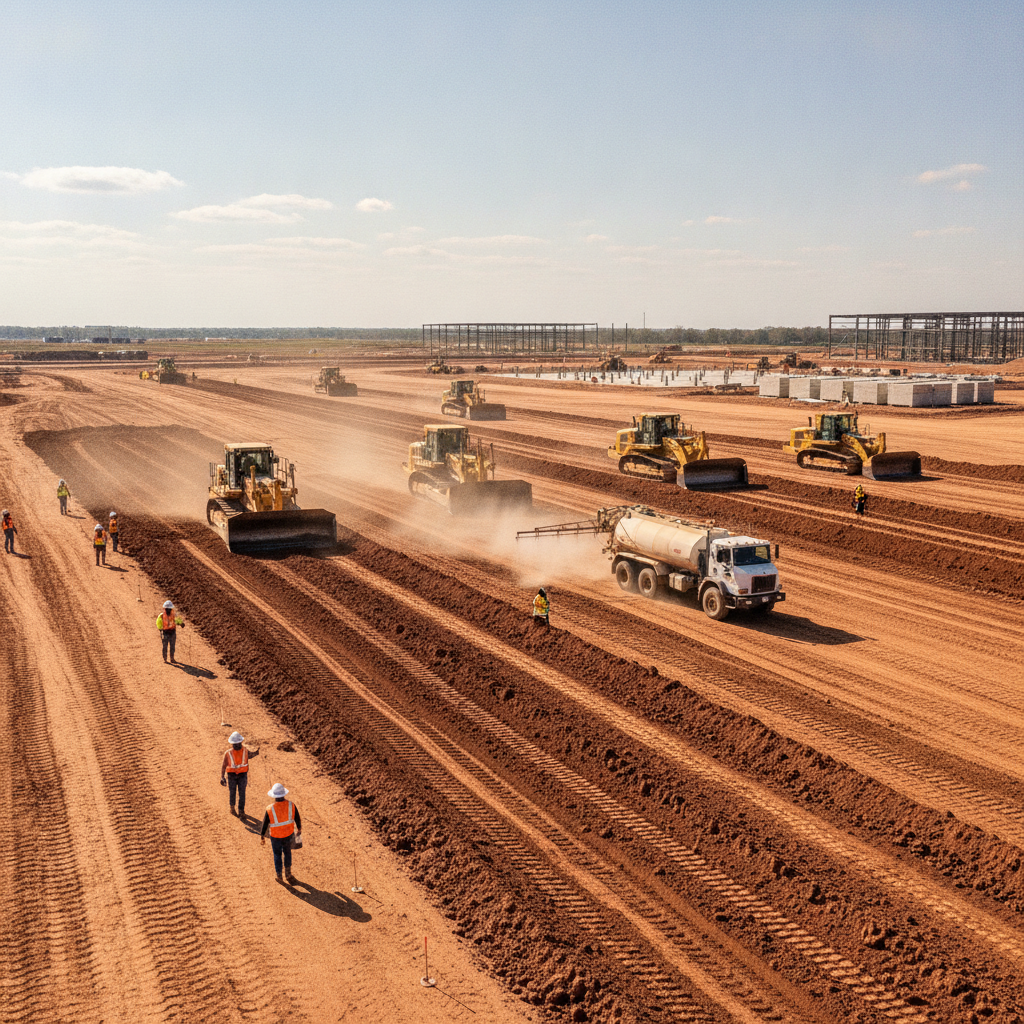
Before any fill material can be placed, the existing ground must be properly prepared. This process begins with site stripping, which involves the complete removal of all topsoil, vegetation, roots, and other organic matter. These materials are unsuitable for supporting structural loads because they decompose over time, leading to voids and settlement. The depth of the strip is determined by the Geotechnical soil report, which identifies the extent of organic-rich layers. Once the site is stripped to the prescribed subgrade elevation, proofrolling is performed. This is a critical quality control step where the exposed subgrade is subjected to repeated passes by a heavy, fully-loaded piece of equipment, such as a tandem-axle dump truck or a scraper. The purpose of proofrolling is to identify any soft, weak, or unstable areas that deflect or rut under the load. A Geotechnical engineer or their representative must observe this process, documenting any areas of failure that require undercutting and replacement with suitable material. This simple test is the first line of defense against future differential settlement.
Structural vs. Non-Structural Fill: Defining the Zones of Performance
Data Center Earthwork Compaction Requirements
| Site Area | Minimum Percent Compaction (% of Modified Proctor) | Maximum Loose Lift Thickness | Typical Testing Frequency |
|---|---|---|---|
| Building Pad & Foundations (Structural Fill) | 98% | 8 inches | 1 test per 2,500 sq. ft. per lift |
| Heavy-Duty Pavement Subgrade (Truck Courts) | 98% | 8 inches | 1 test per 5,000 sq. ft. per lift |
| Light-Duty Pavement Subgrade (Parking) | 95% | 12 inches | 1 test per 10,000 sq. ft. per lift |
| Utility Trench Backfill (Structural Zone) | 95% | 8 inches | 1 test per 200 linear ft. per lift |
| Landscape & Non-Structural Areas | 90% | 12 inches | 1 test per 20,000 sq. ft. per lift |
Not all fill on a data center site is created equal. A well-written specification clearly delineates between zones requiring structural fill and those where non-structural fill is acceptable. Structural fill is engineered material placed under building foundations, floor slabs, and heavy-duty pavements—areas where post-construction settlement must be virtually eliminated. It is subject to the most stringent requirements for material type, placement, and compaction. In contrast, non-structural fill is used in landscape areas, berms, and other non-load-bearing portions of the site. While it still must meet certain quality standards to ensure stability and proper drainage, the specifications are less rigorous. This distinction is crucial for cost management. By clearly defining these zones in the site development plans, a project can optimize the use of on-site soils and minimize the need to import expensive, highly-engineered fill material for areas where it isn’t required. Misclassifying an area can lead to either unnecessary expense or catastrophic structural failure.
Material Properties: Gradation, Plasticity, and Sourcing
The suitability of a soil for use as structural fill is determined by its physical properties. The Geotechnical soil report provides the initial analysis, but the project specifications set the contractual requirements. Key properties include material gradation (the distribution of particle sizes) and plasticity. Well-graded soils, which have a good mix of particle sizes, typically compact more densely and provide better stability. The specification will define an acceptable gradation envelope based on sieve analysis (e.g., ASTM C136). In Florida, a soil’s plasticity is a major concern. The Plasticity Index (PI), determined through Atterberg Limits testing, measures the range of moisture contents over which the soil behaves in a plastic, or moldable, state. Soils with a high PI (typically clays) are sensitive to moisture changes; they swell when wet and shrink when dry, leading to instability. Specifications for data centers often limit the PI of structural fill to a low value (e.g., less than 20) to ensure a stable, predictable subgrade. The specification must also outline the approval process for both on-site borrow sources and imported fill, requiring laboratory testing to confirm compliance before the material is placed.
The Science of Compaction: Lift Thickness and Moisture Conditioning
Achieving the required density in fill material is a scientific process, not guesswork. Fill must be placed in controlled layers, or lifts, of a specified thickness, typically 8 to 12 inches in a loose state. This ensures that the compactive energy from the equipment can penetrate the full depth of the lift uniformly. Placing fill in lifts that are too thick is a common contractor error that results in a dense top layer but a weak, under-compacted layer beneath it. Equally important is moisture conditioning. Every soil has an optimum moisture content at which it can achieve its maximum possible density when compacted. This value is determined in a lab using a Proctor test, most commonly the Modified Proctor (ASTM D1557) for data center projects. The specification will require the contractor to maintain the soil’s moisture content within a narrow range of this optimum (e.g., -2% to +2%). This often requires using water trucks to add moisture or discing and aerating the soil to dry it out, a constant challenge in Florida’s variable climate.
Handling the Unexpected: Undercutting and Unsuitable Material Management
Even with a thorough Geotechnical investigation, unexpected conditions can be discovered once earthwork begins. Proofrolling may reveal pockets of soft clay or organic material not identified in the soil borings. A robust specification anticipates this by clearly defining the process for undercutting. This involves excavating the unsuitable materials to a depth and extent determined by the Geotechnical engineer and backfilling with approved structural fill. To prevent costly disputes and delays, the contract documents must include clear instructions and unit pricing for this work. The specification should define what constitutes unsuitable material, how it should be handled (e.g., stockpiled, disposed of off-site), and the methodology for measuring quantities for payment. Proactive change order management through well-defined specifications protects the owner’s budget and keeps the project on schedule when unforeseen conditions arise.
Achieving Balance: Cut/Fill Analysis and Haul Route Planning
Large data center sites often involve moving hundreds of thousands of cubic yards of earth. A primary goal of the civil engineering design is to achieve a cut and fill balance, where the amount of soil excavated from high areas (cuts) equals the amount needed for low areas (fills). This minimizes the immense cost associated with either importing borrow material or hauling away excess soil. Advanced site development software is used to perform a detailed volumetric analysis to optimize the grading plan. Beyond the numbers, the logistics of moving this material are critical. The specifications and site plans should incorporate efficient haul routes that minimize travel distance, avoid conflicts with other construction activities, and ensure safety. Poorly planned logistics can lead to significant inefficiencies, schedule delays, and increased costs. The earthwork plan is a key component of the overall construction phasing and site logistics strategy.
RSP Engineers’ Approach to Earthwork Specification and Oversight
At RSP Engineers, we treat earthwork as a critical engineering discipline. Our process is designed to minimize risk and deliver a stable, reliable foundation for mission-critical facilities. We begin with a meticulous review of the project’s Geotechnical soil report to understand the site’s unique challenges and opportunities. From there, we develop clear, enforceable technical specifications that leave no room for ambiguity. Our involvement extends into the construction phase. We provide comprehensive Construction Management Services and site observation to verify that the work is performed in strict accordance with the plans and specifications. This includes reviewing material submittals, observing proofrolling operations, and coordinating with the third-party materials testing agency to interpret field density test results. Our proactive approach to construction administration helps identify and resolve issues before they become costly problems, ensuring the final product meets the exacting standards required for data center development.
Common Pitfalls in Data Center Earthwork
Even with a solid plan, several common issues can derail an earthwork program. Ambiguous specifications regarding material quality or compaction standards are a frequent source of disputes and change orders. In Florida, inadequate dewatering plans can halt progress when crews encounter the high water table. Another frequent problem is poor moisture control, where contractors either fail to add enough water, resulting in low compaction, or place fill that is too wet, which is impossible to compact properly. Finally, failing to budget for a reasonable quantity of undercutting can lead to significant cost overruns when unsuitable soils are inevitably discovered.
Partner with RSP Engineers for Mission-Critical Site Development
Your data center’s performance depends on the ground it’s built on. Don’t leave your foundation to chance. RSP Engineers provides the expert civil engineering and site development services needed to navigate the complexities of mission-critical projects. We specialize in creating clear, comprehensive earthwork specifications, providing diligent construction administration, and coordinating with geotechnical experts to deliver a stable, reliable site. Partner with us to mitigate risk, control costs, and build with confidence.
A Solid Foundation for the Digital Future
Ultimately, meticulous earthwork is the unseen hero of a successful data center project. It is a highly engineered process that demands precision, expertise, and proactive quality control. By investing in detailed geotechnical investigations, clear specifications, and experienced construction administration, developers can build a foundation that is as reliable as the digital infrastructure it supports. This commitment to quality from the ground up ensures the long-term stability and performance of these vital facilities.
Related Civil Engineering Insights
Navigating Stormwater Permitting for Large-Scale Florida Developments Utility Coordination Challenges for Mission-Critical Facilities The Developer’s Guide to Florida Land Development Due Diligence
FAQs
-
Data centers house sensitive equipment that is highly intolerant of movement. Differential settlement of even a fraction of an inch can damage structural elements, crack slabs, and misalign critical infrastructure. The stricter specifications for structural fill and compaction are designed to create a uniformly dense and stable earth pad that minimizes post-construction settlement. What is the role of the civil engineer vs.
-
The Geotechnical engineer investigates the subsurface soil and rock conditions and provides recommendations for site preparation, foundation design, and material specifications in the Geotechnical soil report. The Civil Engineer incorporates these recommendations into the overall site development plans and construction specifications, designing the grading, drainage, and utility layouts. During construction, the geotechnical firm typically performs materials testing, while the civil firm provides overall construction administration and oversight.
-
A well-prepared set of specifications will include contingency plans. This typically involves a pre-negotiated unit price for rock excavation or for the undercutting of unsuitable soils. When such conditions are found, the Geotechnical engineer is called to assess the extent, and the work is performed and documented under the unit price provisions to ensure fair compensation and avoid project delays.