
Data Center Drainage Master Planning
Learn the essentials of drainage master planning for multi-phase data center campuses, including sizing for ultimate buildout, phasing, and avoiding costly rework.
Establishing the Campus-Wide Watershed Strategy
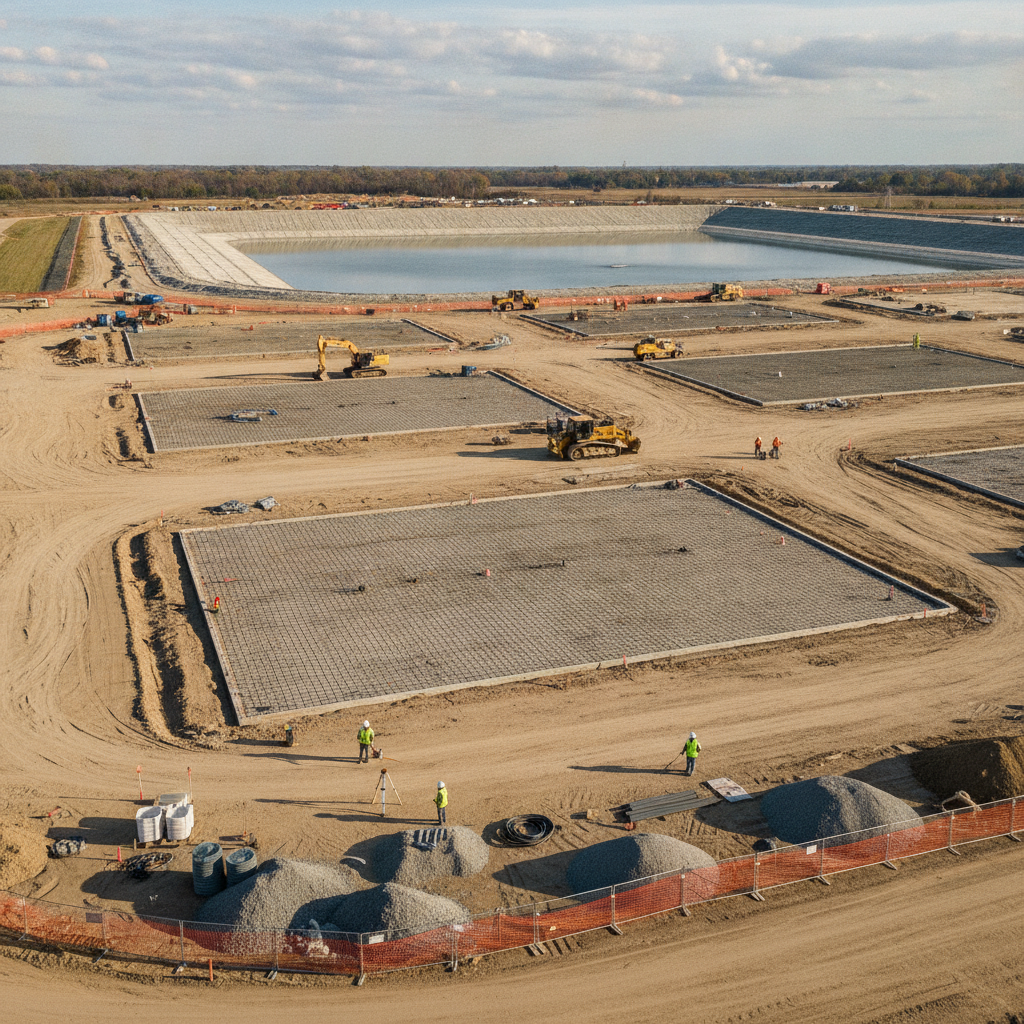
The first step in creating a robust drainage master plan is to look beyond the immediate needs of the first building pad and define the campus-wide watershed strategy. This involves creating a comprehensive hydrologic model for the entire property in its ultimate, fully developed state. We analyze pre-development conditions to establish a baseline, then model the post-development scenario, accounting for every future building, parking lot, and roadway. This ensures the master grading plan directs runoff predictably and efficiently. This watershed analysis is foundational. It identifies the total runoff volume and peak flow rates the campus will generate, determines logical sub-basins, and pinpoints the legal positive outfall locations for treated stormwater discharge. By modeling the ultimate build-out scenario from day one, we establish the performance requirements for the entire stormwater management system, preventing the common mistake of undersizing critical infrastructure that is difficult and expensive to replace later.
Sizing Infrastructure for Ultimate Development
Master Planned vs. Siloed Drainage: A Comparative Analysis
| Design Element | Master Planned Approach | Phase-by-Phase (Siloed) Approach |
|---|---|---|
| Regional Pond Sizing | Sized once for ultimate build-out, constructed in full or in expandable phases. Predictable land use. | Pond is expanded with each phase, leading to rework, repeated mobilization costs, and permitting amendments. |
| Main Conveyance Pipes | Backbone pipes are sized for the total watershed from day one, minimizing future excavation. | Pipes are often undersized and must be replaced or paralleled in later phases at a much higher cost. |
| Easement Planning | All necessary drainage easements are identified and reserved across the entire campus upfront. | Easements are often overlooked, potentially landlocking future phases or requiring costly rerouting. |
| Permitting Strategy | A master permit (e.g., ERP) is secured for the entire campus, with minor modifications for each phase. | Requires a new, major permit for each phase, leading to redundant agency review and potential inconsistencies. |
| Long-Term Cost | Higher initial capital outlay for backbone infrastructure, but significantly lower total project cost. | Lower initial cost per phase, but exponentially higher total cost due to rework, delays, and inefficiencies. |
| Operational Risk | Low. System is designed for ultimate conditions, ensuring long-term performance and compliance. | High. Interim conditions can be unstable, and undersized systems pose a flooding risk to operational facilities. |
With the ultimate hydrology understood, the next critical step is sizing the ‘backbone’ infrastructure to accommodate it. This includes the main conveyance pipes, primary culverts, outfall structures, and any regional stormwater ponds. Designing these core components for the final phase’s capacity is non-negotiable. Imagine installing a 48-inch pipe for Phase 1, only to discover during Phase 3 design that a 72-inch pipe is required for the total build-out. The cost of replacing that buried infrastructure is astronomical. A proper master plan dictates the size, material, and elevation of this backbone conveyance system from the start. This allows for the logical and cost-effective extension of the system as each new phase comes online. The infrastructure sizing process also considers long-term maintenance access and is carefully coordinated with the master utility plan to avoid conflicts with power and fiber conduits. This foresight in the initial site development phase saves millions in averted rework and construction delays.
Shared vs. Distributed Stormwater Management Facilities
A key strategic decision in a data center campus plan is whether to use a single, shared regional stormwater facility or smaller, distributed facilities dedicated to each phase. A large regional detention or retention pond often provides the most efficient use of land, consolidating the required treatment and attenuation volume into one area. This can free up valuable real estate closer to the data halls for other critical infrastructure. However, it requires a significant capital investment upfront to construct the full pond. Conversely, distributed facilities—such as smaller ponds, underground chambers, or bioretention areas for each phase—allow for incremental capital expenditure. This approach can offer more flexibility but may consume more total land area and create long-term maintenance complexities. The optimal permitting strategy and site layout are determined by a careful analysis of soil conditions, available land, construction costs, and the developer’s financial model. A thorough land use optimization study is essential to making the right choice.
Phasing, Interim Conditions, and Temporary Conveyance
A master plan must meticulously account for the ‘in-between’ stages of development. During a multi-year buildout, the site will exist in various interim conditions where only a portion of the ultimate impervious area is complete. Each phase must have a compliant and functional stormwater management system from the day it is stabilized, while also connecting logically to the future phases. This requires a detailed construction phasing plan that includes provisions for temporary conveyance, such as swales or diversions, to route water around active construction zones and into the master system. Robust erosion and sediment control measures, like temporary sediment basins and inlet protection, are critical to maintaining permit compliance with local agencies and the Department of Environmental Protection (DEP). This ensures that active construction in one phase does not negatively impact the operations of a completed, adjacent phase.
The Critical Role of Easement Reservations
One of the most overlooked but critical components of a drainage master plan is the reservation of easements. As a campus develops, future phases will need to route their stormwater across or through already completed phases to reach the master conveyance system or regional pond. Without legally recorded drainage easements, a future phase could be effectively landlocked, with no viable path for its runoff. The master site plan must clearly delineate and legally reserve corridors for all future underground pipes, overland flow paths, and maintenance access roads. This proactive approach to utility coordination and legal platting prevents future conflicts and ensures that the development rights for later phases are protected. Attempting to negotiate an easement after a parcel has been developed or sold is an expensive and often litigious process that can halt a project in its tracks.
Integrating Drainage with Utility and Site Infrastructure
A drainage master plan cannot exist in a vacuum. It must be intricately woven into the broader site development plan, especially concerning the dense network of underground utilities that serve a data center. The routing of large-diameter storm pipes must be coordinated with high-voltage power duct banks, fiber optic conduits, water mains, and sanitary sewer lines. A failure in this utility coordination can lead to catastrophic clashes during construction. Our process involves creating a composite utility plan where potential conflicts are identified and resolved during the design phase, not in the field. This clash detection ensures that required separation distances are maintained and that the gravity-flow drainage system is not compromised by other utilities. A well-integrated site plan design ensures that all systems work in harmony, protecting the mission-critical operations the infrastructure is built to support.
Our Approach to Data Center Drainage Master Planning
At RSP Engineers, we treat drainage master planning as a foundational, risk-mitigation strategy. Our process is designed to provide clarity and cost certainty for mission-critical developers. It begins with intensive due diligence, where we analyze the site’s topography, soils, and regulatory constraints to establish a clear path forward. We then develop a conceptual master drainage plan that aligns with the client’s phasing strategy and financial objectives. This concept is refined through detailed hydrologic and hydraulic modeling, leading to a comprehensive master plan report and drawings. We lead the agency review process, coordinating with Water Management Districts and local municipalities to secure master permits. As development proceeds, we provide detailed design for each phase that aligns perfectly with the master plan, followed by meticulous construction administration to ensure the vision is executed flawlessly in the field.
Common Pitfalls in Data Center Drainage Design
Even with the best intentions, data center drainage projects can encounter significant issues if not managed with expert oversight. A common pitfall is underestimating the final percentage of impervious surfaces, leading to an undersized system that fails during major storm events. Another frequent issue is failing to secure necessary off-site easements for the ultimate outfall early in the process, which can become a major roadblock during permitting. Poor coordination between the civil engineer and other design disciplines can lead to utility conflicts that require costly field changes. Finally, designing systems without considering long-term maintenance access can create significant operational headaches for the facility owner. A proactive approach to permit submittals and interdisciplinary coordination is the best defense against these preventable problems.
Your Partner for Mission-Critical Site Development
Developing a multi-phase data center campus requires a design partner who understands the long-term vision and the critical importance of foundational infrastructure. The team at RSP Engineers specializes in comprehensive site development for mission-critical facilities. We provide the strategic foresight needed to execute a complex, phased buildout efficiently and cost-effectively. From initial due diligence and master planning to final permitting and construction administration, we ensure your project’s success from the ground up. Contact us to discuss how our expertise in stormwater management can de-risk your next data center project.
Conclusion
For data center developers, a Drainage Master Plan is not an optional expense; it is a fundamental component of a successful, scalable project. It provides a clear, predictable roadmap for managing one of the most significant site development challenges. By investing in a comprehensive drainage design upfront, you protect your project from costly rework, streamline the permitting process for future phases, and ensure the long-term resilience of your mission-critical campus. This strategic approach to long-term infrastructure planning is the key to unlocking the full value of your land assets.
FAQs
-
A phase-by-phase approach almost always leads to expensive rework. Infrastructure installed for Phase 1 will likely be too small to handle runoff from future phases, requiring it to be removed and replaced. This siloed method also complicates permitting, creates land-use inefficiencies, and increases the total project cost significantly compared to a master-planned strategy.
-
The primary challenge is often securing the Environmental Resource Permit (ERP) from the governing Water Management District. For a large, multi-phase campus, this involves demonstrating that the stormwater management system for the ultimate build-out will meet complex water quality (treatment) and water quantity (attenuation) criteria and will not cause adverse downstream impacts. A comprehensive drainage design and model are essential for a successful application.
-
A robust master plan is built on a ‘maximum intensity’ or ‘worst-case’ scenario. We work with the developer to establish a maximum allowable impervious coverage and floor area ratio for the campus. The drainage design is based on this upper limit, providing inherent flexibility to accommodate future changes in building footprints or site layout without needing to redesign the core infrastructure.