
Data Center Cooling Tower Foundation Design
A technical guide to data center cooling tower foundation design. Learn about load analysis, geotechnical considerations, settlement control, and corrosion resistance from Florida’s civil engineering
Understanding the Unique Load Profile of Cooling Towers
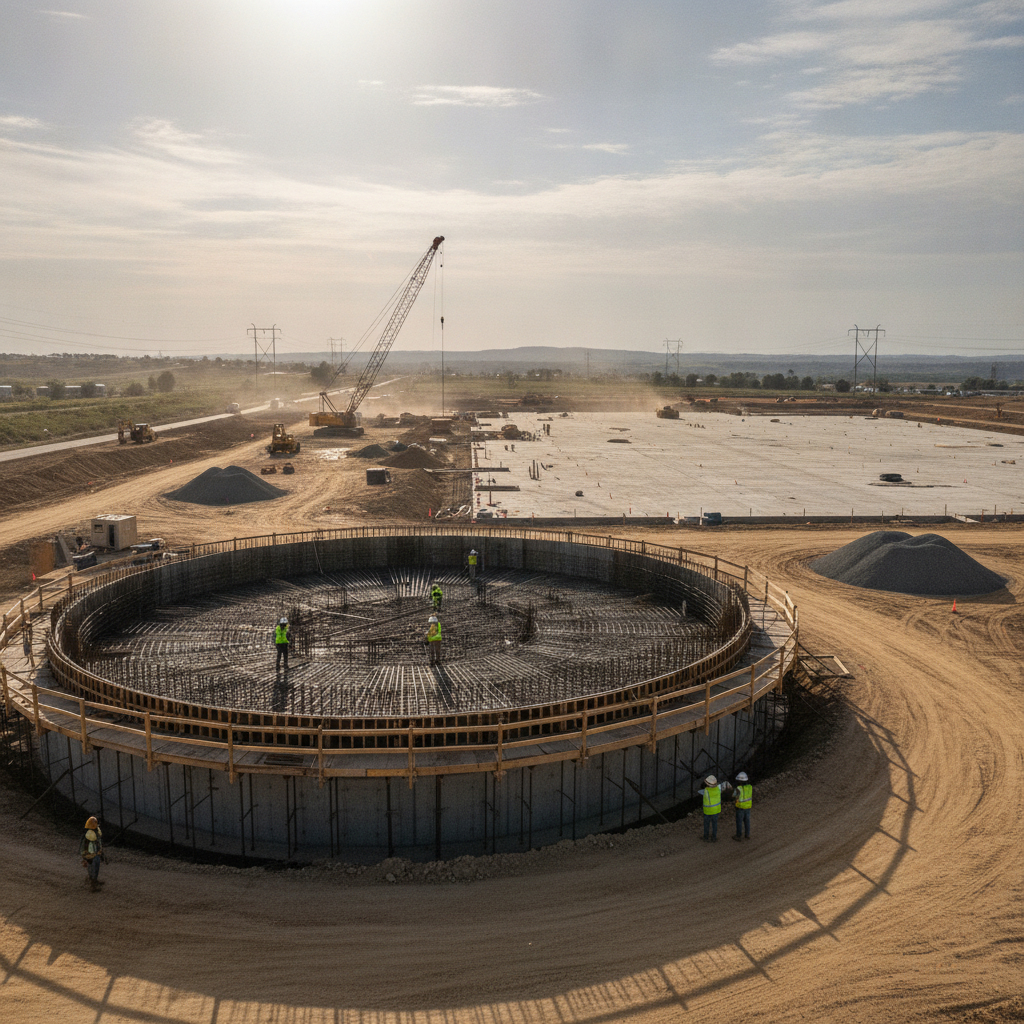
Unlike a typical building foundation that primarily handles static loads, a cooling tower foundation must support a complex combination of forces. The total load profile includes the immense dead load of the steel or fiberglass structure, the operating weight of thousands of gallons of water, and dynamic loads from massive fans and pumping equipment. This combination of heavy, sustained mass and constant vibration requires a foundation designed for both strength and fatigue resistance. A critical first step in the design process is obtaining precise load data from the cooling tower manufacturer. This includes anchor bolt layouts, operating and shutdown weights, and the magnitude and frequency of dynamic loads. Our engineers then model these forces to understand their impact on the foundation and underlying soils. We also must account for transient environmental loads, such as the significant wind loads mandated by the Florida Building Code, which can exert substantial uplift and lateral forces on the tall structures.
The Crucial Role of Geotechnical Investigation
Cooling Tower Foundation Design Considerations
| Design Factor | Key Consideration | Primary Engineering Discipline | Potential Impact if Ignored |
|---|---|---|---|
| Geotechnical Conditions | Soil bearing capacity, settlement potential, water table depth. | Geotechnical Engineering | Excessive settlement, foundation failure, pipe breaks. |
| Operating & Water Loads | Combined weight of structure, water, and equipment. | Structural Engineering | Structural overstress, cracking, or punching shear failure. |
| Dynamic & Vibrational Loads | Forces from fans and motors causing fatigue. | Structural / Mechanical Engineering | Fatigue cracking, resonance, damage to equipment. |
| Differential Settlement | Uneven settlement between tower and main building. | Geotechnical / Structural Engineering | Catastrophic failure of utility connections (pipes, conduits). |
| Water & Corrosion Control | Constant water exposure, chemical treatment, and environmental factors. | Materials / Structural Engineering | Rebar corrosion, concrete spalling, reduced service life. |
| Wind & Seismic Anchorage | Uplift and lateral forces from high winds or seismic events. | Structural Engineering | Tower overturning, sliding, or catastrophic structural failure. |
| Utility Integration | Large-diameter pipes, drains, and electrical conduits. | Civil Engineering / MEP | Pipe clashes, maintenance access issues, improper drainage. |
A foundation is only as strong as the ground it sits on. For a structure as heavy and sensitive as a cooling tower, a comprehensive geotechnical investigation is non-negotiable. This process begins with a series of soil boring tests to characterize the subsurface conditions across the foundation footprint. The resulting Geotechnical soil report provides essential data on soil stratigraphy, bearing capacity, shear strength, and the depth of the water table. A licensed Geotechnical engineer analyzes this data to provide critical recommendations for the foundation design. This report dictates the allowable soil bearing pressure, estimates total and differential settlement, and identifies potential risks like liquefiable soils or highly compressible organic layers common in Florida. Ignoring or under-scoping this investigation is a primary cause of foundation failure, leading to costly remediation and facility downtime. This is a core part of the site engineering services provided by leading Civil Engineering Firms.
Foundation Types: Mat, Piles, and Hybrid Solutions
Based on the geotechnical findings and load requirements, the design team selects the most appropriate foundation type. For sites with strong, consistent soil conditions, a reinforced concrete mat foundation is often the most cost-effective solution. This thick, heavily reinforced slab distributes the concentrated loads from the tower columns over a large area, reducing the bearing pressure on the soil to acceptable levels. When subsurface conditions are poor, a deep foundation system is required. This may involve driving precast concrete piles, drilling auger-cast piles, or installing drilled shafts to transfer the loads through weak upper soil layers to a more competent bearing stratum deep underground. In some cases, a hybrid approach using ground improvement techniques in conjunction with a mat foundation can optimize performance and cost. The selection process is a careful balance of performance, constructability, and budget, guided by the expert analysis of the Geotechnical engineer and structural design team.
Designing for Water: Corrosion and Waterproofing Details
The constant presence of water from basin overflow, drift, and blowdown makes cooling tower foundations highly susceptible to premature deterioration. Water can infiltrate porous concrete, corrode steel reinforcement, and degrade the structure from within. Therefore, designing for durability is as important as designing for strength. This involves a multi-layered defense strategy against water intrusion and corrosion. The first line of defense is a high-performance, low-permeability concrete mix design, often including supplementary cementitious materials like fly ash or slag. We specify an increased concrete cover over the reinforcing steel to provide additional protection. Furthermore, applying robust waterproofing membranes and chemical-resistant coatings to the basin slab and containment walls is standard practice. Proper jointing, sealing, and detailing of all pipe penetrations are also critical to creating a watertight system that ensures the foundation’s design life.
Controlling Differential Settlement Across the Data Center Campus
One of the most significant risks in data center site design is differential settlement—uneven settling of the ground between adjacent structures. If a heavy cooling tower foundation settles more than the main data center building, it can put immense stress on the large-diameter cooling water pipes and electrical conduits connecting the two. A pipe failure would be catastrophic, causing a cooling loss that could shut down the entire data center. Minimizing this risk requires a holistic approach to the overall site development plan. The Geotechnical engineer must analyze the settlement potential under both the cooling tower and the main building to ensure their long-term performance is compatible. The foundation systems for both structures are designed to limit total and differential settlement to within very strict tolerances, often less than half an inch. This requires careful coordination between the structural and geotechnical teams and is a key focus during the site plan design phase.
Anchorage and Support for Wind and Seismic Forces
Cooling towers, with their large surface areas and relatively lightweight superstructures, are highly susceptible to wind forces. In Florida, designing for hurricane-force winds is a primary consideration governed by the Florida Building Code. The foundation and anchorage system must be designed to resist significant lateral (shear) and uplift forces to prevent the tower from sliding or overturning during a major storm event. This is accomplished through robust anchor bolt systems embedded deep within the concrete foundation. The design of these anchors, their embedment depth, and the reinforcement around them are calculated using advanced structural analysis. While Florida has low seismic risk compared to other regions, mission-critical standards often require a seismic analysis to ensure the facility remains operational after an event. The foundation’s mass and stiffness play a crucial role in the overall seismic performance of the system, a task for a qualified Professional Engineer.
RSP Engineers’ Approach to Cooling Tower Foundation Design
At RSP Engineers, we follow a rigorous, integrated process to deliver resilient and reliable foundation designs for mission-critical facilities. Our approach begins with a thorough pre-design phase, where we collaborate with the client, equipment vendors, and a trusted Geotechnical engineer to gather all necessary data. We facilitate integrated design sessions with structural, mechanical, and electrical teams to ensure seamless coordination from the start. Our team utilizes advanced finite element analysis (FEA) software to model the foundation and predict its response to the complex load combinations. This allows us to optimize the design for both performance and material efficiency. We manage the entire permitting process, preparing detailed construction documents and navigating agency reviews to secure approvals. During construction, we provide comprehensive construction administration services, including submittal reviews and site inspections, to ensure the foundation is built exactly as designed.
Common Pitfalls in Cooling Tower Foundation Projects
Several common issues can compromise the success of a cooling tower foundation project. The most frequent is an inadequate Geotechnical soil report, which leads to a design based on flawed assumptions. Another pitfall is underestimating the true operating weight of the water or the long-term effects of vibration. Poor utility coordination is also a major source of construction delays and costly rework, especially with large-diameter cooling pipes. Neglecting durability is a critical mistake. Failing to specify proper concrete mix designs, waterproofing, and corrosion protection can shave years off the foundation’s service life. Finally, a lack of integrated analysis of differential settlement between the cooling tower pad and adjacent structures can lead to severe operational problems down the line. A proactive, experienced engineering team can help developers avoid these costly errors.
Partner with RSP Engineers for Your Mission-Critical Infrastructure
Ensure your data center’s critical support systems are built on a solid foundation. The team at RSP Engineers provides expert civil engineering, geotechnical coordination, and foundation design services for complex mission-critical projects across Florida. Our integrated approach ensures that every aspect of your site, from initial feasibility to final construction, is meticulously planned and executed. Contact us today to discuss your site development needs and secure your project’s success from the ground up.
Conclusion: A Foundation for Uptime and Reliability
A cooling tower foundation is far more than a simple concrete slab; it is a highly engineered system that is fundamental to a data center’s uptime and long-term viability. Its design demands a sophisticated understanding of geotechnical conditions, complex load dynamics, and material durability. By prioritizing a thorough geotechnical investigation, integrated design coordination, and a focus on mitigating risks like differential settlement and corrosion, developers can ensure their critical infrastructure is built to last. Ultimately, a successful project hinges on the expertise and meticulous attention to detail that experienced civil engineering partners bring to the table.
FAQs
-
The most critical first step is commissioning a comprehensive Geotechnical soil report from a qualified geotechnical engineering firm. This report provides the fundamental data upon which all subsequent structural design decisions are based. Without accurate soil data, the foundation design is pure guesswork.
-
The acceptable amount of total settlement depends on the site and equipment, but the more critical factor is differential settlement relative to the main data center. Tolerances are extremely tight, often limited to less than ½ inch, to prevent stress and potential failure of the rigid, large-diameter pipes connecting the structures.
-
Florida’s environment introduces three major challenges: a high water table, which can complicate construction and affect soil properties; a corrosive coastal atmosphere in many areas, which accelerates steel corrosion; and the requirement to design for high-velocity hurricane winds as mandated by the Florida Building Code.