
Data Center Construction Materials Testing
A technical guide to construction materials testing (CMT) for data centers. Learn about soil compaction, concrete testing, rebar inspection, and how RSP Engineers ensures structural integrity.
The Foundation of Reliability: Geotechnical and Soils Testing
Before any vertical construction begins, the building pad and surrounding site must provide a stable, predictable foundation. This is verified through a series of geotechnical and soils tests. The process starts with a Geotechnical soil report, but field verification during construction is non-negotiable. The cornerstone of this effort is the Proctor test (ASTM D698/D1557), a laboratory procedure that determines the maximum dry density and optimum moisture content for the on-site soils. This lab result becomes the benchmark for all subsequent field testing. During site grading, CMT technicians perform frequent in-place density tests, typically using a nuclear density gauge. These tests measure the real-time compaction and moisture content of the soil being placed and compacted in lifts. The results must meet a specified percentage (often 95% or 98%) of the laboratory Proctor value. Before the foundation is excavated, a final proofroll is conducted, where a heavy, loaded vehicle drives over the entire building pad to identify any soft, yielding, or unstable areas that require remediation. This systematic approach to earthwork quality control is the first line of defense against differential settlement, which could compromise sensitive equipment and structural systems.
Concrete Quality Control: From Batch Plant to Placement
CMT Sampling and Testing Frequency for Data Center Construction
| Material / Test | Typical Frequency | Key Acceptance Criteria |
|---|---|---|
| Soil Compaction (In-Place Density) | 1 test per 2,500 sq. ft. per lift for building pads; 1 per 5,000 sq. ft. for pavement areas. | Typically 95-98% of Maximum Dry Density from a Standard or Modified Proctor test. |
| Concrete Compressive Strength | 1 set of cylinders per 50 cubic yards, or per day's pour, whichever is more frequent. | 28-day strength must meet or exceed the specified design strength (e.g., 4000 psi). |
| Concrete Slump, Air, & Temp | First truck on site and every 50 cubic yards thereafter. | Must be within the tolerance range specified in the project mix design submittal. |
| Reinforcing Steel Inspection | Prior to each concrete placement for foundations, slabs, and walls. | Must match approved structural drawings for size, spacing, grade, and cover. |
| Asphalt Pavement Density (Cores) | 1 core per 1,000 linear feet of paving lane or as specified. | Typically must achieve 92-96% of the theoretical maximum density (Rice value). |
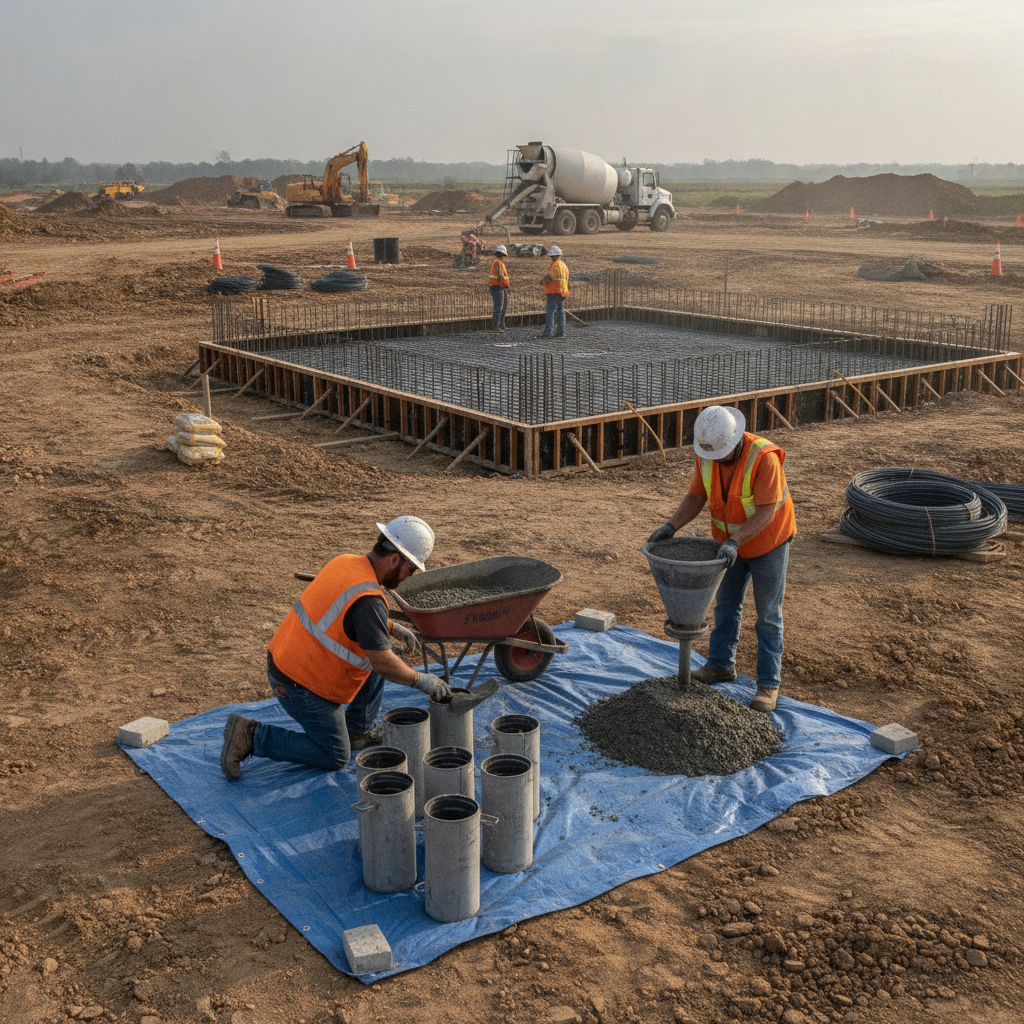
Concrete is the primary structural material in most data centers, forming everything from foundations and slab-on-grade to tilt-up walls and equipment pads. Its performance is not guaranteed; it must be verified. CMT for concrete begins at the batch plant with mix design verification and continues at the job site with a standard battery of tests for every pour. A certified technician tests the fresh concrete for slump (a measure of consistency and workability), air content (critical for durability), and temperature. The most critical test is for compressive strength. Technicians cast concrete test cylinders from the same batch being placed in the forms. These cylinders are carefully cured and transported to an accredited laboratory, where they are broken at specific intervals—typically 7, 14, and 28 days—to confirm the concrete is gaining strength as specified in the structural drawings. All testing must comply with the Florida Building Code and project-specific requirements. Meticulous record-keeping of batch tickets, test locations, and strength results provides an auditable trail of quality for every structural element.
Reinforcing Steel Inspection and Verification
Concrete is strong in compression but weak in tension; reinforcing steel (rebar) provides the necessary tensile strength. However, it only works if it is placed correctly. A crucial part of the CMT process is the pre-pour inspection of all reinforcing steel. A qualified inspector, often working alongside the local building official, verifies several key details against the approved structural drawings and specifications. This inspection confirms the correct rebar size, grade, and spacing. It also checks for proper lap splice lengths, clearances from the edge of forms (known as “cover”), and secure tying to prevent shifting during the concrete pour. Any discrepancies, such as missing bars, incorrect spacing, or insufficient cover, are documented in a field report and must be corrected before concrete placement is authorized. This step is a critical hold-point in the construction sequence, as mistakes buried in concrete are nearly impossible to fix and can severely compromise the structure’s load-bearing capacity.
Aggregate and Asphalt Testing for Site Infrastructure
A data center’s operational integrity extends to its site infrastructure, including access roads, fire lanes, and parking areas. The CMT program must also cover these elements to ensure long-term durability and minimize maintenance. For flexible pavements, this involves testing the aggregate base course material. Samples are checked for proper gradation (particle size distribution) and compaction is verified in the field, similar to building pad soils. For the final asphalt surface, testing is equally important. Technicians monitor the asphalt temperature at the paver to ensure it is within the optimal range for placement and compaction. After paving, asphalt cores are drilled from the finished mat and taken to the lab. These cores are tested for density (to ensure proper compaction and minimize voids) and thickness. Proper drainage design and durable pavements are essential for maintaining 24/7 site access for fuel deliveries, maintenance crews, and emergency services.
The Role of the Accredited CMT Laboratory and Field Technicians
The credibility of a materials testing program hinges on the qualifications of the people and facilities performing the work. It is essential to use a CMT firm with a laboratory accredited by a recognized body like the Construction Materials Engineering Council (CMEC) or AASHTO. This ensures their equipment, procedures, and quality management systems meet national standards. The data they produce is defensible and trusted by the entire project team, including the Professional Engineer of record and building officials. Field technicians should hold relevant certifications from organizations like the American Concrete Institute (ACI) for concrete testing or the National Institute for Certification in Engineering Technologies (NICET) for soils and asphalt. These technicians are the project’s front-line quality control agents. They are responsible for performing tests correctly, maintaining a proper chain of custody for all samples, and generating clear, accurate field reports. This documentation becomes a permanent part of the project record and is vital for final acceptance and project closeout.
Navigating Non-Conformance: Protocols for Failing Test Results
Even on well-managed projects, materials can sometimes fail to meet specifications. A low concrete strength break or a failed soil compaction test triggers a non-conformance protocol. The first step is immediate notification of the contractor, owner’s representative, and the design team. The CMT firm and the civil engineering team then work to investigate the cause and extent of the issue. This may involve non-destructive testing (NDT) like rebound hammers or ultrasonic pulse velocity for concrete, or further investigation of subgrade conditions for soils. Based on the investigation, the engineer of record will evaluate the structural or performance impact of the deficiency. The resolution could range from the removal and replacement of the non-conforming material to the acceptance of the material based on further analysis or a structural retrofit. Having a clear, pre-defined protocol for handling these issues is a hallmark of effective construction administration. It ensures that problems are addressed systematically and transparently, preventing them from escalating or causing significant project delays.
The RSP Engineers Approach to CMT Management
At RSP Engineers, we view Construction Materials Testing not as a separate service but as an integrated component of our construction administration and quality assurance process. Our approach is proactive, designed to identify and resolve issues before they impact the project schedule or budget. We begin during the design phase by developing a clear and comprehensive CMT plan and technical specifications that are tailored to the unique demands of a data center project. During construction, our project managers and engineers work directly with the owner, contractor, and the third-party CMT firm. We review daily field reports, track test results in a systematic log, and facilitate communication to ensure all stakeholders have timely information. When a non-conformance occurs, we lead the investigation and provide the engineering judgment needed to determine the appropriate resolution. This hands-on management of the site engineering services ensures that the quality specified in the design documents is achieved in the final built product.
Common Pitfalls in Data Center Materials Testing
Several common issues can undermine the effectiveness of a CMT program if not managed carefully. One of the most frequent is inadequate subgrade preparation, where undocumented fill or organic material leads to failed proofrolls and costly rework. For concrete, improper field curing of test cylinders—leaving them in the sun or letting them freeze—can lead to artificially low strength results that do not represent the in-place material, causing unnecessary investigation and delays. Communication gaps are another major pitfall. If a failing test result from a morning soil compaction test isn’t communicated until the end of the day, the contractor may have already placed several more lifts of uncertified material on top of it, compounding the problem. This highlights the need for a robust communication protocol and a responsive civil engineering team that can interpret results and provide direction quickly. Incomplete or delayed reporting can also halt progress, especially when a pre-pour rebar inspection report is needed to proceed with a large slab pour, impacting critical path activities. Frequently Asked Questions (FAQ) How often should concrete be tested on a large data center slab pour? For large, continuous pours, testing frequency is typically specified as one set of compressive strength cylinders for every 50 to 100 cubic yards of concrete placed. Additionally, tests for slump, air content, and temperature should be performed on the first truck and at similar intervals to ensure consistency throughout the pour. What is a Proctor test and why is it essential for the building pad? A Proctor test is a laboratory test that establishes the maximum density a specific soil type can achieve at an ideal moisture content. This value becomes the target benchmark (e.g., 95% of the Proctor value) that must be met during the field compaction of the building pad, ensuring a stable foundation and preventing future settlement. Who is responsible for paying for re-testing if a material fails? Typically, the construction contract specifies that the contractor is responsible for the cost of the material, its removal, its replacement, and any subsequent re-testing required to verify that the replacement material meets specifications. The owner is generally responsible for the initial testing costs as part of the quality assurance program. Can we use a non-accredited lab to save money? This is strongly discouraged. Using an accredited laboratory is critical for ensuring the test results are reliable, defensible, and will be accepted by building officials, lenders, and insurers. The data from an accredited lab provides a trusted record for project closeout and is a key part of professional risk management. How does CMT documentation affect the Certificate of Occupancy (CO)? The final CMT report, which compiles all field reports and laboratory test results, is often a required document for project closeout. Building departments may require this report as proof that the structure was built in accordance with the approved plans and the Florida Building Code. A complete and clean CMT record can be essential for securing the final CO.
Your Partner in Mission-Critical Construction Quality
Ensuring the structural integrity of a multi-million dollar data center requires a deep understanding of materials science and a rigorous approach to quality assurance. RSP Engineers provides the expert oversight needed to manage your project’s CMT program effectively. We help you navigate the complexities of site development, coordinate with testing agencies, and provide the decisive engineering judgment required for successful construction administration. Our goal is to ensure your facility is built on a foundation of verified quality. Contact us today to discuss how our civil engineering services can protect your investment and ensure the long-term reliability of your next mission-critical project.
Conclusion
Construction Materials Testing is an indispensable quality assurance discipline in the development of data centers. It is not merely a series of pass/fail checks, but a comprehensive process that verifies the very building blocks of the facility. From ensuring proper soil compaction to confirming concrete strength and rebar placement, a well-executed CMT program mitigates long-term structural risk. For developers of high-value assets, investing in thorough CMT management provides the confidence that the final product aligns with the critical performance and reliability standards demanded by a complete site plan design.
FAQs
-
Data Center Construction Materials Testing requires careful planning, qualified engineering, and compliance with the applicable codes and permits.
-
Getting Data Center Construction Materials Testing right protects safety, supports regulatory compliance, and avoids costly redesigns or delays.
-
RSP Engineers provides licensed expertise and end-to-end support for Data Center Construction Materials Testing, from early planning through permitting.