
Data Center Climate Resilience Through Stormwater Design
A technical guide for data center developers on designing climate-resilient stormwater systems in Florida. Learn about advanced rainfall data, strategic freeboard, and permitting.
The New Baseline: Integrating Forward-Looking Rainfall Data
Historically, civil engineering has relied on historical rainfall data, such as the tables provided by the Florida Department of Transportation (FDOT) or older NOAA Atlas 14 volumes. While these are suitable for typical commercial projects, they represent past performance. For a 50-year-lifespan data center, this is a critical vulnerability. Resilient design begins by shifting the baseline to incorporate forward-looking climate projections and updated precipitation frequency estimates, such as those emerging from NOAA Atlas 15. This updated data often shows significant increases in rainfall intensity and depth for design storms like the 25-year, 50-year, and 100-year events. By using this more conservative data, we can more accurately model future conditions. This affects every aspect of the stormwater management system, from the sizing of pipes and culverts to the required volume of retention or detention ponds. Adopting this new baseline is a fundamental step in future-proofing the site and is a key part of the due diligence process during the initial site development phase. It’s a conversation that must happen early, as it directly influences the site layout and project budget.
Beyond Code Minimums: Strategic Freeboard for Critical Infrastructure
Comparison of Standard vs. Resilient Stormwater Design Approaches for Data Centers
| Design Parameter | Standard Code-Minimum Approach | Climate-Resilient Approach |
|---|---|---|
| Design Storm Event | 100-year, 24-hour storm based on historical data (e.g., NOAA Atlas 14). | 100-year storm using forward-looking data (e.g., NOAA Atlas 15) plus a safety factor, or stress-tested against a 500-year event. |
| Equipment Pad Freeboard | Typically 1 foot above the 100-year flood elevation or adjacent crown of road. | 2-3 feet (or more) above the 500-year flood elevation, confirmed with hydraulic modeling. |
| System Redundancy | Single primary pond outfall and conveyance system sized for the design storm. | Dual outfalls, emergency spillways, and defined overland flow paths to manage system failure or blockage. |
| Rainfall Data Source | Standard regional data published by regulatory agencies (FDOT, WMDs). | Latest climate-adjusted precipitation data (NOAA Atlas 15) and consideration of future climate model projections. |
| Conveyance System Sizing | Pipes and swales sized to handle the peak flow of the design storm without surcharging. | Oversized pipes and culverts with capacity for partial blockages; analysis of hydraulic grade line under stress conditions. |
| Groundwater Analysis | Design based on the seasonal high water table (SHWT) at the time of design. | Analysis includes projections for future groundwater elevation changes due to sea-level rise or altered rainfall patterns. |
Freeboard—the vertical distance between a design flood elevation and the elevation of a structure or piece of equipment—is a critical resilience factor. While local codes might mandate one foot of freeboard above the 100-year flood elevation, this minimum is inadequate for protecting irreplaceable data center infrastructure. We advocate for a risk-based approach, often recommending two to three feet of freeboard, and calculating it based on a more severe event, such as the 500-year storm or a modeled “stress-test” scenario. This enhanced freeboard applies to all critical elevations: finished floors, electrical transformer pads, generator platforms, and fuel tank bases. This strategy directly mitigates risks from storm surge in coastal areas and extreme ponding from rainfall-driven events inland. The additional elevation provides a buffer against uncertainties in hydraulic modeling, wave action, and debris blockages that can cause water levels to exceed predicted elevations. Justifying this enhanced freeboard during agency review requires clear documentation and modeling, demonstrating the rationale behind exceeding the standard requirements of the Florida Building Code and local land development regulations.
Designing for Redundancy: Failure-Mode Analysis in Stormwater Systems
A resilient system is one that anticipates failure. In stormwater design, this means assuming a component could fail at the worst possible moment and ensuring the site can still manage water safely. A key practice is designing redundant conveyance systems. Instead of relying on a single outfall pipe for a detention pond, a resilient design may include a secondary outfall at a slightly higher elevation or a structurally stabilized emergency spillway. This ensures that if the primary outlet becomes clogged with debris during a storm, a secondary path exists to prevent catastrophic overtopping of the pond berm. This philosophy extends to the entire drainage network. We analyze the site for potential failure points and design countermeasures. This could include creating formal overland flow paths to direct excess water away from critical buildings if an inlet is overwhelmed, specifying dual culverts under a primary access road, or designing interconnected drainage basins that can balance loads during an extreme event. This level of site engineering services moves beyond simple conveyance to a holistic risk management approach, ensuring operational continuity even when individual components are compromised.
Protecting the Core: Elevating Critical Electrical and Mechanical Equipment
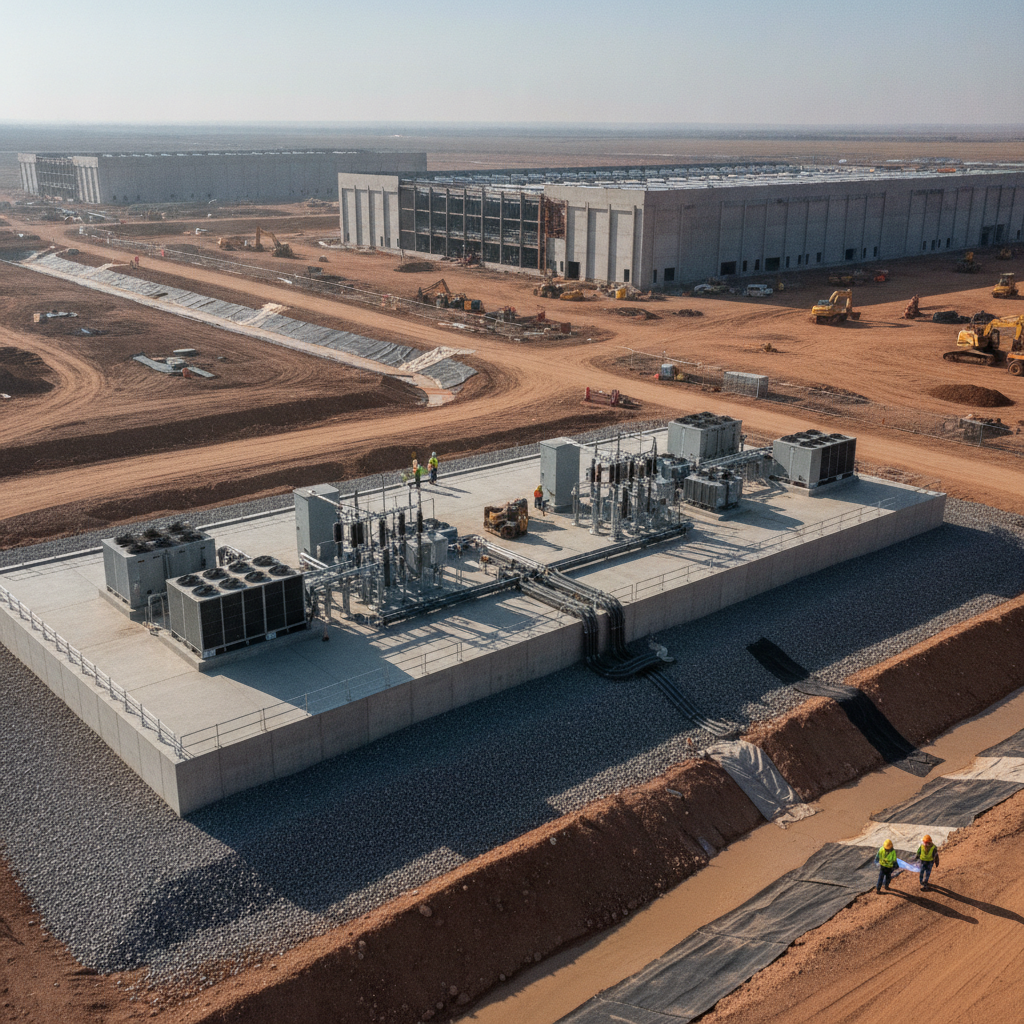
The most vulnerable and valuable components of a data center are often the external electrical and mechanical systems: switchgear, generators, chillers, and fuel supplies. The core principle of resilient design is to physically isolate this equipment from any potential floodwaters. This is achieved by placing all critical infrastructure on elevated structural pads or within hardened structures whose finished floor elevation is set well above the stress-tested flood level. The specific elevation is determined by detailed hydraulic and hydrologic (H&H) modeling, not a generic code requirement. The design of these equipment pads is a multidisciplinary effort involving civil, structural, and electrical engineers. The civil engineering team establishes the target elevations based on our stormwater models. We also ensure that site grading directs water away from these critical zones under all conditions. This includes designing localized drainage, such as trench drains or scuppers, on the pads themselves to handle direct rainfall and prevent localized ponding that could damage sensitive equipment. This meticulous attention to elevation is a non-negotiable aspect of mission-critical land development.
Stress-Testing the Design: Hydraulic Modeling for Extreme Weather Scenarios
A resilient design must be proven through rigorous analysis. We use sophisticated hydraulic modeling software (like ICPR or SWMM) to simulate how the site will perform under extreme stress. This goes beyond simply running the 100-year design storm. We model larger, less frequent events (e.g., the 200-year or 500-year storm) to understand the system’s breaking points. We also simulate failure modes, such as a fully blocked primary outfall or a collapsed culvert, to verify that our redundant systems and overland flow paths function as intended and continue to protect critical facilities. These stress-test simulations provide invaluable data for risk assessment and decision-making. They allow us to identify hidden vulnerabilities and refine the design before construction begins. The outputs, including detailed flood inundation maps and hydraulic grade line (HGL) profiles, become essential documentation in our permit submittals to agencies like the Water Management Districts (WMDs) and local municipalities, demonstrating that the design’s robustness is based on quantitative analysis, not just assumption.
Permitting Resilient Designs with Florida Water Management Districts
Navigating the permitting process for a design that exceeds standard code can be complex. Florida’s WMDs and local governments have well-defined criteria for stormwater quantity and quality, but they are primarily focused on preventing off-site impacts and meeting minimum standards. Proposing an oversized pond, enhanced freeboard, or unconventional redundancy requires a clear and compelling engineering narrative. The key is to present the design not as arbitrary, but as a necessary and calculated response to the specific operational risks faced by a mission-critical facility. Our approach involves proactive communication with regulators. We prepare comprehensive reports that include our forward-looking rainfall data, stress-test modeling results, and a risk analysis that justifies the enhanced design criteria. By demonstrating that our design provides superior protection for the facility without causing adverse off-site impacts, we can streamline the agency review process. This collaborative approach helps build trust and ensures that permit reviewers understand the unique requirements driving the civil engineering design for data center infrastructure.
How RSP Engineers Approaches Resilient Site Design
At RSP Engineers, our process for designing resilient data center sites is built on a foundation of proactive risk assessment. We begin every project with a detailed site investigation and a climate vulnerability analysis, using the latest data to establish robust design criteria. Our team of Florida Licensed Engineers collaborates closely with the client, architects, and other disciplines to integrate resilience into the earliest stages of the site plan design. We leverage advanced H&H modeling to test our designs against a range of scenarios, ensuring that every potential vulnerability is identified and mitigated. This process is iterative, allowing us to optimize the design for maximum protection while managing site constraints and project costs. Our deep experience with Florida’s regulatory environment enables us to effectively communicate the necessity of our designs, facilitating a smoother permitting journey.
Common Issues in Data Center Site Development
Even with careful planning, data center projects face common hurdles. One major issue is underestimating the impact of the seasonal high water table on underground infrastructure and pond design, which can lead to costly dewatering or redesigns. Another is insufficient utility coordination, where conflicts with major fiber, gas, or power trunk lines are discovered late in the design process, forcing significant site layout changes. Finally, value engineering that targets the stormwater system—reducing pipe sizes, eliminating redundancy, or lowering freeboard—is a frequent but dangerous mistake. While it may save costs upfront, it exposes the entire facility to unacceptable levels of risk that far outweigh the initial savings. A robust civil engineering design is not a cost center; it’s an insurance policy for operational continuity.
Your Partner in Mission-Critical Site Development
Protecting your data center investment from climate-related risks requires specialized expertise in Florida civil engineering. The team at RSP Engineers has a proven track record of delivering resilient site development solutions for mission-critical facilities. We manage the entire process, from initial due diligence and climate risk assessment to detailed drainage design, complex multi-agency permitting, and construction administration. We are one of the leading Civil Engineering firms in the state for this type of work. Contact us to discuss how we can safeguard your next project against the challenges of tomorrow’s climate.
Conclusion
In the high-stakes world of data center operations, climate resilience is no longer an option—it is a fundamental requirement. By moving beyond outdated standards and embracing a forward-looking approach that includes advanced climate data, strategic freeboard, and robust system redundancy, developers can significantly reduce the risk of weather-related downtime. This level of diligence in stormwater management and site development is the bedrock upon which a truly reliable mission-critical facility is built. Investing in a resilient civil engineering design is a direct investment in the long-term viability and profitability of the asset.
FAQs
-
We justify the cost by framing it as risk mitigation and uptime insurance. We present a quantitative analysis comparing the modest incremental cost of a resilient stormwater management system against the catastrophic financial and reputational losses of a single hour of data center downtime, which can run into the millions of dollars. The ROI on resilience is exceptionally high for mission-critical assets.
-
The Geotechnical engineer plays a crucial role. They provide the Geotechnical soil report, which informs everything from foundation design to stormwater pond construction. For resilience, their analysis of soil permeability, groundwater levels, and potential for soil saturation under extreme rainfall is critical for ensuring our drainage design and pond infiltration assumptions are valid and sustainable.
-
A resilient design often requires larger stormwater ponds and wider, more gradual overland flow paths, which can impact the developable area. Our approach is to integrate these features intelligently into the site plan design from day one. By treating stormwater elements as site amenities or security buffers, we can often optimize the layout to meet resilience goals without significantly compromising the building program.