
Data Center Agency Coordination: A Florida Civil Engineer’s Guide
A guide for data center developers on navigating local, state, and federal agency coordination in Florida. Learn about utility, environmental, and zoning permits from RSP Engineers.
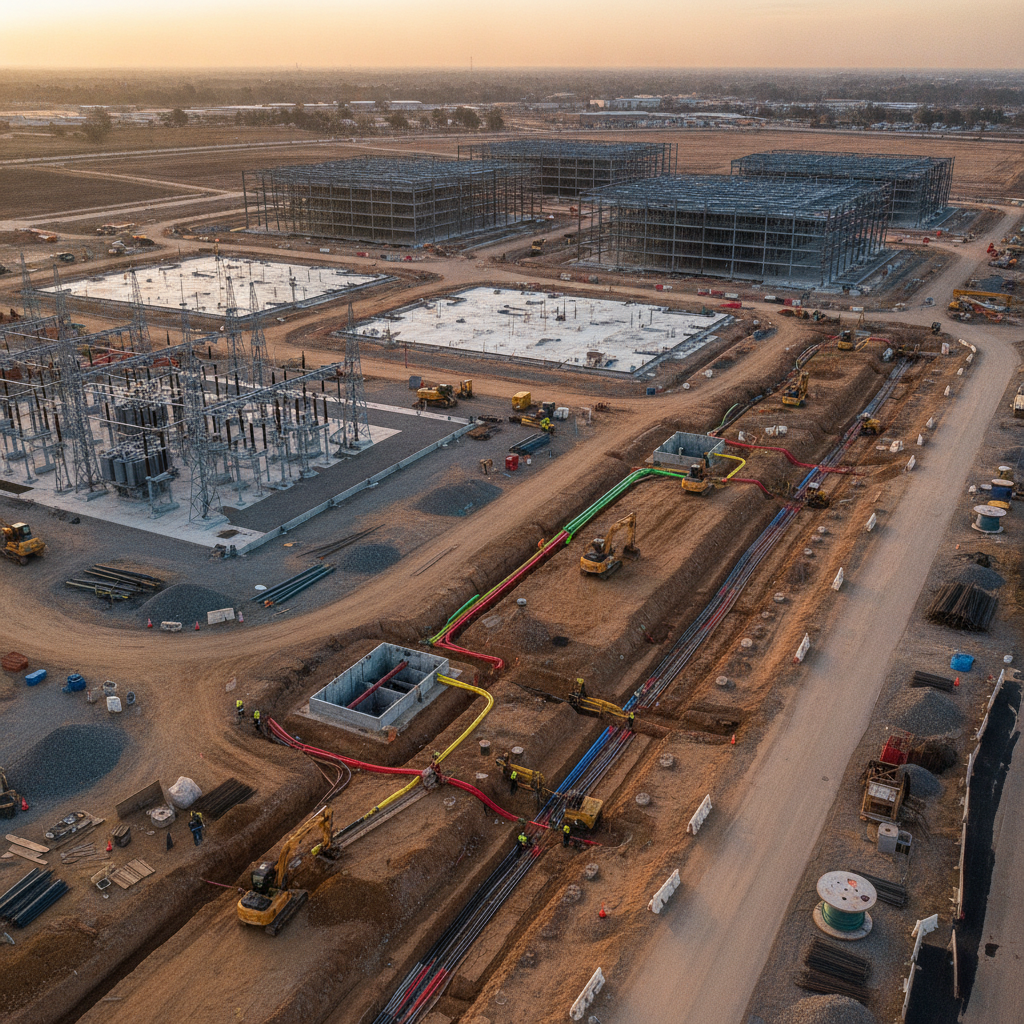
Local Agency Engagement: Zoning, Site Planning, and Building Permits
The foundation of any data center project is securing local entitlements. This process begins with confirming the property’s zoning designation is appropriate for such an intensive industrial use. A project may require a rezoning application or a special exception, which involves public hearings and demonstrating compatibility with the local comprehensive plan. The core of the local review is the site plan design, which must address everything from building setbacks and parking ratios to landscaping and lighting standards. Beyond zoning, the site development plan undergoes a detailed technical review by various municipal departments, including Public Works, Utilities, and Fire Rescue. Engineers must demonstrate compliance with local ordinances for traffic circulation, fire access, and on-site utility connections. The entire design must adhere to the Florida Building Code, which governs structural, electrical, and mechanical systems. A thorough understanding of these local requirements is critical for avoiding costly delays during the initial agency review phase.
Utility Coordination: The Critical Path for Power and Water
Key Agency Review Matrix for Florida Data Centers
| Agency/Jurisdiction | Primary Focus Area | Key Deliverables & Permits |
|---|---|---|
| Local Municipality/County | Zoning, Land Use, Building Code | Site Plan Approval, Building Permits, Rezoning/Special Exception |
| Electric Utility Provider | Power Capacity & Infrastructure | Power Availability Letter, System Impact Study, Electrical Easements |
| Water Management District (WMD) | Stormwater, Flooding, Water Use | Environmental Resource Permit (ERP), Consumptive Use Permit (CUP) |
| Florida DEP (FDEP) | Water Quality, Environmental Impacts | NPDES Permit, Joint ERP Application Review, Environmental Assessments |
| Florida DOT (FDOT) | State Roadway Access & Traffic | Connection Permit, Drainage Permit, Traffic Impact Analysis |
| U.S. Army Corps of Engineers (USACE) | Federal Wetlands & Waterways | Section 404 Dredge and Fill Permit, Jurisdictional Determination |
| Federal Aviation Administration (FAA) | Airspace Safety & Obstructions | Form 7460-1 Filing, Determination of No Hazard |
Data centers have an insatiable appetite for power and water, making utility coordination arguably the most critical and longest lead-time item in the development schedule. Early engagement with the electric utility provider (e.g., FPL, Duke Energy, TECO) is non-negotiable. This involves detailed load letters, system impact studies to assess grid capacity, and the design of redundant power feeds and on-site substations. Securing a firm power availability commitment is a major project milestone. Similarly, coordination with the local water and wastewater authority is essential for both potable water and the massive cooling demands of the facility. This includes negotiating capacity reservation agreements and designing the necessary on-site infrastructure for water distribution and sanitary sewer discharge. The civil engineering team must also coordinate with fiber optic providers to plan diverse, redundant connectivity paths into the site, which often involves securing complex utility easements and right-of-way use permits.
State-Level Environmental Permitting: FDEP and Water Management Districts
Florida’s sensitive ecosystem necessitates stringent state-level environmental review. The two primary agencies are the Florida Department of Environmental Protection (FDEP) and the regional Water Management District (WMD). The cornerstone of this process is the Environmental Resource Permit (ERP), which governs alterations to surface water flows and impacts to wetlands. The ERP application requires a sophisticated stormwater management system designed to treat runoff and prevent flooding, a critical task given Florida’s intense rainfall. The drainage design for a data center must account for vast impervious areas like rooftops and parking lots. This often involves creating large-scale retention or detention ponds and implementing advanced water quality treatment measures. If the project impacts wetlands, extensive mitigation efforts will be required. Furthermore, facilities using evaporative cooling may need a Consumptive Use Permit (CUP) from the WMD to authorize large water withdrawals, a process that involves detailed hydrogeological analysis to ensure the use is sustainable and does not harm natural resources.
Transportation and Access Management: FDOT and County Roadways
A data center’s construction and operation generate significant traffic. The project’s access points must be carefully designed to ensure safe and efficient traffic flow. If the site fronts a state road, a permit from the Florida Department of Transportation (FDOT) is required. This process involves traffic impact studies, turn lane warrant analyses, and detailed roadway engineering to design and permit any necessary improvements like deceleration lanes or new traffic signals. Even on local or county roads, the Public Works department will scrutinize the access design. The civil engineering plans must demonstrate adequate sight distances, proper driveway geometry, and the ability to accommodate large construction vehicles and future employee traffic. Neglecting transportation analysis early in the design process can lead to significant redesigns and delays in securing site plan approval and building permits.
Federal Agency Oversight: When Projects Trigger EPA and USACE Review
While most reviews are local or state-level, certain site characteristics can trigger federal agency jurisdiction. The most common trigger is the presence of federally protected wetlands, which falls under the authority of the U.S. Army Corps of Engineers (USACE) through Section 404 of the Clean Water Act. Any proposal to dredge or fill these wetlands requires a federal permit, a process that can be lengthy and requires extensive environmental documentation and mitigation planning. Additionally, the U.S. Environmental Protection Agency (EPA) sets standards for environmental quality. While the FDEP manages most environmental programs in Florida under delegated authority, the EPA retains oversight. For example, the National Pollutant Discharge Elimination System (NPDES) permit program, which regulates stormwater discharges from construction sites over one acre, is a federal program administered by the FDEP. A robust Stormwater Pollution Prevention Plan (SWPPP) is a key component of this permitting requirement.
Specialized Agency Reviews: Aviation, Archeological, and Security
Data center projects can also require coordination with more specialized agencies. If the proposed facility is located near an airport, a review by the Federal Aviation Administration (FAA) may be necessary to ensure that building heights and construction equipment do not pose a hazard to air navigation. This involves filing a Notice of Proposed Construction or Alteration and conducting an aeronautical study. Furthermore, a cultural resource assessment may be required to identify any potential historical or archeological sites. This involves coordination with the Florida Division of Historical Resources, also known as the State Historic Preservation Office (SHPO). The discovery of significant resources can trigger requirements for preservation or excavation, impacting the site development timeline. Finally, due to their critical nature, coordination with local emergency services and law enforcement is often necessary to develop comprehensive security and emergency response plans.
RSP Engineers’ Proactive Agency Coordination Strategy
At RSP Engineers, our approach is built on proactive, strategic engagement. We begin every data center project with a comprehensive due diligence and feasibility study, identifying all potential agency jurisdictions and critical path permits from day one. This includes initiating early pre-application meetings with key reviewers at the local, state, and federal levels to build consensus and identify potential issues before significant engineering resources are expended. Our team manages the entire lifecycle of the permit submittals, creating an integrated master schedule that tracks the dependencies between different agency reviews. We prepare clear, concise, and complete application packages that anticipate reviewer comments, minimizing requests for additional information (RAIs) that can stall a project. This meticulous management ensures that the complex web of approvals proceeds in a logical and efficient sequence. Our role extends beyond securing the initial permits. During construction, we provide ongoing construction administration and compliance support, helping clients navigate field inspections, permit modifications, and final certifications. We act as the central point of communication between the project team and agency staff, ensuring that the project is built in full compliance with all approved plans and permit conditions, leading to a smooth final closeout and certificate of occupancy.
Common Pitfalls in Data Center Agency Coordination
One of the most frequent and costly mistakes is underestimating the lead time for high-capacity power delivery. The process of studying grid impacts, designing substations, and procuring long-lead equipment can take 18-36 months or more. Another common pitfall is discovering significant environmental constraints, such as protected species or extensive wetlands, late in the design process. This can force major site plan revisions or trigger lengthy and expensive mitigation requirements. Zoning and land use incompatibilities can also derail a project. A site may seem perfect from a logistical standpoint but may require a contentious rezoning process that faces public opposition. Finally, failing to create a unified and integrated permitting strategy can lead to chaos. Submitting applications out of sequence or with conflicting information between agencies is a recipe for delays, confusion, and a loss of credibility with regulatory reviewers.
Partner with RSP Engineers for Your Florida Data Center Project
The success of your data center project in Florida depends on a civil engineering partner who can master the complexities of multi-agency coordination. RSP Engineers provides the expert guidance needed to navigate every stage of the process, from initial site selection and due diligence to final permit closeout. Our team specializes in complex site development, integrated permitting strategies, and proactive utility coordination. Contact us today to discuss how we can help de-risk your project and pave a clear path to construction.
Conclusion: Integrated Coordination is Key to Success
Developing a data center in Florida is a complex but achievable goal. Success hinges on a deep understanding of the intricate regulatory landscape and a commitment to proactive, integrated agency coordination from the very beginning. By addressing zoning, utility, environmental, and transportation requirements in a holistic manner, developers can mitigate risk and streamline the path to approval. Partnering with a skilled civil engineering firm near me that specializes in Florida land development is the most critical step in transforming a promising site into an operational, mission-critical facility.
FAQs
-
You should begin preliminary discussions with the electric utility provider during the initial site selection phase, even before you have a property under contract. Securing a formal load letter and understanding the timeline and costs for power delivery are essential due to the extremely long lead times involved in utility coordination for high-capacity service.
-
The most common delays often stem from an incomplete or inadequate stormwater management plan. This can include insufficient water quality treatment calculations, incorrect modeling for flood control, or a failure to properly address secondary and cumulative environmental impacts. A thorough and well-documented drainage design is critical for a smooth FDEP review.
-
Not automatically. Federal review, typically by the USACE, is triggered by specific site conditions, most notably the presence of federally regulated wetlands or waters. A comprehensive environmental assessment during due diligence is the only way to determine if a project will require federal permitting under the Clean Water Act.