
Data Center 100-Year Storm Design Explained
A technical guide for data center developers on designing for the 100-year storm. Learn about recurrence intervals, FFE, and stormwater management.
Deconstructing the “100-Year Storm”: Recurrence Interval vs. Probability
The term “100-year storm” is a common but often misunderstood piece of engineering jargon. It does not mean a storm that occurs only once every century. Instead, it refers to a rainfall event that has a 1% chance of being equaled or exceeded in any given year. This is its Annual Exceedance Probability (AEP). Thinking in terms of probability rather than a fixed return period is crucial for risk assessment. For a facility with a 30-year operational lifespan, there is a greater than 26% chance of experiencing at least one 100-year storm event during that time. Understanding this statistical nature is the first step in effective drainage design. Civil engineers use historical rainfall data, compiled by agencies like the National Oceanic and Atmospheric Administration (NOAA) and local water management districts, to define the intensity, duration, and depth of these design storms. This data forms the basis for all subsequent hydrologic modeling, which calculates the volume of runoff a site will generate. For a data center, misinterpreting this fundamental concept can lead to under-designed systems and unacceptable operational risk.
Why Mission-Critical Facilities Demand More Than the Minimum
Mission-Critical Stormwater Design Comparison
| Design Parameter | Standard Commercial Site (25-Year Storm Design) | Mission-Critical Data Center (100-Year+ Storm Design) | Rationale & Impact |
|---|---|---|---|
| Governing Storm Event | Typically 25-year, 24-hour storm as per local code minimum. | 100-year, 500-year, or Probable Maximum Precipitation (PMP) event. | Protects against extreme, low-probability events to ensure operational uptime. Increases infrastructure size and cost. |
| Finished Floor Elevation (FFE) | Minimum 1 foot above the 100-year floodplain or local requirement. | Minimum 2 feet above the 500-year flood elevation, including ponding analysis. | Provides a critical safety buffer against catastrophic building flooding, protecting billions in IT assets. |
| Stormwater Pond Sizing | Sized to attenuate post-development peak flows to pre-development levels for the 25-year storm. | Sized to contain the 100-year or 500-year storm volume with controlled release. | Requires significantly more land area for ponds, impacting overall site development layout and land acquisition costs. |
| Conveyance System Capacity | Pipes and inlets designed to handle the 25-year storm without significant surface ponding. | Pipes and inlets designed for the 100-year storm, with redundant flow paths and defined overland relief routes. | Ensures site access and functionality of supporting infrastructure (e.g., generator yards) are maintained during the event. |
| Emergency Overflow Design | A single overflow weir to handle storms exceeding the design event. | Multiple, hardened emergency overflow spillways designed to pass extreme flows without erosion or failure. | Creates a fail-safe system to protect the integrity of the stormwater basin berm and prevent uncontrolled release. |
| Utility Resilience | Standard burial depth and protection for utilities. | Underground utilities (power, fiber) are routed to avoid flood-prone areas or encased in concrete duct banks. | Prevents service interruption from saturated soils or erosion, which is a critical aspect of utility coordination for data centers. |
While many local jurisdictions mandate designing for a specific storm event (often the 25-year or 100-year storm), the operational and financial stakes of a data center often justify a more conservative approach. A flooded site can mean more than just physical damage; it can sever fiber connections, compromise backup generators, and lead to catastrophic data loss. Consequently, many data center developers and hyperscale clients elect to design their sites to withstand a 500-year storm (a 0.2% AEP event) or even more extreme scenarios. This decision goes beyond simple zoning compliance. Designing for a higher standard impacts every aspect of the site plan design. It requires larger stormwater ponds, bigger pipes, and more robust overflow systems. The goal is not just to prevent flooding of the building but to ensure the entire site—including access roads, fuel delivery pads, and critical utility infrastructure—remains operational during and after an extreme weather event. This level of resilience requires close collaboration between the developer and their Civil Engineer near me to balance risk, cost, and regulatory requirements.
Selecting the Right Design Storm: Rainfall Distributions and Durations
A design storm isn’t just a single rainfall total; it’s a complex event defined by its duration and how the rainfall is distributed over that time. Engineers typically use specific synthetic rainfall distributions, such as the Department of Transportation (DOT) or Natural Resources Conservation Service (NRCS) Type II FL and Type III FL curves. These distributions model how rainfall intensity changes during a storm, often peaking in the middle of the event. The standard duration used for most stormwater management system designs is 24 hours. The choice of distribution and duration is critical for accurate hydrologic and hydraulic (H&H) modeling. A short, high-intensity storm might test the capacity of your pipe network (peak flow), while a long, sustained rainfall event will test the volume of your detention or retention ponds (total storage). For data centers, engineers often analyze multiple storm durations (e.g., 1-hour, 3-hour, 24-hour) to identify the worst-case scenario for different components of the drainage system, ensuring comprehensive resilience.
Translating Rainfall into Infrastructure: Stormwater Management Systems
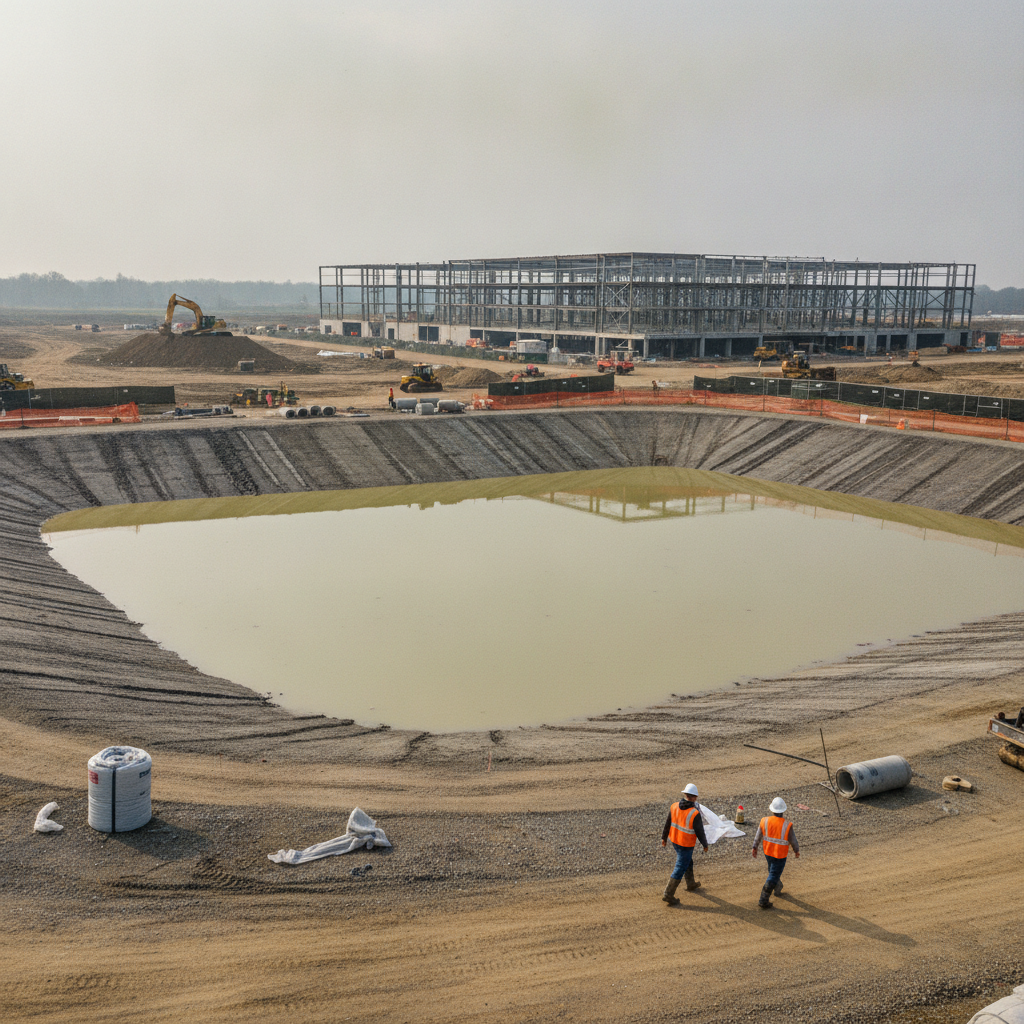
Once the design storm is defined, the engineer’s task is to design a system that can safely collect, store, treat, and discharge the resulting runoff. This involves a network of inlets, pipes, and, most visibly, stormwater ponds. For a sprawling data center campus, these ponds can be massive, requiring significant land allocation. The primary goal is to ensure the post-development discharge rate does not exceed the pre-development rate, a core principle of land development regulations. The design involves two key calculations. Hydrologic modeling (using software like ICPR or HEC-HMS) determines the volume and peak rate of runoff. Hydraulic modeling then analyzes how that water moves through the system of pipes and channels, ensuring they have enough capacity to convey the flow without causing localized flooding. This process includes sizing control structures, which are engineered weirs or orifices that regulate the rate at which water is released from the pond. Proper utility coordination is essential to avoid conflicts between these large storm pipes and the dense network of power and fiber conduits serving the facility.
Setting the Foundation: Finished Floor Elevation and Floodplain Management
Perhaps the most critical design decision driven by storm analysis is setting the Finished Floor Elevation (FFE). The FFE is the height of the ground floor of the data center building, and it must be set high enough to be completely protected from the design storm’s peak flood elevation. This isn’t just about the water level in the pond; it includes a safety margin known as freeboard, typically 1 to 2 feet above the calculated design high water level. This protects the facility from wave action and modeling uncertainties. Engineers must also analyze the site’s relationship to the FEMA Flood Insurance Rate Maps (FIRMs). If any portion of the site is within a designated special flood hazard area, strict Building Code and local floodplain management ordinances apply. This may require elevating the entire site with fill, constructing flood-proof walls, or other mitigation measures. For a data center, even a location outside the 100-year floodplain may warrant elevating the FFE to protect against the 500-year flood event, providing an additional layer of security for the mission-critical infrastructure within.
Permitting and Agency Review for High-Stakes Stormwater Design
A well-engineered design is only valuable once it’s approved. Stormwater management systems for data centers undergo intense scrutiny from multiple agencies, most notably the regional Water Management District (WMD) and the local municipality. The permit submittals must include detailed engineering reports, hydrologic and hydraulic models, construction plans, and calculations demonstrating compliance with all applicable criteria. This includes water quality treatment (removing pollutants) and water quantity control (preventing downstream flooding). The agency review process can be lengthy, often involving several rounds of comments and revisions. The engineer must clearly justify all design assumptions, from the chosen rainfall data to the sizing of every pipe and weir. For a data center with a heightened design standard (e.g., 500-year storm), the engineer must demonstrate that the more robust system does not create any adverse impacts on neighboring properties. A thorough and well-documented submittal package, prepared by experienced Licensed Engineers, is key to a smooth and predictable permitting timeline.
Our Approach to Mission-Critical Site Design
At RSP Engineers, we recognize that data center development is a high-stakes endeavor. Our process begins with a comprehensive due diligence phase, where we analyze floodplain maps, local rainfall data, and soil conditions to identify potential risks upfront. We work collaboratively with the client to establish a design storm criterion that aligns with their operational risk tolerance, often going beyond minimum code requirements. Our team of Civil Engineers utilizes advanced H&H modeling software to simulate various storm scenarios, optimizing the drainage design for both resilience and cost-effectiveness. We manage the entire lifecycle, from initial concept and site plan design through rigorous agency review and final permitting. Our deep experience with Water Management Districts and local municipalities allows us to anticipate reviewer comments and streamline the approval process. During construction, we provide Construction Management Services to ensure the stormwater system is built exactly as designed, verifying pipe inverts, pond dimensions, and control structure elevations to safeguard the client’s investment.
Common Issues in Data Center Stormwater Design
Even with careful planning, challenges can arise. One common issue is underestimating the footprint required for stormwater ponds, especially when designing for a 500-year storm. This can force costly late-stage redesigns or land acquisition. Another challenge is dealing with characteristically high water tables, which can limit the effectiveness of certain stormwater solutions like exfiltration trenches and may require expensive pond liners. Finally, ensuring that the emergency overflow systems are designed to function without causing erosion or flooding adjacent properties is a complex hydraulic challenge that requires expert analysis to avoid future liability. Frequently Asked Questions (FAQ) Is the 100-year storm the same rainfall amount everywhere? No, it varies significantly. The rainfall depth for a 100-year, 24-hour storm is location-specific. For example, coastal areas may have different rainfall statistics than inland areas due to tropical storm influence. Engineers must use the precise NOAA Atlas 14 or local agency rainfall data for the project’s specific location to ensure an accurate drainage design. What happens if a storm exceeds our 500-year design capacity? While extremely rare, it’s possible. A well-designed system includes a safe failure mechanism. This is the role of the emergency overflow spillway. It is a hardened channel designed to direct water exceeding the pond’s absolute maximum capacity to a predetermined, safe location away from the building and critical infrastructure, preventing a catastrophic berm failure. This is a key part of resilient site development. How does a high groundwater table affect the stormwater design? A high seasonal high water table (SHWT) can significantly impact design. It reduces the available soil volume for water storage, making retention (infiltration) systems less effective. This often necessitates lined detention ponds to prevent groundwater infiltration from consuming the required storage volume. It also requires careful consideration during utility coordination to ensure pipe trenches don’t become conduits for groundwater. Can we phase the stormwater system for a multi-building data center campus? Yes, this is a common strategy. The civil engineering master plan will often include a regional stormwater facility designed for the full campus build-out. However, construction can be phased. This requires designing and permitting interim stormwater controls for early phases to ensure compliance at every stage, which is a critical part of the overall permitting strategy. What is the difference between a hydrologic and a hydraulic model? Hydrology and hydraulics are related but distinct. Hydrologic modeling calculates the amount of stormwater runoff generated by a given rainfall event (the volume and peak flow rate). Hydraulic modeling analyzes the physical behavior of that water as it moves through pipes, channels, and ponds, calculating water surface elevations and velocities to ensure the system has adequate capacity.
Your Partner for Resilient Data Center Development
Designing a data center site that can withstand most extreme weather requires specialized expertise. The difference between a standard commercial design and a mission-critical one lies in the details of the stormwater management system, the foresight in the site development plan, and the rigor of the engineering analysis. Don’t leave your critical infrastructure vulnerable. Contact RSP Engineers today to discuss how our team can help you navigate the complexities of permitting, design, and construction to deliver a resilient and successful project.
Conclusion
Ultimately, designing for the 100-year storm—or beyond—is an exercise in risk management. For data centers, where the cost of downtime is immense, investing in a superior stormwater management system is a foundational requirement. By understanding the true meaning of recurrence intervals, carefully selecting design criteria, and meticulously engineering the site’s drainage, FFE, and overflow systems, developers can protect their assets and ensure continuous operation. This level of planning, supported by experienced civil engineering, transforms a potential liability into a source of competitive advantage and long-term resilience.
FAQs
-
Data Center 100-Year Storm Design Explained requires careful planning, qualified engineering, and compliance with the applicable codes and permits.
-
Getting Data Center 100-Year Storm Design Explained right protects safety, supports regulatory compliance, and avoids costly redesigns or delays.
-
RSP Engineers provides licensed expertise and end-to-end support for Data Center 100-Year Storm Design Explained, from early planning through permitting.