
Queueing Analysis at Data Center Security Gates
A guide to civil engineering queueing analysis for data center security gates. Learn how to design for vehicle stacking, service times, and roadway geometry to ensure site security and operational eff
Defining Key Inputs for Vehicle Arrival Patterns
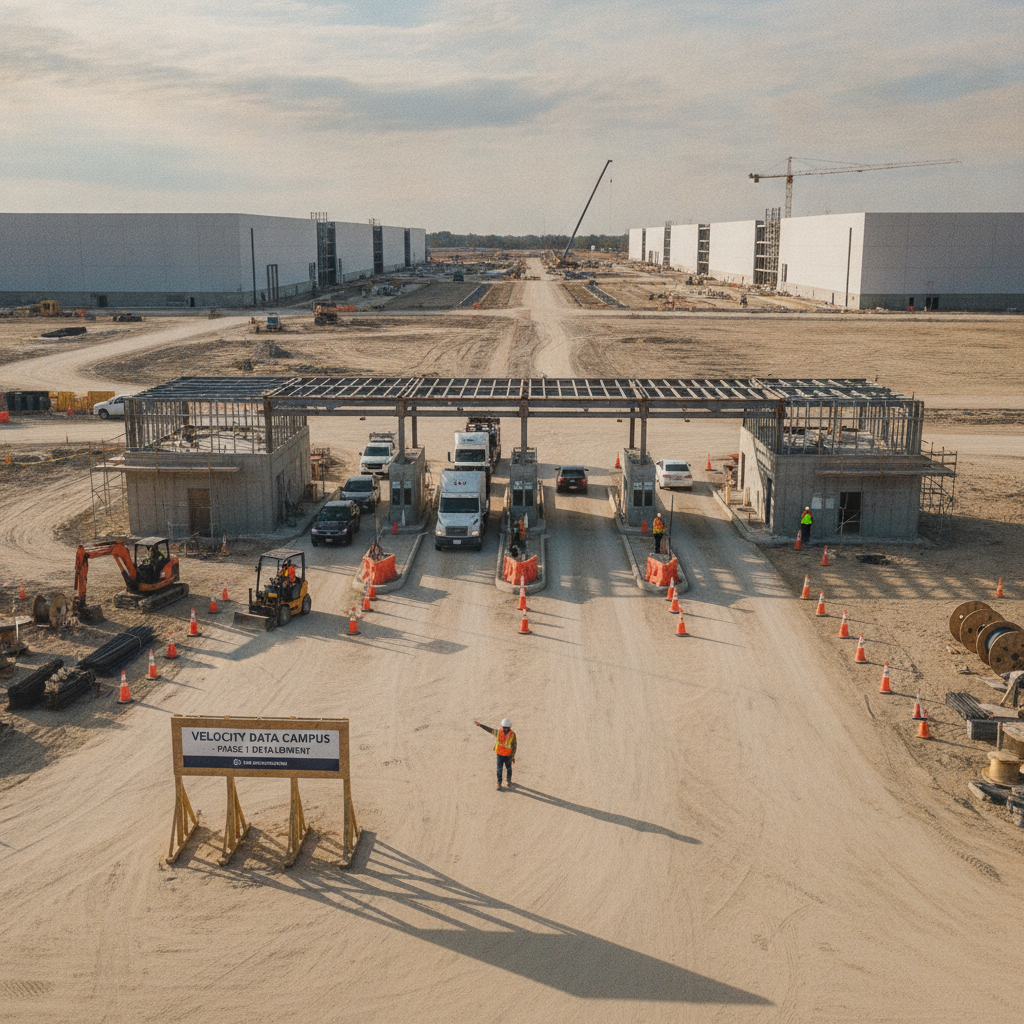
The foundation of any accurate queueing analysis is a comprehensive understanding of vehicle arrival patterns. This is not a single number but a complex model accounting for different user groups and peak operational periods. The analysis must differentiate between employee vehicles, which typically arrive in concentrated waves during shift changes, and delivery or construction vehicles, which may have more sporadic but impactful arrival times. We use industry-standard resources like the ITE Trip Generation Manual as a baseline, but tailor the inputs to the specific operational profile of a mission-critical facility. A critical consideration is the traffic generated during the facility’s construction and commissioning phases. The volume and type of construction traffic can often exceed the operational traffic, requiring a design that accommodates heavy trucks and a large temporary workforce without compromising the site development schedule. This foresight is a key part of effective construction administration. The analysis must model these distinct peak hours to ensure the roadway engineering and gate configuration can handle worst-case scenarios from day one through full build-out.
Analyzing Service Time and Gate Throughput
Key Parameters in Data Center Gate Queueing Models
| Parameter | Description | Design Consideration |
|---|---|---|
| Arrival Rate (λ) | The average number of vehicles arriving at the gate per unit of time (e.g., vehicles per hour). | Must be determined for peak periods, such as employee shift changes, construction surges, and peak delivery hours. |
| Service Rate (μ) | The average number of vehicles that can be processed by a single service channel (gate lane) per unit of time. | Varies significantly based on security protocols, vehicle type (employee vs. delivery), and technology used (e.g., RFID, LPR). |
| Number of Service Channels (s) | The total number of parallel processing lanes available at the security gate. | Increasing the number of channels is a primary strategy to increase overall throughput and reduce queue lengths. |
| Queue Discipline | The rule by which arriving vehicles are served (e.g., First-In, First-Out). | Most vehicle queues follow FIFO, but dedicated lanes can create a priority system. |
| Stacking Length Requirement | The physical length of roadway needed to store the anticipated queue without spilling onto public roads. | Calculated based on the 95th or 99th percentile queue length to ensure a low probability of failure. |
| System Utilization (ρ) | The ratio of arrival rate to total service rate (λ / sμ). A key indicator of how busy the system is. | Designs should target a utilization rate well below 1.0 to avoid unstable, ever-growing queues. |
Once arrival rates are established, the next step is to analyze the service time—the time it takes for a single vehicle to be processed through the security gate. This metric is highly variable and depends on the facility’s specific security protocols. For example, a pre-registered employee with an RFID tag may be processed in seconds, while an unscheduled delivery truck may require manual credential verification, vehicle inspection, and coordination with on-site personnel, taking several minutes. Our civil engineering team works closely with the owner’s security consultants to define these service times for each vehicle class. We also evaluate how technology, such as license plate recognition (LPR) systems or automated access controls, can reduce average service times and increase overall gate throughput. Modeling different service rates allows us to quantify the operational benefits of technology investments and design a system that meets both security and efficiency targets for the site development.
Calculating Required Stacking Length and Lane Geometry
The primary goal of queueing analysis is to determine the necessary stacking length—the amount of on-site storage space for vehicles waiting to be processed. The design must provide enough storage to ensure that, even during peak arrival periods, the queue does not back up onto the public road network. A queue spillback is not just an inconvenience; it can create a serious traffic safety hazard and draw unwanted attention from the local roadway authority. The calculation of this length is based on principles of queueing theory, which models the probability of queue formation based on arrival and service rates. We typically design for a low probability of failure, such as accommodating the 95th or 99th percentile queue, to create a resilient and reliable system. This analysis directly informs the geometric layout of the entrance road, including its length and the number of required lanes. Roadway connection permit requirements and off-site impact thresholds vary by jurisdiction, and every project team should confirm the applicable standards with the local, state, regional, and federal authorities that hold review authority over the site. This proactive approach is crucial for a smooth permitting process and successful project execution.
Design Strategies for Multi-Lane and Bypass Configurations
For high-volume data centers, a single-lane entrance is rarely sufficient. A multi-lane configuration is often necessary to segregate different types of traffic, improving both security and throughput. For instance, a dedicated lane for pre-approved employees can operate with a much faster service time, while a separate lane can be used for visitors and deliveries requiring more intensive screening. This approach prevents a single slow-to-process truck from delaying dozens of employees. Furthermore, a robust site plan design must include contingency lanes. A rejection lane is critical for vehicles that are denied entry, providing a safe space for them to turn around without blocking the entire entrance. Equally important is a dedicated emergency bypass lane. This ensures that fire trucks and other first responders can bypass any queue and access the site without delay, a fundamental requirement for life safety and often mandated by the International Fire Code and the authority having jurisdiction. These considerations are central to responsible access control design.
Integrating Gate Design with Overall Site Circulation and Security
The security gate is not an isolated element; it is the primary node in the site’s overall circulation and security network. The geometric design of the entrance, including lane widths and turning radii, must seamlessly integrate with the on-site roadway system to ensure safe and efficient site circulation for all vehicle types, from passenger cars to the largest delivery trucks. This often requires detailed truck turning simulations to verify that design vehicles can navigate the entrance without encroaching on curbs or security infrastructure. Coordination with other security features is also essential. The gate layout must align with the site’s perimeter fencing, anti-ram barriers, and surveillance systems. Clear and intuitive pavement markings and signage, conforming to standards like the Manual on Uniform Traffic Control Devices (MUTCD), are necessary to guide drivers. Finally, the design must account for site infrastructure, including underground utilities and stormwater management systems, ensuring that the gate’s construction does not create conflicts with critical site services.
Our Approach to Data Center Access Design
At RSP Engineers, our process for designing data center access begins with a collaborative data-gathering phase. We work with the client, their security team, and the project architect to define the operational parameters and security requirements that will drive the traffic modeling. This includes projecting employee counts, delivery schedules, and the phasing of construction activities. Using this data, we develop a sophisticated queueing model to simulate traffic flow and test various design alternatives. Our iterative design process allows us to optimize the gate configuration, number of lanes, and required stacking length to meet the project’s specific needs. We present our findings clearly, demonstrating how the proposed design will perform under peak conditions. This analytical rigor is invaluable during the agency review process, as it provides a defensible rationale for the proposed entrance geometry and its impact on the surrounding road network. This proactive stakeholder coordination is a hallmark of our civil engineering practice.
Common Challenges in Security Gate Design
Even with careful planning, several common challenges can arise in the design and implementation of data center security gates. One of the most frequent is underestimating the volume and impact of construction traffic, leading to significant delays and on-site congestion during the build-out phase. Another is failing to plan for future expansion; a gate designed only for Day 1 needs may become a major bottleneck as the facility grows. From a technical perspective, inadequate geometry for truck turning analysis can lead to damaged curbs and security equipment. Below ground, unforeseen conflicts with major utility corridors can force costly redesigns. Finally, neglecting the area’s drainage design can result in localized flooding at the security checkpoint, creating operational and safety issues. A comprehensive site development plan must address all these potential challenges proactively.
Partner with RSP Engineers for Your Mission-Critical Site Design
Designing a secure and efficient entrance for a mission-critical facility requires a specialized blend of traffic engineering, security planning, and robust civil design. The team at RSP Engineers has the expertise to navigate these complex challenges. We provide comprehensive site development services, from initial feasibility studies and permitting support to detailed roadway engineering and construction documents. Our data-driven approach to queueing analysis ensures your facility’s access point will be a secure, reliable, and efficient asset for the life of the project.
Conclusion
A data center’s security gate is far more than just a checkpoint; it is a critical piece of infrastructure that directly impacts site safety, security, and operational uptime. A thorough queueing analysis, grounded in sound civil engineering principles, is not an optional exercise but a fundamental requirement for success. By proactively modeling traffic, planning for peak demands, and integrating the gate with the overall site plan design, developers can avoid costly bottlenecks and ensure smooth operations. Proper planning that includes considerations for utility coordination and future expansion is the best way to protect a long-term investment.
FAQs
-
We determine peak arrival rates by combining data from several sources. We use industry-standard data from the ITE Trip Generation Manual as a starting point, then refine it based on the client’s specific operational plans, including employee shift schedules, expected delivery volumes, and the phasing of the construction administration plan. For unique facilities, we may also conduct traffic counts at comparable existing sites.
-
If a queue exceeds the designed stacking length, it will spill back onto the public roadway. This creates a significant safety hazard, impedes public traffic flow, and can result in citations or mandated retrofits from the local roadway authority. This is why our civil engineering analysis is conservative, designing for a very low probability of queue failure.
-
Yes, absolutely. Local fire codes and the authority having jurisdiction typically have strict requirements for emergency access. This almost always includes the need for an unobstructed bypass lane that allows fire apparatus and other emergency vehicles to enter the site without being delayed by a queue. The geometry of this access must also accommodate the turning radii of the largest emergency vehicles serving the area.