
How Stormwater Credits Work for South Florida Land Development
Learn how stormwater credits work for land development in South Florida. Our civil engineering experts explain the SFWMD permitting process, costs, and benefits.
Defining Stormwater Credits and Their Purpose
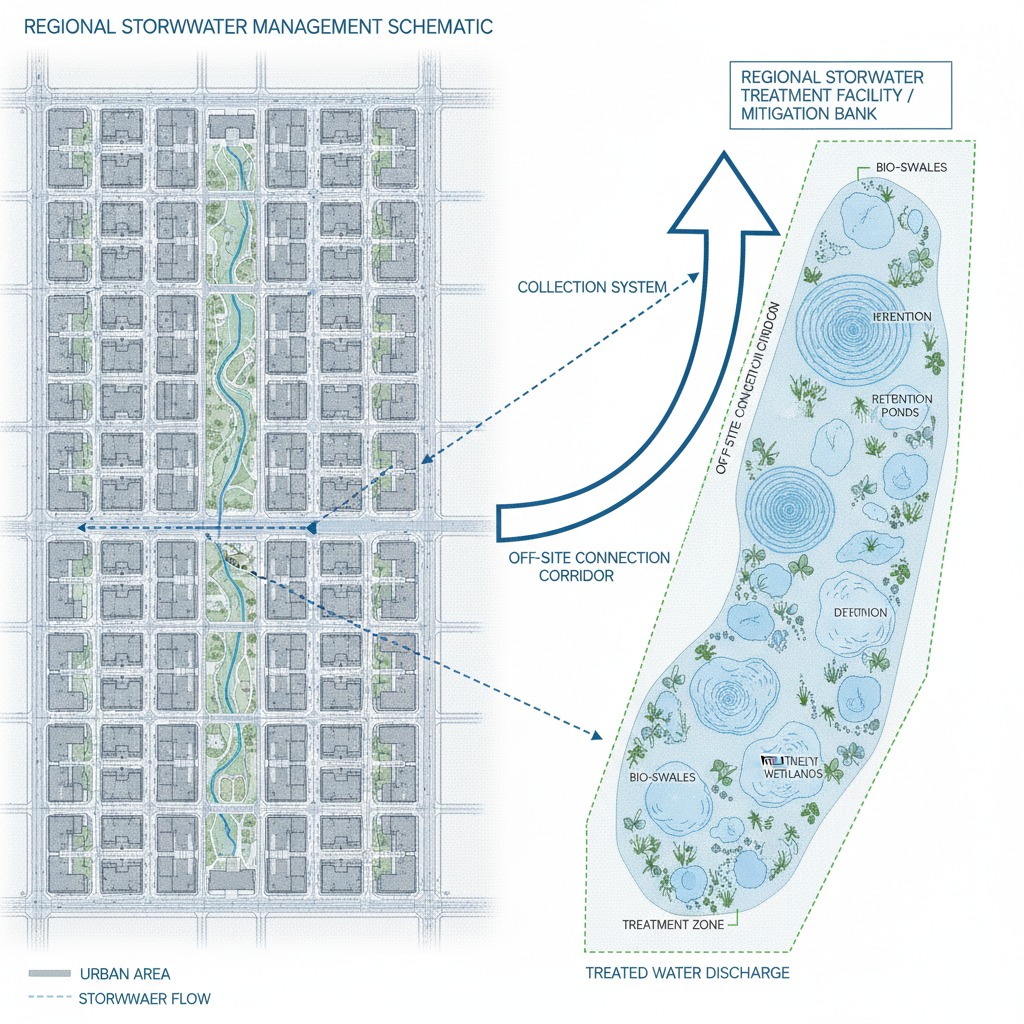
At its core, a stormwater credit is a quantifiable and tradable unit representing a specific amount of stormwater treatment capacity. These credits are generated by large, off-site regional stormwater treatment facilities or mitigation banks that have been permitted and constructed to exceed their own regulatory requirements. Developers can purchase these credits to satisfy the water quality treatment and, in some cases, water quantity requirements for their own projects. This system allows a project that cannot efficiently manage stormwater on-site to contribute to a larger, more efficient regional solution. The primary purpose of this system is to address nutrient loading—specifically the reduction of pollutants like nitrogen and phosphorus—in regional watersheds. By consolidating treatment into professionally managed off-site facilities, the overall ecological benefit can be greater than that of numerous small, isolated on-site systems. This approach is heavily regulated by agencies like the South Florida Water Management District (SFWMD) to ensure that the off-site mitigation provides a tangible and equivalent environmental benefit for the impacts of the new development.
The Regulatory Framework: SFWMD and Local Ordinances
On-Site vs. Off-Site Stormwater Compliance Comparison
| Feature | On-Site Treatment (e.g., Retention Pond) | Off-Site Stormwater Credits |
|---|---|---|
| Land Use Impact | Requires significant land area, reducing the developable footprint of the site. | Preserves maximum developable area, allowing for higher density or more green space. |
| Long-Term Maintenance | Requires ongoing maintenance (mowing, sediment removal, structural repairs) by the property owner or HOA. | No direct long-term maintenance burden for the developer; handled by the off-site facility operator. |
| Permitting Complexity | Involves detailed hydraulic and hydrologic modeling, geotechnical analysis, and bespoke design review by agencies. | Streamlines the stormwater portion of the ERP application by using a pre-approved mitigation solution. |
| Initial Capital Cost | Includes costs for excavation, earthwork, structures, landscaping, and the opportunity cost of the land itself. | Involves a direct, one-time capital outlay for the purchase of credits. Can be higher or lower than on-site costs depending on land values. |
| Design Flexibility | Can be restrictive, dictating site layout and grading. May create aesthetic or safety challenges. | Offers complete flexibility in site layout, as the stormwater solution is decoupled from the project's physical design. |
| Regulatory Risk | Risk of design-related review comments (RAIs) or long-term performance failure. | Lower risk during permitting review, as the treatment methodology is already vetted and approved by the WMD. |
The use of stormwater credits in South Florida is governed primarily by the state’s Water Management Districts (WMDs), with the South Florida Water Management District (SFWMD) being the principal authority in the region. The entire process is integrated into the Environmental Resource Permit (ERP) application, which is the comprehensive permit required for most land development activities. The SFWMD sets the standards for how treatment requirements are calculated, how credits are valued, and which off-site facilities are approved to sell them. Beyond the SFWMD, developers must also navigate local ordinances. Municipalities and counties, such as Miami-Dade or Broward, may have their own specific stormwater criteria, master plans, or special overlay districts that can influence or even restrict the use of off-site mitigation. A thorough zoning compliance review is necessary to confirm that purchasing credits is an acceptable strategy. The coordination between the WMD and the local stormwater utility is a critical step in the permit submittals process, ensuring all regulatory bodies are in agreement with the proposed strategy.
When Are Stormwater Credits a Viable Option?
Stormwater credits are not a universal solution, but they are an invaluable tool in specific scenarios. The most common driver is significant site constraints, where the physical space for a conventional retention or detention pond is unavailable or would render the project financially unviable. This is particularly true for ultra-urban infill projects, redevelopment of sites with high percentages of existing impervious area, or properties with challenging subsurface conditions like a high water table or poor soil infiltration rates confirmed by Geotechnical Engineering analysis. Another key scenario is when a project’s economics hinge on maximizing the developable area. The land that would have been allocated for an on-site retention pond can instead be used for additional residential units, commercial space, or parking, often generating a return on investment that far exceeds the cost of the credits. A civil engineering firm can perform a detailed feasibility study to compare the cost of land and construction for an on-site system versus the all-in cost of purchasing credits, providing a clear financial basis for the decision.
The Mechanics of Purchasing and Applying Credits
The process of utilizing stormwater credits is methodical and integrated directly into the site development and permitting timeline. First, a Professional Engineer performs detailed stormwater modeling to precisely calculate the project’s required water quality treatment volume and/or pollutant load reduction based on SFWMD criteria. This calculation determines the exact number and type of credits the project must acquire to achieve compliance. Once the requirement is quantified, the project team identifies an approved mitigation bank or regional treatment facility that operates within the same drainage basin as the project. A credit purchase agreement is executed, and proof of this transaction becomes a core component of the ERP application package. During the agency review process, regulators verify the calculations, the validity of the credits, and the standing of the provider. A properly documented credit purchase can streamline the review process, as it demonstrates a clear and pre-approved method of meeting environmental standards, leading to a more predictable permit approval timeline.
Types of Stormwater Credits: Water Quality vs. Water Quantity
It is crucial to distinguish between the two primary categories of stormwater credits. Water quality credits are the most common type used in South Florida and are designed to offset a project’s impact on pollutant levels in receiving water bodies. These credits are typically measured in pounds of phosphorus or nitrogen removed per year. They are the go-to solution for projects that need to meet nutrient load reduction targets but lack the space for on-site treatment systems like wet detention ponds or baffle boxes. Conversely, water quantity credits address flood control by offsetting increases in the volume and peak discharge rate of stormwater runoff. These are less common, as most jurisdictions still require projects to manage post-development runoff rates on-site to prevent localized flooding. However, in certain regional contexts or for specific types of redevelopment, quantity credits may be an option. The drainage design for a project must clearly specify which type of credit is being used to satisfy the specific requirements outlined in the ERP application.
Financial and Project Timeline Implications
A thorough cost-benefit analysis is fundamental when considering stormwater credits. The upfront cost of purchasing credits can be substantial, but it must be weighed against the significant expense of land acquisition, construction, and long-term maintenance of an on-site stormwater pond. By eliminating the need for a pond, a project can significantly increase its developable area, which is often the most valuable asset, especially in high-demand urban markets. This can dramatically improve overall project feasibility and financial returns. From a timeline perspective, using credits can sometimes expedite the permitting process. It simplifies the engineering design and removes a complex component—the stormwater management system—from the detailed review. Regulators are often familiar with the performance of approved regional facilities, which can lead to fewer technical questions or Requests for Additional Information (RAIs) related to the drainage design. This predictability can be a major advantage in a competitive development landscape.
RSP Engineers’ Approach to Stormwater Credit Strategy
At RSP Engineers, we treat the decision to use stormwater credits as a strategic component of the overall site development plan. Our process begins with an in-depth feasibility study, where we analyze the project’s goals against the site’s physical and regulatory constraints. We perform detailed stormwater modeling to accurately quantify the project’s treatment requirements, ensuring our clients only purchase the necessary number of credits. Our team conducts thorough due diligence to identify and vet approved credit providers within the correct drainage basin, negotiating the best possible terms. We then prepare a comprehensive financial analysis comparing the total lifecycle cost of an on-site system with the cost of off-site credits. This data-driven approach empowers our clients to make an informed decision. Finally, we meticulously prepare all permit submittals, including the credit purchase documentation, to ensure a smooth and efficient agency review process.
Common Pitfalls in Using Stormwater Credits
While beneficial, navigating the stormwater credit market has potential pitfalls. A primary issue is drainage basin restrictions; credits must typically be purchased from a facility within the same basin as the development to ensure the environmental benefit is localized. The availability and pricing of credits can also fluctuate based on market demand, potentially impacting project budgets if not secured early in the planning process. Another common problem is incomplete documentation, which can trigger a Request for Additional Information (RAI) from the reviewing agency and cause significant delays. Developers must also be wary of local regulations that may supersede WMD rules. Some municipalities have specific requirements that limit or even prohibit off-site mitigation for certain types of projects. Proper due diligence and a clear understanding of both state and local zoning compliance are essential to avoid these costly mistakes. Frequently Asked Questions Can any project in South Florida use stormwater credits? Not necessarily. The viability depends on the project’s location within an approved drainage basin, the availability of credits from a permitted facility, and local municipal ordinances. Some jurisdictions may require a certain percentage of stormwater management to be handled on-site regardless of credit availability. How is the number of required credits calculated? The calculation is based on a detailed stormwater modeling analysis performed by a Professional Engineer. It considers the project’s total impervious area, land use type, and the specific pollutant reduction targets (e.g., for phosphorus or nitrogen) set by the SFWMD for that particular watershed. Are stormwater credits the same as wetland mitigation credits? No, they are distinct. Stormwater credits address water quality and/or quantity from runoff, while wetland mitigation credits are used to offset the direct physical impact or destruction of jurisdictional wetlands. While both are market-based environmental compliance tools, they address different regulations and ecological impacts and are not interchangeable. What happens if I can’t find a credit provider in my project’s basin? If there are no approved credit providers within the required drainage basin, you will likely be required to meet all stormwater management requirements with an on-site system. This highlights the importance of early-stage due diligence during the property acquisition or site planning phase. Does using credits eliminate all on-site stormwater infrastructure? Typically, no. While credits can satisfy the main water quality treatment requirement, a project will still need an on-site conveyance system (pipes, inlets, swales) to collect and direct runoff to the municipal storm sewer system. Basic pre-treatment or flow control structures may also be required by local code before discharge. How do I verify a credit provider is approved by the SFWMD? The SFWMD maintains a list of permitted and approved regional stormwater treatment facilities and mitigation banks. Your civil engineering consultant should verify the provider’s status and ensure the credits are valid for your specific project location and impact type as part of their standard due diligence process.
Your Partner for Strategic Stormwater Solutions
Navigating South Florida’s complex stormwater management regulations requires expert guidance. The team at RSP Engineers provides comprehensive civil engineering services, from initial site development feasibility and financial analysis to final permit approval. We help developers evaluate all compliance options, including the strategic use of stormwater credits, to maximize project value and ensure a smooth path through the regulatory process. Contact us today to discuss your project’s stormwater strategy.
Conclusion
Stormwater credits represent a critical and sophisticated tool for modern land development in South Florida. For the right projects, they offer a powerful alternative to traditional on-site ponds, unlocking site potential and providing economic advantages. However, their successful implementation hinges on a deep understanding of the regulatory framework, careful financial analysis, and meticulous documentation. Partnering with an experienced civil engineering firm is essential to navigate the complexities of permitting and ensure this innovative solution is applied effectively and correctly.
FAQs
-
How Stormwater Credits Work for South Florida Land Development requires careful planning, qualified engineering, and compliance with the applicable codes and permits.
-
Getting How Stormwater Credits Work for South Florida Land Development right protects safety, supports regulatory compliance, and avoids costly redesigns or delays.
-
RSP Engineers provides licensed expertise and end-to-end support for How Stormwater Credits Work for South Florida Land Development, from early planning through permitting.