
Designing for Resilience: A Civil Engineer’s Guide to Florida’s Coastal Zones
A guide to the civil engineering strategies for designing resilient coastal developments in Florida. Explore stormwater management, permitting, and structural considerations.
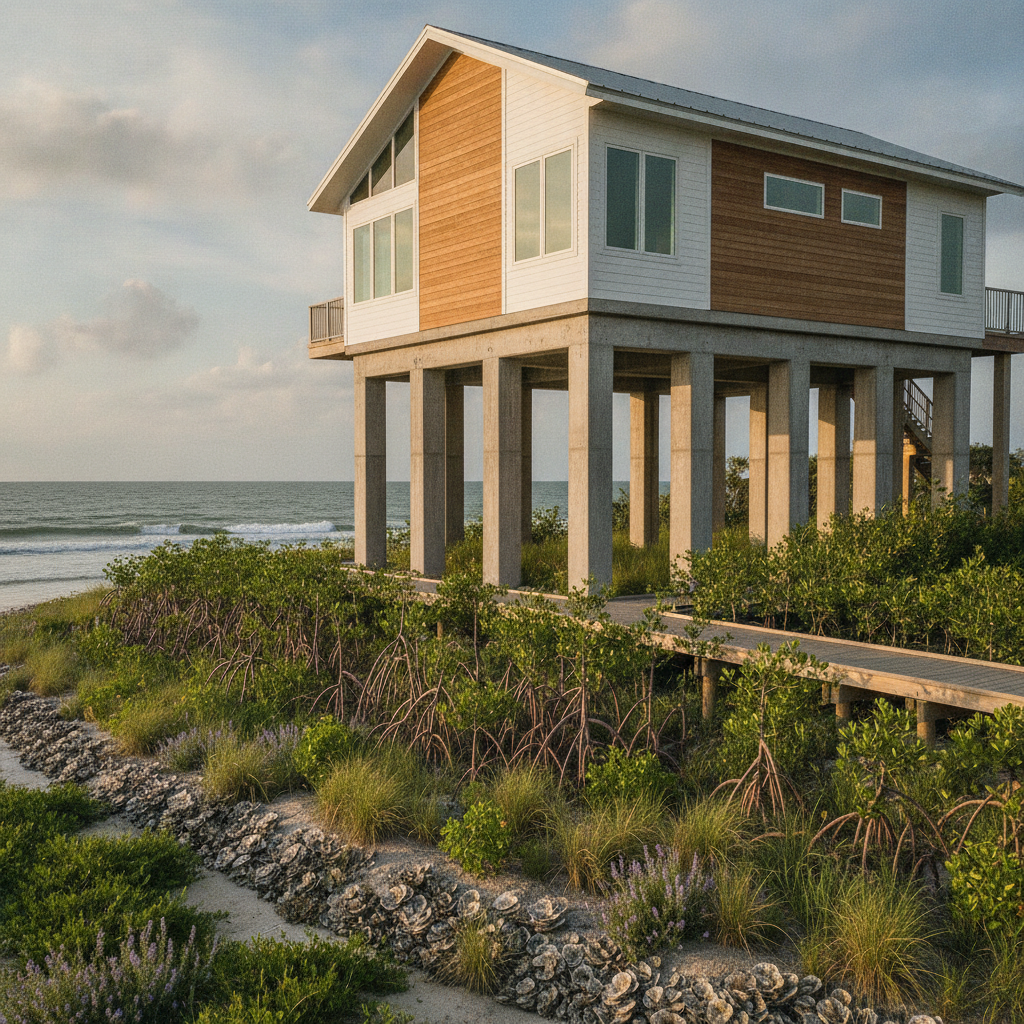
Understanding Coastal Construction Control Lines (CCCL) and Permitting
One of the most significant regulatory hurdles in Florida coastal development is the Coastal Construction Control Line (CCCL). Established by the Florida Department of Environmental Protection (FDEP), the CCCL defines the portion of the beach-dune system that is subject to the most severe wave action and erosion during a 100-year storm. Any construction seaward of this line requires a highly specialized CCCL permit, which involves a rigorous review process focused on minimizing adverse impacts on the coastal system and ensuring structural integrity. The permitting process for CCCL is far more intensive than typical land use permits. It requires detailed structural calculations, erosion-impact studies, and a comprehensive site development plan that demonstrates the project will not cause public or private harm. Our role as Civil Engineers is to navigate this complex regulatory landscape, preparing meticulous permit submittals that include everything from detailed topographic and bathymetric surveys to turtle-nesting protection plans. Successfully securing a CCCL permit is a critical first step that dictates much of the subsequent design and construction strategy.
FEMA Flood Zone Compliance and Base Flood Elevation (BFE)
Coastal Armoring Technique Comparison
| Technique | Primary Function | Key Design Consideration | Permitting Complexity |
|---|---|---|---|
| Vertical Seawalls | Hard barrier to prevent erosion and flooding | Foundation depth (scour protection), material strength, drainage behind the wall | High (Requires extensive engineering and environmental impact analysis) |
| Revetments | Absorb and dissipate wave energy with sloped, armored surface | Armor stone size and placement, filter fabric to prevent soil loss, slope stability | High (Similar to seawalls, often requires CCCL permit) |
| Living Shorelines | Stabilize shoreline, reduce wave energy, and create habitat | Plant species selection, tidal elevation, wave climate, use of biodegradable materials | Moderate to High (Often favored by agencies but requires ecological expertise) |
| Offshore Breakwaters | Reduce wave energy before it reaches the shore | Crest elevation, gap spacing, potential impacts on sediment transport | Very High (Major projects requiring extensive modeling and agency review) |
| Beach Nourishment | Widen the beach to provide a sacrificial buffer against erosion | Sand source compatibility, placement profile, long-term renourishment schedule | Very High (Typically large-scale public projects with complex funding and permits) |
Parallel to state regulations, federal flood zone requirements from the Federal Emergency Management Agency (FEMA) are paramount. Coastal areas are typically designated as Zone VE (Velocity Zone) or Coastal AE, which carry the highest risk of damage from storm surge and wave action. The Florida Building Code incorporates these standards, mandating that structures be designed to withstand these forces. A key requirement is elevating the lowest horizontal structural member above the Base Flood Elevation (BFE), often with an additional margin of safety known as ‘freeboard’ required by local ordinances. In Zone VE, foundation design is critical. Structures must be elevated on piles or columns, and any enclosure below the BFE must be built with non-supporting, breakaway walls that can fail under wave loads without compromising the elevated building. This requires careful coordination between the civil engineering design for the site and the structural engineer’s design for the building. Proper certification of the finished floor elevation (FFE) through an Elevation Certificate is a non-negotiable step for obtaining a Certificate of Occupancy and flood insurance.
Advanced Stormwater Management for Coastal Environments
Conventional stormwater management techniques often fall short in coastal settings. The high groundwater table, sandy soils, and proximity to saltwater bodies necessitate a more sophisticated approach to drainage design. The primary goal is to manage stormwater onsite to prevent runoff pollution and localized flooding, but the methods must be adapted for the environment. For instance, traditional retention or detention ponds may be infeasible due to the limited vertical separation from the water table. Instead, resilient coastal design often employs low-impact development (LID) strategies. These can include exfiltration trench systems, pervious pavement, and vegetated swales designed with salt-tolerant native plants. These systems promote infiltration and water treatment while being more adaptable to fluctuating groundwater levels. The permitting process through Florida’s Water Management Districts (WMDs) requires detailed hydraulic and hydrologic modeling to prove that the post-development runoff will not adversely impact adjacent properties or sensitive coastal waters.
Utility Coordination and Infrastructure Hardening
Public and private utilities are the lifelines of any development, and in coastal zones, they are exceptionally vulnerable. Storm surge can inundate electrical transformers, saltwater can infiltrate sewer systems, and erosion can expose and break water mains. A resilient site plan design must include a robust strategy for infrastructure hardening. This involves close utility coordination with power, water, sewer, and communications providers from the earliest stages of design. Key strategies include elevating critical electrical equipment above the BFE, specifying waterproof conduits and sealed access points for underground utilities, and using corrosion-resistant materials for all components. For sanitary sewer systems, preventing inflow and infiltration (I&I) of saltwater is crucial to protect the wastewater treatment plant. This level of detailed planning ensures that essential services can be maintained during and quickly restored after a storm event, a critical component of community resilience and a focus of our site engineering services.
Material Selection and Corrosion Resistance
The coastal environment is relentlessly corrosive. The combination of salt spray, high humidity, and intense sun degrades building materials at an accelerated rate. Specifying the right materials is a fundamental aspect of resilient design that falls under the purview of both the structural and civil engineering teams. Failure to do so can lead to premature structural failure and soaring maintenance costs. For site infrastructure, this means using materials like fiberglass-reinforced polymer (FRP) or stainless steel for utility hardware, specifying hot-dip galvanized or stainless steel fasteners, and using concrete mixes designed for marine environments. During construction administration, we meticulously verify that the materials supplied and installed on-site match these stringent specifications. This focus on material science is essential for ensuring the long-term durability and safety of coastal projects.
Living Shorelines and Nature-Based Solutions
While traditional ‘hard’ armoring like seawalls and revetments has its place, there is a growing emphasis on nature-based solutions for shoreline stabilization. Living shorelines use strategic plantings of native vegetation like mangroves and salt marsh grasses, often combined with oyster reefs or other natural elements, to create a resilient edge that absorbs wave energy, reduces erosion, and provides valuable ecological habitat. These solutions are a key part of modern, sustainable site development. From a civil engineering perspective, designing a living shoreline requires a deep understanding of coastal processes, hydrology, and ecology. It involves analyzing wave energy, tidal ranges, and sediment transport to create a stable, self-sustaining system. While the permitting process can be complex, agencies like the FDEP and the U.S. Army Corps of Engineers often favor these approaches for their environmental benefits. A well-designed living shoreline can be a cost-effective and highly resilient alternative to a concrete wall.
Our Approach to Resilient Coastal Design
At RSP Engineers, our process for coastal projects is built on a foundation of thorough due diligence and proactive design. We begin with a comprehensive site assessment to identify all regulatory constraints, including FEMA flood zones, CCCL jurisdiction, and local zoning overlays. This informs our integrated site plan design, where we strategically balance development goals with the absolute requirements for resilience. Our team excels at navigating the multi-agency agency review process, preparing detailed and defensible permit submittals for the FDEP, WMDs, and local municipalities. We coordinate closely with structural engineers, architects, and environmental consultants to ensure a cohesive design. During construction, our Construction Management Services provide critical oversight, ensuring that every element—from the foundation piles to the stormwater management system—is built exactly to the resilient specifications required for Florida’s coast.
Common Pitfalls in Coastal Site Development
Even experienced developers can encounter significant setbacks in coastal projects. A common mistake is underestimating the timeline and technical detail required for CCCL permitting, which can delay a project for months or even years. Another pitfall is a failure to adequately plan for future conditions, such as designing a drainage design based only on current rainfall data without accounting for projected sea-level rise. Value engineering, while important, can also be a source of risk if it compromises long-term resilience. Opting for less corrosion-resistant materials or reducing foundation embedment depth to save on initial costs can lead to catastrophic failures and expensive repairs down the line. Finally, insufficient utility coordination can result in vulnerable infrastructure that fails during the first major storm, undermining the resilience of the entire project.
Partner with Florida’s Coastal Engineering Experts
Successfully developing in Florida’s coastal zones requires more than just a standard engineering approach. It demands a deep understanding of coastal processes, a mastery of complex regulations, and a forward-thinking commitment to resilience. The team at RSP Engineers provides the expert guidance needed to navigate these challenges. From initial feasibility studies and coastal permitting to resilient stormwater management and comprehensive site development, we are your partners in building a durable and valuable coastal asset. Contact us today to discuss your project’s unique requirements.
Building a Resilient Future for Florida’s Coastline
In conclusion, designing for resilience in Florida’s coastal zones is a multi-faceted discipline that integrates structural robustness, environmental stewardship, and regulatory expertise. The principles of elevating structures, hardening infrastructure, and implementing advanced stormwater management are no longer best practices—they are the standard for responsible development. By prioritizing a comprehensive site plan design and navigating the permitting process with experienced professionals, developers can create projects that not only withstand the forces of nature but also contribute positively to Florida’s coastal communities for generations to come. This is the core mission of our civil engineering firm near me.
FAQs
-
Both are high-risk flood zones, but the VE Zone (Velocity Zone) is the most hazardous coastal area, with an anticipated wave height of 3 feet or more during the base flood. It requires a more stringent foundation design, typically deep piles or columns and breakaway walls. The AE Zone has a risk of inundation from rising water but with smaller wave action, allowing for a wider range of compliant foundation types, such as solid foundation walls with flood vents.
-
The CCCL imposes significant restrictions on your site plan design. It dictates the location, size, and type of structures you can build. Any construction seaward of the line requires a special permit from the FDEP and must be designed by a Professional Engineer to withstand a 100-year storm, minimize erosion, and protect native vegetation and wildlife, such as sea turtles.
-
Yes, in many situations, they are a highly effective and often preferred alternative. Living shorelines are best suited for lower-energy environments like bays, estuaries, and canals. They may not be appropriate for high-energy, open-ocean coastlines. The feasibility depends on a site-specific analysis of wave energy, water depth, and other environmental factors, which is a key part of our civil engineering assessment.