
Data Center Water Service Design: Capacity, Reliability, and Redundancy
A guide to designing reliable and redundant water services for data centers in Florida. Learn about capacity planning, utility coordination, and permitting with RSP Engineers.
Defining Water Demand: Beyond Domestic Use
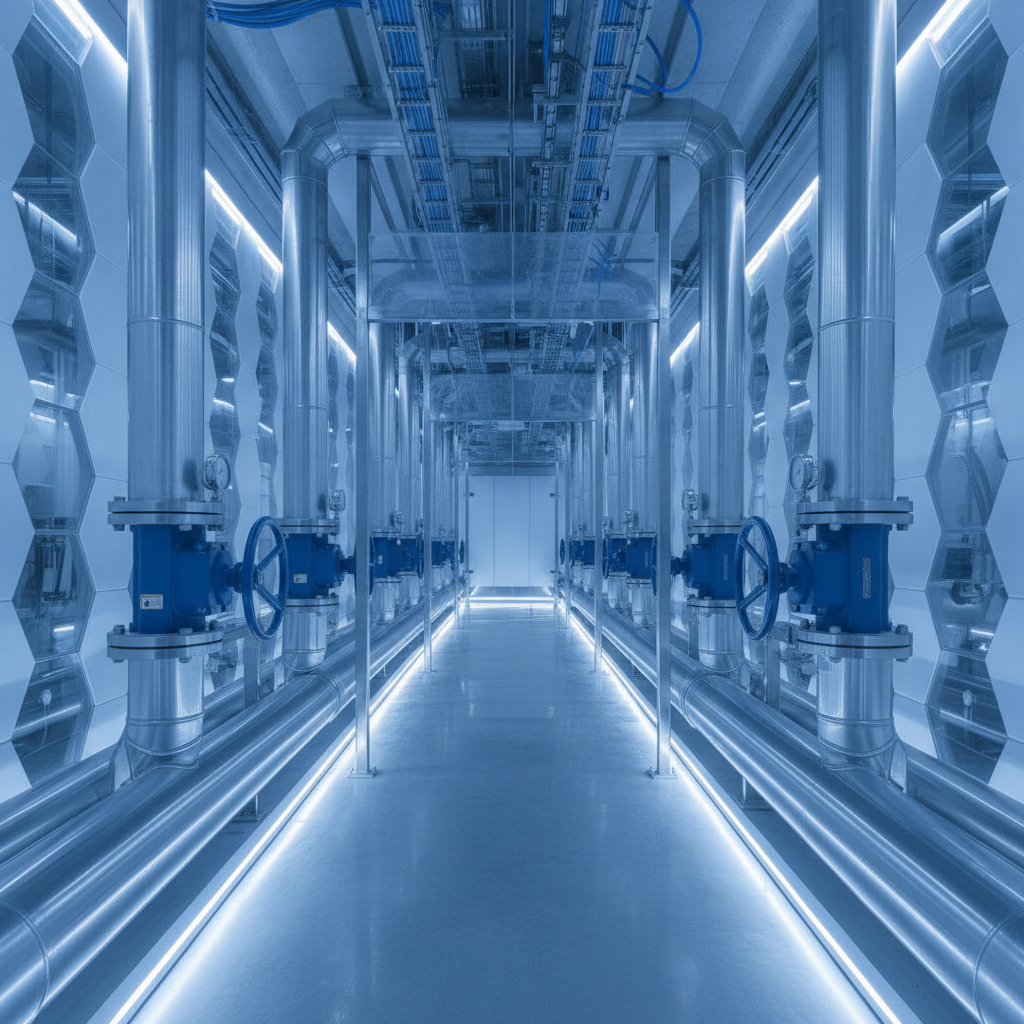
A data center’s water demand is driven by two primary, high-volume needs: cooling and fire protection. Unlike a typical commercial building, domestic water use for restrooms and sinks is a negligible fraction of the total demand. The core of the design process begins with accurately calculating the peak demand for these critical systems. This involves close collaboration with mechanical and fire protection engineers to establish the required flow rates and pressures. For cooling, the primary consumer is the cooling tower makeup water, which replaces water lost to evaporation, drift, and blowdown in evaporative cooling systems. This demand is continuous during operation and can be substantial, often measured in hundreds of gallons per minute for large facilities. For fire protection, the design must satisfy the most demanding scenario dictated by NFPA 13 and the Florida Building Code. This typically involves calculating the flow required for the fire sprinkler system plus a hose stream allowance, which can demand thousands of gallons per minute for a sustained duration. The civil engineering design must ensure the water service can meet this instantaneous peak demand without a critical drop in pressure.
The Critical Role of Utility Coordination and Capacity Analysis
Water Service Redundancy Strategy Comparison
| Strategy | Key Components | Reliability Level | Typical Use Case |
|---|---|---|---|
| Single Utility Feed (N) | One connection to a municipal water main; single backflow preventer. | Low | Tier I data centers or facilities where some downtime is tolerable. Not common for modern data centers. |
| Single Feed with On-Site Storage (N + Storage) | One utility feed plus on-site tanks for fire and/or cooling water. | Moderate | Locations where a second utility feed is not available. Provides autonomy during utility outages. |
| Dual Utility Feeds (N+1 or 2N) | Two independent connections to the municipal grid, ideally from different mains. | High | Tier III and IV data centers. Protects against a single municipal main break or shutdown. |
| Dual Feeds with On-Site Storage (2N + Storage) | Two utility feeds plus on-site storage tanks. | Very High | The highest level of reliability. Protects against both single-source failure and widespread grid outages. |
| Closed-Loop System with On-Site Well | On-site wells, treatment system, and storage tanks. Completely independent of municipal supply. | Exceptional (if designed correctly) | Remote locations or facilities requiring total utility independence. Involves extensive environmental permitting. |
Engaging the local utility provider is one of the first and most critical steps in the site development process. You cannot assume the adjacent municipal water main has adequate capacity. We initiate a formal inquiry to obtain a ‘will-serve’ letter and, more importantly, a detailed capacity analysis. This often involves requesting the municipality to perform hydraulic modeling of their system to confirm that the data center’s projected demand will not negatively impact the surrounding network. In many cases, we conduct our own independent flow and pressure tests on nearby fire hydrants to verify the utility’s data. This early utility coordination is essential for identifying potential off-site improvements that may be required, such as the upsizing of existing mains or the extension of new lines to the project site. Discovering these requirements late in the design process can lead to significant project delays and budget overruns. Securing a firm capacity reservation from the utility is a key milestone that allows the detailed design to proceed with confidence. This process is a core competency of experienced Civil Engineering Firms like ours.
Designing for Redundancy: N+1, 2N, and Beyond
For mission-critical facilities, a single point of failure is unacceptable. This principle applies directly to the water service. The level of redundancy is typically dictated by the data center’s desired uptime tier. A common approach is to provide dual water feeds to the site. Ideally, these feeds tap into two different municipal water mains, preferably on different loops of the provider’s grid, to protect against a single main break or shutdown for maintenance. This creates an N+1 or 2N level of redundancy, ensuring a continuous supply if one source is compromised. When dual municipal feeds are not feasible, redundancy must be created on-site. This is often achieved with a combination of a single utility feed and large on-site water storage tanks. These tanks can be sized to provide hours or even days of cooling tower makeup water and the full volume required for fire suppression. The design of these systems includes redundant pumps, emergency power connections, and sophisticated controls to ensure a seamless switchover in an emergency. The goal is to isolate the facility’s critical operations from any single failure in the public utility infrastructure.
Navigating Florida’s Permitting Landscape for Water Services
Securing the necessary permits for a data center water service in Florida involves multiple agencies and a detailed permit submittal package. The primary approvals typically come from the local utility provider, the county or city public works department, and the Florida Department of Environmental Protection (FDEP) for aspects like backflow prevention. Each agency has its own set of standards, specifications, and review timelines that must be carefully managed. A critical component of the permitting process is the design of the backflow prevention assembly. Given the critical nature of data centers, regulators are extremely focused on protecting the public water supply from any potential contamination. This often requires the installation of a reduced pressure zone (RPZ) backflow preventer, which has specific installation and testing requirements. Furthermore, if any on-site activities impact wetlands or other environmental resources, permits from the local Water Management District may also be necessary, adding another layer to the regulatory process.
On-Site Storage Solutions: Tanks, Pumps, and Controls
When on-site storage is part of the redundancy strategy, its design is a significant civil engineering task. The most common solution is the use of large, ground-level steel or concrete tanks. Sizing these tanks requires careful calculation. The fire protection water storage volume is dictated by NFPA standards and is a fixed, reserved capacity. The cooling makeup water volume is sized based on the client’s operational requirements for autonomy during a utility outage, which could range from 8 to 72 hours or more. These tanks are almost always paired with a dedicated pump house containing a set of booster pump systems. For fire protection, a fire pump is used to deliver water at the high pressure required by the sprinkler system. For cooling makeup, a smaller set of domestic booster pumps, often in a duplex or triplex configuration for redundancy, maintains pressure to the cooling towers. The entire system must be integrated with the building management system (BMS) and have reliable backup power to be effective during an emergency.
Integrating Water Design with Overall Site Development
The water service design cannot be done in a vacuum; it is an integral part of the overall site development plan. The routing of dual water feeds requires careful planning of utility easements and corridors to ensure proper separation from other utilities like power, gas, and fiber. Physical separation is crucial to prevent a single excavation accident from compromising both redundant lines. The location of fire hydrants, post-indicator valves (PIVs), and backflow preventers must be coordinated with site access, roadway engineering, and landscaping. Furthermore, the water system must integrate with the site’s drainage design. For example, the discharge from fire pump testing or cooling tower blowdown must be directed to an appropriate location in the stormwater management system, and may require pre-treatment depending on local regulations. This holistic approach ensures that all site systems work in harmony and that the design is efficient, compliant, and constructible.
RSP Engineers’ Approach to Data Center Water Design
At RSP Engineers, we follow a structured, proactive process to ensure our data center clients receive a water service design that meets their exact uptime and reliability requirements. Our approach is phased to mitigate risk and provide clarity at every stage. Feasibility & Due Diligence: We begin with a thorough investigation of the available utility infrastructure. This includes initial talks with providers, reviewing utility maps, and conducting a preliminary capacity analysis to identify any major constraints before the site is even acquired. Conceptual Design & Redundancy Planning: Working closely with the client and their operations team, we define the required level of redundancy. We model different scenarios—dual feeds, on-site storage, or a hybrid approach—and provide a cost-benefit analysis for each to inform the final design direction. Detailed Civil Engineering Design & Permitting: Our team of Florida Licensed Engineers develops a full set of construction documents, including detailed hydraulic calculations, pipe sizing, and site utility plans. We manage the entire permitting process, from the initial application to final agency approval. Construction Administration & Commissioning Support: We provide robust Construction Management Services during the build phase. This includes reviewing contractor submittals, observing critical installations, and witnessing pressure tests, flushing, and disinfection procedures to ensure the system is built to specification and ready for commissioning.
Common Challenges in Data Center Water Service Projects
Even with careful planning, data center projects can encounter challenges. Being aware of these common issues is the first step in mitigating them: Insufficient Municipal Capacity: A utility provider’s initial ‘will-serve’ letter may not guarantee capacity. Discovering during detailed design that off-site upgrades are needed can cause major delays. Unforeseen Utility Conflicts: In dense urban areas, existing underground utilities may not be accurately mapped, leading to costly and time-consuming relocations during construction. Permitting Delays: The agency review process can be slow, especially if the project is complex or requires variances. Incomplete submittals or slow responses to comments are common causes of delay. Easement Acquisition: Securing off-site easements for new water lines across private property can be a lengthy and unpredictable process. Value Engineering Pitfalls: Pressure to reduce costs can sometimes lead to decisions that compromise long-term reliability, such as removing a redundant line or reducing on-site storage capacity.
Partner with RSP Engineers for Your Mission-Critical Facility
Designing and permitting water infrastructure for data centers in Florida requires specialized expertise and a proactive approach. The stakes are too high for a one-size-fits-all solution. RSP Engineers provides the expert site engineering services needed to navigate these complex projects. Our team has extensive experience in utility coordination, navigating complex permitting with Florida agencies, and designing robust, reliable site development plans that protect your critical investment. We ensure your facility has the foundational infrastructure it needs to achieve its uptime goals.
Conclusion: Securing Water is Securing Uptime
In conclusion, the design of a data center’s water service is a complex engineering challenge with zero margin for error. Success depends on early and thorough capacity planning, a well-defined redundancy strategy, and meticulous execution from design through construction. By focusing on robust civil engineering and proactive utility coordination, developers can ensure their facility is equipped with a water system that is as reliable and resilient as the digital infrastructure it supports. Ultimately, a secure water supply is fundamental to securing uptime.
FAQs
-
You should engage a civil engineering firm during the site selection and due diligence phase. Early involvement allows for a thorough assessment of utility availability and potential site constraints, which is critical for determining a site’s viability and can prevent costly mistakes down the line.
-
The most common cause of delays is an incomplete or inaccurate submittal package. This often stems from a lack of familiarity with the specific requirements of the local utility and the FDEP. Thorough utility coordination and a detailed, compliant design package are the best ways to ensure a smooth agency review process.
-
Yes, but it involves a significantly more complex permitting process through the Water Management District and FDEP. It requires hydrogeological studies to prove the well will not adversely affect the aquifer or nearby wells, and a water use permit (WUP) must be obtained. While it offers utility independence, the regulatory hurdles are substantial.