
Data Center Utility Coordination: Best Practices for Successful Projects
A guide to successful data center utility coordination in Florida. Learn best practices for power, water, and fiber from RSP Engineers, a leading civil engineering firm.
The Critical Role of Early Utility Due Diligence
The success or failure of a data center project is often determined before a single shovelful of dirt is moved. Early and thorough utility due diligence is the most critical phase, informing site selection and overall project feasibility. Engaging a civil engineering firm at this stage is paramount. We begin by identifying all relevant utility providers for power, water, wastewater, and telecommunications. The primary goal is to obtain utility capacity letters, which are formal documents from providers confirming their ability to serve the projected demands of the facility. These letters are non-negotiable for securing financing and moving forward with design. This phase goes beyond simple inquiries. It involves detailed load calculations to project the facility’s ultimate power and water consumption, including phased build-outs. We conduct preliminary site investigations to identify existing utility corridors, potential connection points, and any major physical constraints. For example, in Florida, we work closely with power providers like FPL, Duke Energy, and TECO to verify not just capacity, but the feasibility of providing redundant feeds from separate substations, a standard requirement for modern data centers. This initial analysis prevents costly surprises and ensures the selected site can truly support the mission-critical operations planned for it.
Navigating Power Infrastructure: Redundancy and Capacity Planning
Utility Coordination Comparison: Data Center vs. Standard Commercial
| Utility Aspect | Standard Commercial Project (e.g., Warehouse) | Data Center Project |
|---|---|---|
| Power Demand & Redundancy | Single feed from one substation is typical. Demand is predictable and relatively low (e.g., 1-2 MW). | Requires dual (or more) independent feeds from separate substations. Demand is massive and mission-critical (20-100+ MW). |
| Water/Wastewater Volume | Primarily for domestic use (restrooms, breakrooms). Minimal process water needs. | Extremely high demand for cooling tower makeup water. Significant wastewater discharge requiring potential industrial pretreatment permits. |
| Fiber Optic Requirements | Standard business-class fiber from one or two local carriers is sufficient. | Requires multiple, physically diverse dark fiber routes from numerous national carriers to ensure network uptime. |
| Permitting Complexity | Standard local site development and building permits. Utility connections are typically routine. | Involves complex utility agreements, extensive off-site easement acquisition, and heightened scrutiny from environmental and utility agencies. |
| Utility Provider Lead Times | Standard connection timelines, often a few months. Capacity is usually readily available. | Can require 18-36 months or more for major substation upgrades or new transmission lines. Capacity is a major constraint. |
| On-Site Infrastructure Scale | Simple utility stubs to the building. Minimal on-site equipment. | Requires large-scale generator farms, extensive underground duct banks, fuel storage, and dedicated central utility plants. |
Power is the lifeblood of any data center, and its design requires a level of rigor far exceeding standard commercial projects. The core objective is achieving high availability through redundancy, often expressed as N+1, 2N, or 2N+1 configurations. From a civil engineering perspective, this translates into complex on-site and off-site infrastructure. Our role involves coordinating the physical routing of multiple, diverse power feeds to the site. This includes negotiating and securing extensive easement acquisition for new utility corridors, which can be a lengthy and complex process involving multiple landowners and government agencies. The design must also account for the placement of significant on-site electrical equipment, such as primary switchgear, transformer pads, and backup generator farms. The layout of these elements has major implications for the overall site plan design, impacting grading, drainage, and internal circulation. We work hand-in-hand with the project’s MEP (Mechanical, Electrical, and Plumbing) engineers to ensure the civil design accommodates the massive electrical infrastructure. Whether designing underground concrete-encased duct banks for maximum protection or coordinating overhead power line routes, our focus is on creating a resilient and constructible system that meets the stringent uptime requirements of the data center operator.
Water and Wastewater Management for High-Density Cooling
Modern data centers generate an enormous amount of heat, making water for cooling systems a critical utility on par with power. The water demand for a large data center’s cooling towers can be equivalent to that of a small town. Our utility coordination efforts involve verifying that the local municipality can provide the required volume of potable or reclaimed water. This often requires hydraulic modeling of the public water system to ensure that serving the data center will not negatively impact pressure for existing users. A robust utility coordination plan is essential for securing the necessary water use permits. Equally important is managing the wastewater generated from cooling tower blowdown and sanitary systems. This effluent may require an industrial pretreatment permit from the local utility authority, depending on its chemical composition. The civil engineering design must include appropriately sized lift stations, force mains, and gravity sewer lines to handle these flows. Furthermore, the vast impervious surfaces of a data center campus—roofs, parking lots, and equipment pads—necessitate a comprehensive stormwater management system designed to meet Florida’s stringent water quality and quantity regulations, often requiring large retention or detention ponds.
Fiber Optic and Telecommunications Connectivity
A data center is useless without robust, high-speed connectivity. A key planning objective is to ensure the facility has access to multiple, diverse fiber optic routes from different telecommunications carriers. A single point of failure is unacceptable. Our due diligence process involves identifying all available fiber providers near the site and mapping their existing infrastructure. The goal is to design at least two, and often three or more, separate entry points for fiber cables into the facility, originating from different directions to protect against a single event like a road construction accident severing connectivity. This requires extensive right-of-way (ROW) permitting with state and local transportation agencies to install new underground conduits. The site development plan will include a detailed design for on-site duct banks, manholes, and vaults to support this infrastructure. We coordinate directly with telecommunications consultants and carriers to ensure our site engineering services align with their technical requirements, creating a seamless path from the public right-of-way to the data center’s meet-me room. This proactive coordination prevents last-minute design changes and costly construction delays.
Integrating On-Site and Off-Site Utility Design
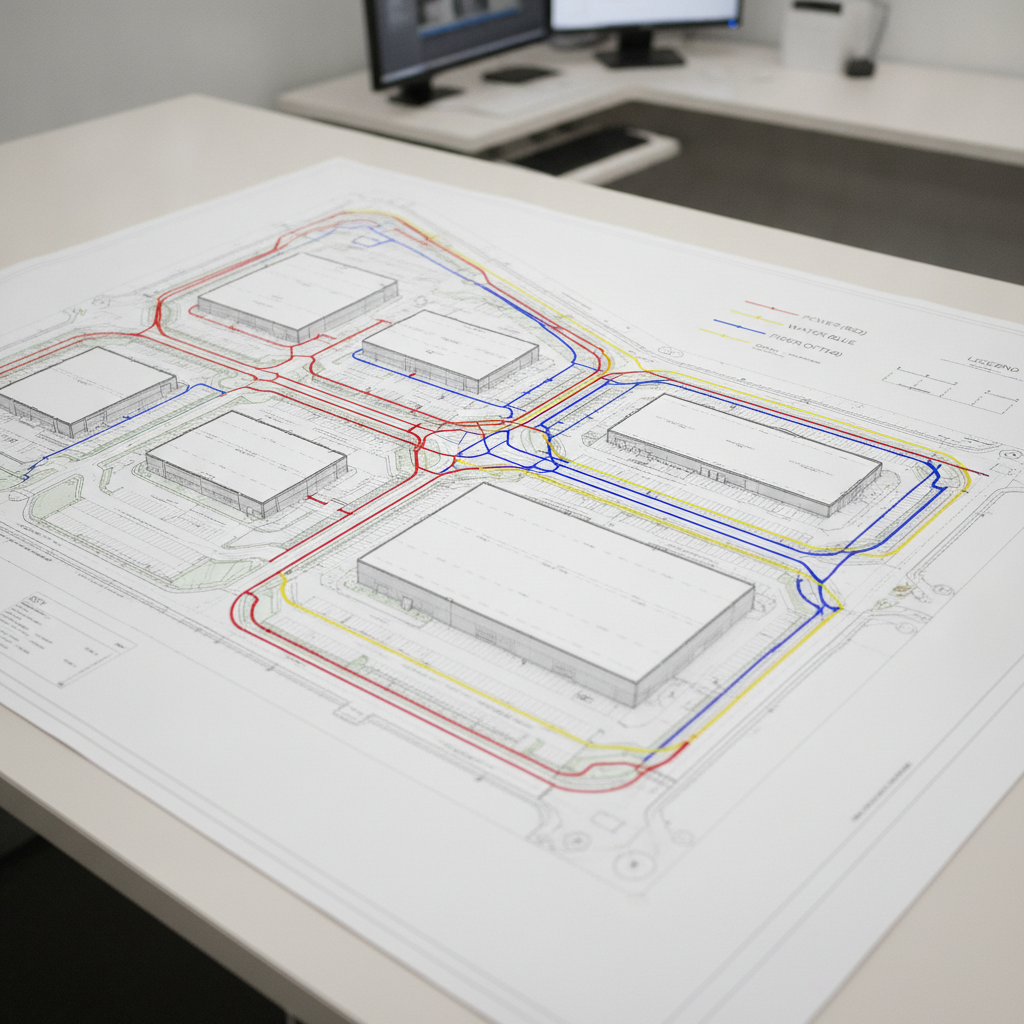
A successful data center project depends on the seamless integration of on-site infrastructure with off-site public utilities. This is a core responsibility of the civil engineering team. The process involves creating a comprehensive utility master plan that accounts for the full build-out of the campus, even if it’s constructed in phases. This plan dictates the location of primary utility corridors, ensuring that future expansions do not conflict with existing infrastructure. It’s a complex puzzle of horizontal and vertical alignments to avoid clashes between power, water, sewer, storm, and fiber optic lines. Coordination extends to numerous agencies. For example, a new force main might need to cross a county road, requiring a permit from the Public Works department. A power duct bank may run along a state highway, necessitating a permit submittal to the Florida Department of Transportation (FDOT). Our team manages these intricate agency review processes, ensuring that all off-site improvements are designed and permitted in parallel with the on-site work. This holistic approach prevents the on-site construction from being completed only to be delayed by pending off-site utility approvals.
The Permitting Labyrinth: Agency Coordination and Timelines
Navigating the permitting process for a data center in Florida is a marathon, not a sprint. The project’s scale and impact trigger reviews from a multitude of local, regional, and state agencies. Beyond standard site plan approvals, data centers require specific and often time-consuming utility-related permits. This includes securing utility agreements with power and water providers, which are legally binding contracts that can take months to negotiate. It also involves environmental permits from Florida’s Water Management Districts (e.g., SFWMD, SWFWMD) for stormwater management and any impacts on wetlands. A critical component of our role as the Professional Engineer of record is developing a realistic and strategic permitting strategy from day one. We identify all required approvals, map out their dependencies, and establish a timeline that accounts for agency review cycles. Long lead times are the norm, especially for major electrical infrastructure upgrades or new water main extensions. Proactive communication and strong relationships with agency staff are essential to keep the process moving. Failing to appreciate the complexity and duration of the permitting process is one of the most common reasons for project delays.
RSP Engineers’ Approach to Data Center Utility Coordination
At RSP Engineers, we employ a phased and systematic approach to manage the complexities of data center utility coordination. Our process is designed to identify risks early and create a clear path to construction, ensuring alignment among the client, utility providers, and design team at every stage. First, during the Feasibility and Due Diligence Phase, we perform a comprehensive utility analysis for potential sites. This includes sourcing capacity letters, identifying major infrastructure constraints, and developing high-level cost estimates for utility upgrades. This provides our clients with the critical data needed to make informed site selection decisions. Next, in the Design and Permitting Phase, we translate the project’s requirements into a fully engineered site plan design. We lead the coordination efforts with all utility providers and manage the preparation and submittal of all necessary permit applications. Our proactive engagement with agency reviewers helps streamline the approval process. Finally, during the Construction Administration Phase, we remain deeply involved, reviewing utility-related shop drawings, responding to contractor RFIs, and providing on-site observation to ensure the infrastructure is installed according to the approved plans and specifications.
Common Pitfalls in Data Center Utility Projects
Even with careful planning, data center projects can encounter significant hurdles. One of the most common pitfalls is underestimating the lead times required by major utility providers, especially for power. A utility company may need two years or more to design, permit, and construct a new substation, a timeline that can severely impact the project schedule if not accounted for from the start. Another frequent issue is inadequate due diligence on fiber optic diversity. Simply having two carriers is not enough; their cables must follow truly diverse physical paths to avoid a single point of failure. Failing to secure necessary off-site easements early in the process can also bring a project to a halt. Easement acquisition can be a protracted negotiation, and construction cannot begin without these legal rights in place. Finally, a lack of seamless coordination between the civil, MEP, and structural engineering teams can lead to design conflicts, such as underground utility clashes or improper grading for large equipment pads. A highly integrated design team, led by an experienced civil engineering firm, is the best defense against these preventable problems.
Partner with RSP Engineers for Your Data Center Project
Successfully delivering a data center in Florida requires a specialized skill set that goes beyond traditional land development. The complexities of high-density power, water, and fiber infrastructure demand an engineering partner with proven experience in mission-critical facilities. RSP Engineers provides the expert utility coordination, strategic permitting, and meticulous site development services necessary to navigate these challenges. Our team of Florida Licensed Engineers understands the unique regulatory and environmental landscape of the state. We act as a central point of contact, managing the intricate web of communication between your team, utility providers, and government agencies. If you are planning a data center project, contact us today to discuss how our site engineering services can help you achieve your goals on time and within budget.
Conclusion: Proactive Coordination is Key to Success
In the world of data center development, utility infrastructure is not an afterthought; it is the foundation of the entire project. The immense requirements for power, cooling, and connectivity necessitate a proactive, integrated, and expert-led approach. From initial due diligence and site selection to final commissioning, successful outcomes are directly tied to the quality of the utility coordination and the foresight of the engineering design. By engaging an experienced civil engineering team early, developers can mitigate risks, avoid costly delays, and ensure their facility is supported by the resilient and redundant systems it requires. Ultimately, a strategic approach to site development and permitting is the most effective way to transform a promising site into a fully operational, mission-critical data center.
FAQs
-
You should engage a civil engineering firm during the site selection process, even before you have a property under contract. Early involvement allows for critical due diligence on utility availability, zoning compliance, and potential site constraints, which can prevent you from investing in a property that is not viable for development.
-
A utility capacity letter is a formal document from a utility provider (power, water, sewer) stating that they have sufficient capacity in their system to serve the proposed project’s demands. It is a critical piece of due diligence that confirms the project is feasible from a utility standpoint and is often required for financing and permitting.
-
Securing off-site easements is a collaborative effort. The developer and their legal team are typically responsible for the negotiation and acquisition. However, the civil engineering team provides the technical support, including preparing the necessary legal descriptions, survey exhibits, and justification for why the easement is needed, which is crucial for the acquisition process.