
Data Center Transmission Line Connections: A Developer’s Guide to Florida’s Civil Engineering Requirements
A guide for data center developers on navigating the civil engineering, permitting, and utility coordination challenges of high-voltage transmission line connections in Florida. Learn about site selec
Early-Stage Site Selection and Power Feasibility Analysis
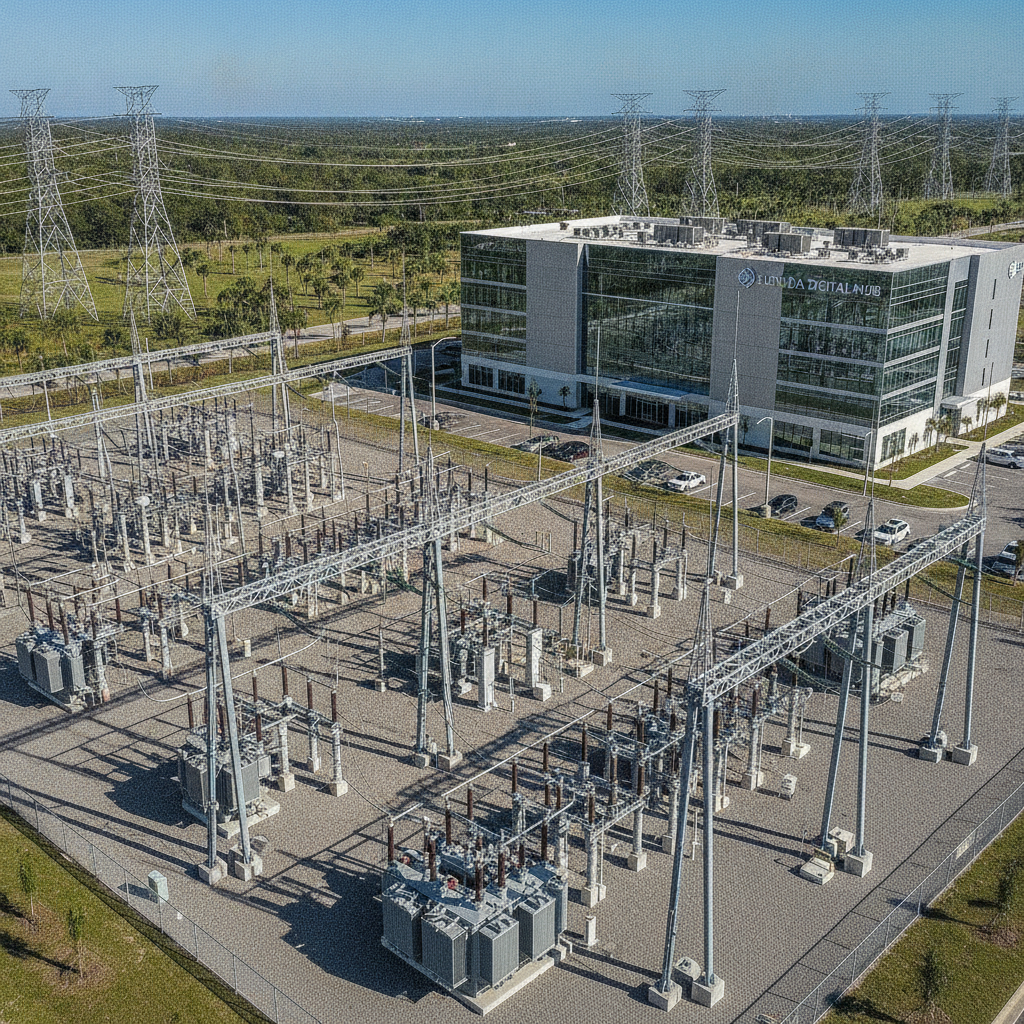
The adage ‘location, location, location’ is paramount for data centers, but the criteria extend far beyond fiber connectivity and tax incentives. Proximity to adequate power infrastructure is the primary driver of site viability. A thorough due diligence process, led by a qualified civil engineering firm, must include a detailed power feasibility analysis. This involves identifying nearby high-voltage transmission lines and, more importantly, assessing the capacity of adjacent substations. A site may be next to a major transmission corridor, but if the local substations are at capacity, the cost and timeline for necessary upgrades can be prohibitive. This early analysis involves direct outreach to the utility provider (e.g., FPL, Duke Energy, TECO) to request a preliminary load letter or feasibility study. This initial assessment provides a high-level overview of the grid’s ability to serve the proposed load. Simultaneously, the civil engineering team must evaluate the physical and regulatory constraints of the potential transmission route. This includes a preliminary review of zoning compliance, existing easements, environmental features like wetlands, and potential crossings of major roadways, all of which heavily influence the project’s budget and schedule.
Navigating Utility Coordination and Interconnection Agreements
Key Permitting Pathways for Transmission Line Corridors
| Permit/Approval | Governing Agency | Key Civil Engineering Deliverables | Typical Review Timeline |
|---|---|---|---|
| Utility Interconnection Agreement | Power Utility (e.g., FPL, Duke) | Load letters, site plans, electrical one-lines, System Impact Study application. | 12-24+ months |
| Environmental Resource Permit (ERP) | Water Management District (WMD) | Stormwater management report, hydrologic modeling, wetland delineation, environmental assessment, mitigation plans. | 6-12 months |
| Local Government Site Plan Approval | City/County Planning & Engineering | Complete civil construction drawings, including grading, drainage, utilities, and erosion control plans. | 4-9 months |
| FDOT Utility Permit | Florida Dept. of Transportation | Utility location exhibits, traffic control plans, detailed crossing profiles, drainage analysis. | 3-6 months |
| Right-of-Way/Easement Platting | County Property Appraiser/Clerk | Boundary surveys, legal descriptions, easement exhibits, subdivision plats (if applicable). | 2-5 months |
Engaging with the power utility is one of the longest lead-time items in a data center development. The formal process begins with submitting an application for an interconnection agreement, which triggers a series of detailed engineering reviews by the utility. The most critical of these is the System Impact Study. This comprehensive analysis determines how the new, massive electrical load will affect the stability and reliability of the existing power grid. The study’s findings dictate the scope of required off-site improvements, which can range from minor equipment upgrades to the construction of entirely new substations and transmission lines, with costs often borne by the developer. Effective utility coordination is an active, persistent process managed by the project’s lead engineer. It requires a dedicated point of contact who understands the utility’s technical requirements, internal processes, and review timelines. The civil engineer acts as the developer’s advocate, translating complex electrical requirements into actionable site plans and ensuring that the on-site infrastructure design aligns perfectly with the utility’s point of connection. Missteps in this phase can lead to significant redesigns and delays in the overall site development schedule.
Easement Acquisition and Right-of-Way Permitting
A new transmission line requires a clear, legally secured path from the utility’s grid to the project site. This path is known as the right-of-way (ROW), and securing it often involves acquiring easements from multiple property owners. Easement acquisition is a complex legal and logistical process that includes title searches, property appraisals, and negotiations with landowners. The civil engineer’s role is to provide the precise legal descriptions and survey exhibits required for these legal agreements, ensuring the corridor is wide enough to accommodate construction, maintenance, and required safety clearances. Once the route is defined, the project must obtain the necessary permits to occupy that ROW. This involves multiple agencies. If the route crosses a state road, an FDOT Utility Permit is required. Crossings of county roads or municipal streets require local permits. The entire process is underpinned by detailed site engineering services that produce surveys, plats, and construction documents. Failure to properly secure the full length of the ROW can halt a project indefinitely, making proactive route planning and permitting strategy essential.
Civil Engineering Design for Transmission Infrastructure
The physical design of the transmission line’s civil components is a core engineering task. This begins with a detailed geotechnical investigation along the proposed route. Soil boring tests are performed at proposed tower and pole locations to determine soil capacity, groundwater levels, and rock profiles. The resulting Geotechnical soil report is the basis for designing the massive concrete foundations required to support the transmission structures against Florida’s high wind loads, as mandated by the Florida Building Code. Beyond foundations, the civil design includes creating graded access roads for construction and maintenance vehicles, which must be designed to handle heavy equipment. A critical component of this work is the associated drainage design. Proper grading and culvert placement are necessary to prevent erosion around the tower foundations and ensure that the new access roads do not impede natural stormwater flow. This work often requires a separate stormwater management plan to address the impacts of the new impervious and compacted surfaces.
Stormwater Management and Environmental Permitting
In Florida, any significant land disturbance, including the clearing of a transmission line corridor, triggers the need for an Environmental Resource Permit (ERP) from the regional Water Management District (WMD). This is one of the most complex and time-consuming permits in the land development process. The application must demonstrate that the project will not cause adverse water quality, flooding, or environmental impacts. This requires a comprehensive stormwater management system designed by a Professional Engineer. For a linear project like a transmission line, the design must account for impacts across multiple drainage basins. Engineers must perform detailed hydrologic and hydraulic modeling to design swales, culverts, and other features that maintain pre-development flow patterns. Furthermore, the ERP process requires a thorough environmental assessment, including wetland delineation and surveys for protected species. If wetlands are impacted, a mitigation plan must be developed and approved, adding significant time and cost to the project’s permitting phase.
Substation Site Development and Civil Requirements
The transmission line terminates at a substation, which steps down the voltage before it enters the data center. The substation pad itself is a significant site development project. The civil engineering scope includes mass grading to create a level and stable pad, often requiring thousands of cubic yards of earthwork. A sophisticated drainage design is essential to manage sheet flow across the large, impervious site and prevent water from pooling around critical equipment. Substations also have unique civil requirements, such as oil containment systems for large transformers, which are designed to capture any potential spills and prevent environmental contamination. The site must be secured with fencing and access control gates. While often unmanned, any associated control buildings must still adhere to certain accessibility standards, requiring consideration of ADA compliance for pathways and entrances. The complete civil package, including utilities, grading, and drainage, is formalized in the site plan design submitted to the local government for approval.
RSP Engineers’ Approach to Data Center Utility Integration
At RSP Engineers, we approach data center power connections with a proactive, integrated strategy. Our process is designed to identify and mitigate risks early, ensuring a predictable path to energization. We begin with a comprehensive due diligence and feasibility phase, providing developers with a clear-eyed view of a site’s power potential and associated costs. We then lead agency review and utility pre-application meetings to establish clear expectations and timelines with all stakeholders. Our integrated design process combines civil engineering, environmental science, and geotechnical analysis to create a cohesive set of construction documents. This ensures that the site plan design, stormwater system, and foundation plans are fully aligned with both regulatory requirements and utility standards. We manage the entire entitlements process, from ERP and local site plan approvals to complex utility agreements. During construction, our Construction Management Services provide oversight to ensure the work is executed according to plan, keeping the project on track for its critical energization date.
Common Pitfalls in Data Center Power Connection Projects
Even with expert planning, data center power projects are fraught with potential issues. One of the most common pitfalls is underestimating the utility’s timeline for the System Impact Study and subsequent infrastructure upgrades; it is often the longest lead item. Another frequent issue is discovering unexpected environmental constraints, such as undiscovered wetlands or protected species habitat within the proposed ROW, which can force costly and time-consuming reroutes. Inadequate geotechnical investigation can lead to foundation redesigns during construction, causing significant delays. Finally, failing to identify existing underground utilities within the proposed corridor can lead to dangerous conflicts and require last-minute adjustments to the entire alignment.
Partner with RSP Engineers for Your Data Center Development
Successfully connecting a data center to the power grid is a complex infrastructure challenge that demands specialized expertise. The team at RSP Engineers provides the comprehensive site engineering services needed to navigate this process. We manage every phase, from initial site feasibility and utility coordination to final permitting and construction oversight. Our deep experience with Florida’s regulatory environment and major utility providers ensures a strategic, efficient approach to securing the power your project needs. Contact us today to discuss your project’s power infrastructure requirements and ensure a successful grid connection.
Conclusion: Integrating Power is a Foundational Civil Engineering Task
Bringing high-voltage power to a data center is far more than flipping a switch. It is a foundational land development project that requires meticulous planning, proactive stakeholder management, and expert engineering. Success depends on treating the transmission line connection as a critical infrastructure project from day one. By integrating strategic civil engineering, a robust permitting strategy, and persistent utility coordination, developers can mitigate risks, control costs, and ensure their facility has the power it needs to come online.
FAQs
-
You should engage a civil engineering firm during the initial site selection process, even before you have a property under contract. Early feasibility analysis of power, water, and sewer infrastructure, along with a preliminary review of permitting and zoning compliance, is crucial for making an informed investment decision and avoiding sites with fatal flaws.
-
A System Impact Study is a detailed analysis conducted by the power utility to determine how your data center’s large electrical load will affect their grid’s stability and capacity. It is critical because its findings dictate the scope and cost of necessary grid upgrades (e.g., new substations, reconductoring lines), which are typically paid for by the developer. The study’s timeline and conclusions are a major factor in the project’s overall budget and schedule.
-
While technically possible, it is extremely challenging and often cost-prohibitive. It requires complex easement acquisition from numerous private landowners, which can be a contentious and lengthy process. It also involves significant public scrutiny and hearings. The preferred approach is to select sites where transmission corridors can follow existing utility easements, industrial areas, or undeveloped land to minimize community impact and streamline the permitting process.