
Data Center Stormwater Retrofit Strategies
A guide for data center developers on stormwater retrofit strategies in Florida. Learn about upgrading legacy systems, permitting, and construction phasing with RSP Engineers.
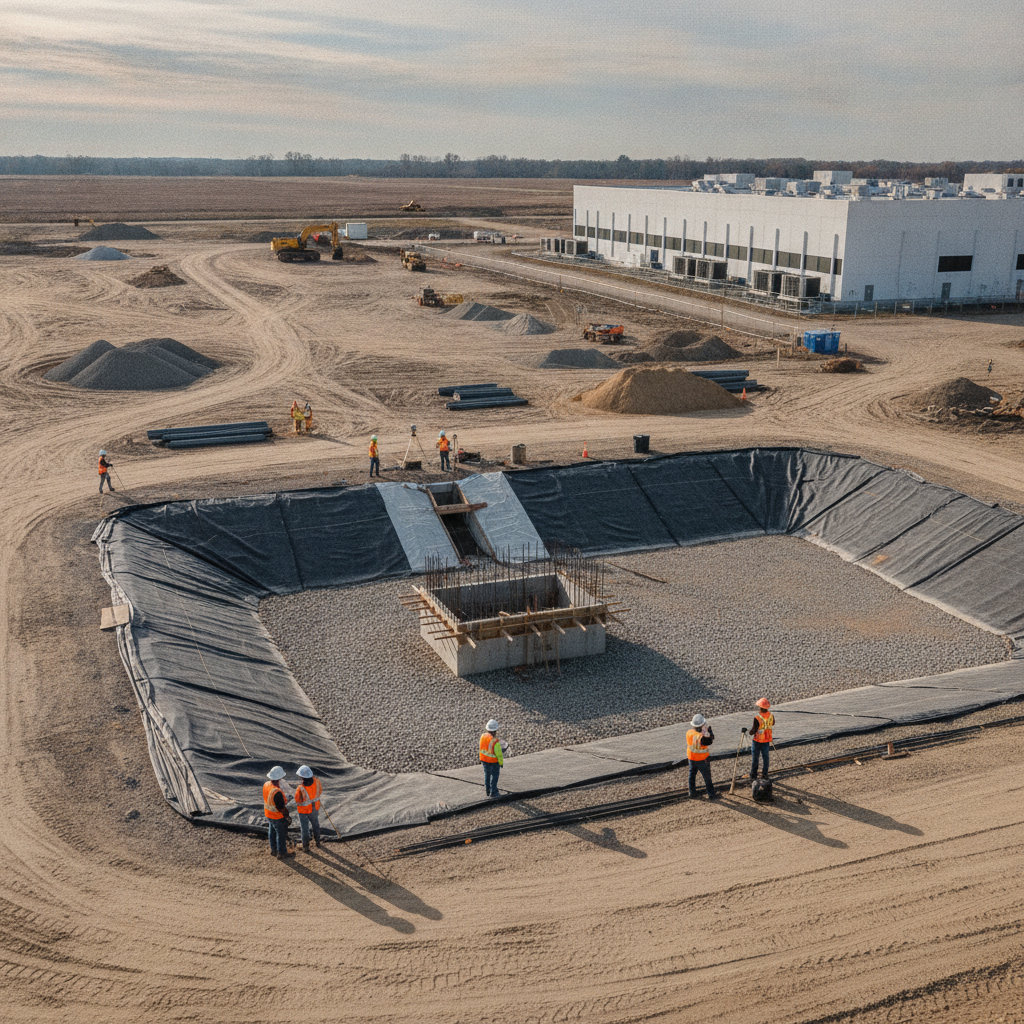
Assessing Legacy Stormwater Systems on Existing Data Center Campuses
The first step in any retrofit project is a thorough investigation of the existing infrastructure. Many legacy sites have incomplete or inaccurate as-built drawings, making a physical and digital assessment critical. This process involves a detailed topographic survey, utility locates, and a comprehensive review of any existing permits. Our engineers perform an as-built verification to confirm pipe inverts, sizes, and pond geometries, which serves as the baseline for all future modeling. Using this data, we develop a detailed hydraulic and hydrologic (H&H) model of the current system. This model simulates how the site performs under various storm events, identifying deficiencies in storage capacity, conveyance, or water quality treatment. The analysis compares the system’s performance against current Water Management District (WMD) and local criteria. This initial permit compliance review often reveals significant gaps, such as insufficient flood protection or a complete lack of nutrient removal, which is a key focus of modern stormwater management regulations.
Navigating Florida’s Evolving Stormwater Permitting Requirements
Comparison of Stormwater Retrofit Technologies
| Technology | Primary Function | Key Considerations for Data Centers | Relative Cost |
|---|---|---|---|
| Underground Detention Vaults | Volume Control / Detention | Maximizes usable land area; high initial cost; requires careful coordination with underground utilities. | High |
| Wet Detention Pond Conversion | Volume Control & Water Quality | Excellent nutrient removal; requires sufficient space; potential for wildlife interaction. | Moderate |
| Permeable Pavement Systems | Volume & Peak Rate Reduction | Best for low-traffic areas like employee parking; requires specific subgrade and maintenance. | Moderate-High |
| High-Efficiency Baffle Boxes | Water Quality Treatment | Compact footprint for tight spaces; targets sediment and gross pollutants; often used for pre-treatment. | Low-Moderate |
| Green Roof Installation | Volume & Peak Rate Reduction | Reduces runoff at the source; adds structural load to building; provides cooling benefits. | High |
| Outlet Structure Modification | Peak Rate Control | Cost-effective way to change discharge timing; may not address volume or quality issues alone. | Low |
Florida’s regulatory landscape for stormwater is constantly evolving. An expansion or significant modification to a site almost always triggers the need for a new Environmental Resource Permit (ERP) from the Florida Department of Environmental Protection (FDEP) or the governing WMD. These modern permits carry much stricter requirements than those issued 10 or 20 years ago, particularly concerning water quality. Regulations now often mandate specific removal efficiencies for nutrients like nitrogen and phosphorus to protect downstream water bodies, guided by Total Maximum Daily Loads (TMDLs). Successfully navigating the permitting process requires a deep understanding of these nuanced rules. For data center expansions, the increase in impervious surfaces (roofs, pavement) is a primary trigger. The design must not only manage the runoff from the new development but often must bring the entire site into compliance. This involves intricate negotiations with agency reviewers and demonstrating through detailed calculations and modeling that the proposed retrofit meets all current standards for peak discharge attenuation, flood prevention, and water quality treatment.
Strategies for Increasing Storage Capacity on Constrained Sites
One of the most significant challenges on existing data center campuses is the lack of available space. With land dedicated to server halls, cooling infrastructure, and security buffers, finding room for larger ponds is often impossible. This is where innovative civil engineering solutions become essential. A primary strategy is the implementation of underground detention systems. These systems, composed of large concrete vaults or interconnected corrugated metal pipes, can store massive volumes of stormwater beneath parking lots or other open areas, preserving valuable surface real estate. Another effective approach is a wet detention conversion. Many older sites feature dry detention basins that only hold water temporarily after a storm. By retrofitting the outlet structure and excavating the basin to create a permanent pool of water, we can significantly increase storage volume while also providing powerful, passive water quality treatment. In other cases, we can optimize site grading to create shallower, more distributed storage areas or incorporate Low Impact Development (LID) techniques like permeable pavers in non-critical traffic areas to reduce runoff volume at the source.
Upgrading Water Quality Treatment to Meet Modern Standards
Beyond managing the quantity of runoff, modern stormwater regulations place a heavy emphasis on quality. Legacy systems were often designed simply to prevent flooding, with little to no mechanism for removing pollutants. Retrofitting a site to meet today’s nutrient removal standards requires integrating modern Best Management Practices (BMPs) into the existing drainage network. This is a critical component of any site development plan involving modifications. For sites with existing ponds, retrofits can include adding littoral shelves with specific plantings to absorb nutrients or installing engineered systems like nutrient-separating baffle boxes within the pond itself. In cases where space is extremely limited, high-efficiency proprietary filters or a baffle box installation can be placed upstream of the main pond or discharge point. These devices are designed to capture sediment, oils, and debris, providing essential pre-treatment. The selection of the right BMP depends on a careful analysis of site constraints, required removal efficiencies, and long-term maintenance considerations.
Phasing and Construction Sequencing for Live Data Center Environments
For a mission-critical facility, construction cannot disrupt operations. A meticulously planned construction sequencing strategy is paramount. The entire retrofit must be phased to maintain stormwater capacity and site access at all times, especially during Florida’s intense rainy season. This often involves building new system components offline before decommissioning old ones, ensuring a seamless transition. A key element of this process is developing robust bypass pumping plans. During the modification of a primary outfall or pond, temporary pumps and piping are used to route stormwater around the construction zone, preventing flooding and maintaining system function. Equally important is extensive utility coordination. Data center sites have a dense web of underground power, fiber, and cooling lines. Our plans are built around precise utility mapping to de-conflict the new stormwater infrastructure from these critical assets, ensuring the operational continuity of the facility is never compromised.
Integrating New Expansions with Existing Stormwater Infrastructure
When a data center adds a new server hall or support building, the project must be viewed holistically. The new impervious area cannot be treated in isolation; its impact on the entire campus drainage system must be evaluated. This requires updating or creating a master drainage plan that accounts for both existing and proposed conditions. The goal is to create a unified system where the retrofitted components and new infrastructure work in concert. Our team uses comprehensive stormwater modeling to simulate the integrated system’s performance. This ensures that a new detention area for an expansion doesn’t inadvertently cause upstream flooding or overwhelm a downstream conveyance pipe. This process of impervious area mitigation is a core part of the permitting strategy, demonstrating to regulators that the overall site will be compliant and resilient. As one of the leading Civil Engineering firms in the region, we specialize in this type of integrated site development planning.
RSP Engineers’ Approach to Data Center Stormwater Retrofits
At RSP Engineers, our approach is tailored to the unique demands of mission-critical facilities. We follow a proven process to de-risk projects and deliver compliant, resilient solutions. It begins with a comprehensive Site Assessment and Feasibility Study to identify all constraints and opportunities. We then proceed to Advanced H&H Modeling and Conceptual Design, where we test various retrofit scenarios to find the optimal solution. Our deep experience with Florida agencies informs our Agency Coordination and Permitting Strategy, streamlining the approval process. We then produce detailed Construction Documents and Phasing Plans that prioritize operational continuity. Finally, our team provides hands-on Construction Administration and as-built certification to ensure the project is built to specification and meets all regulatory requirements for closeout.
Common Challenges in Stormwater Retrofit Projects
Even with careful planning, retrofit projects can present challenges. Unforeseen underground utilities that conflict with proposed pipe runs or vault locations are a common issue, requiring quick redesign. Poor soil conditions, such as a high water table or unsuitable material, can complicate excavation and impact the feasibility of infiltration-based systems. During the agency review process, complex technical questions or requests for additional analysis can arise, demanding a nimble and experienced engineering team to address them without significant delays. Finally, maintaining stringent site security protocols and managing contractor access around sensitive areas is a constant logistical challenge that must be managed proactively throughout construction.
Partner with RSP Engineers for Your Mission-Critical Site Development
Retrofitting stormwater systems on live data center campuses requires a specialized skill set that goes beyond standard site development. It demands a deep understanding of mission-critical operations, complex regulatory environments, and innovative engineering solutions. The team of Florida Licensed Engineers at RSP Engineers has the experience to navigate these challenges. We provide the expert stormwater management, detailed drainage design, and strategic permitting services needed to ensure your project is a success. Contact us today to discuss how we can help you achieve compliance and secure your site’s future.
Future-Proofing Your Data Center with Strategic Stormwater Engineering
In the fast-paced world of data infrastructure, proactive site management is a competitive advantage. Addressing legacy stormwater issues is not just a regulatory burden; it is a strategic investment in your facility’s resilience, compliance, and future expandability. A well-designed retrofit protects your assets from flooding, meets environmental obligations, and streamlines future permit submittals. By partnering with a civil engineering firm that understands the unique operational constraints of data centers, you can ensure your site development and stormwater infrastructure are as robust and reliable as the digital services you provide.
FAQs
-
A compliance assessment by a qualified Professional Engineer is the best approach. This involves reviewing original permits, modeling the existing system against current Florida Building Code and WMD criteria, and identifying any gaps in water quality treatment or flood protection.
-
It’s unlikely. Any significant increase in impervious area typically triggers a requirement to bring the entire basin or site into compliance with current stormwater management regulations. A partial upgrade may be possible, but a comprehensive analysis is always required by the permitting agencies.
-
Timelines vary by jurisdiction, but it’s common for an Environmental Resource Permit (ERP) to take 6 to 12 months from submittal to issuance. This includes agency review periods, requests for additional information (RAIs), and public notice requirements. Early agency coordination is key to a predictable timeline.