
Data Center Service Road Design for Equipment Yards
A technical guide to designing service roads in data center equipment yards. Learn about crane pad design, turning radii, drainage, and surface selection for mission-critical facilities.
Defining the Functional Requirements of Equipment Yard Access Roads
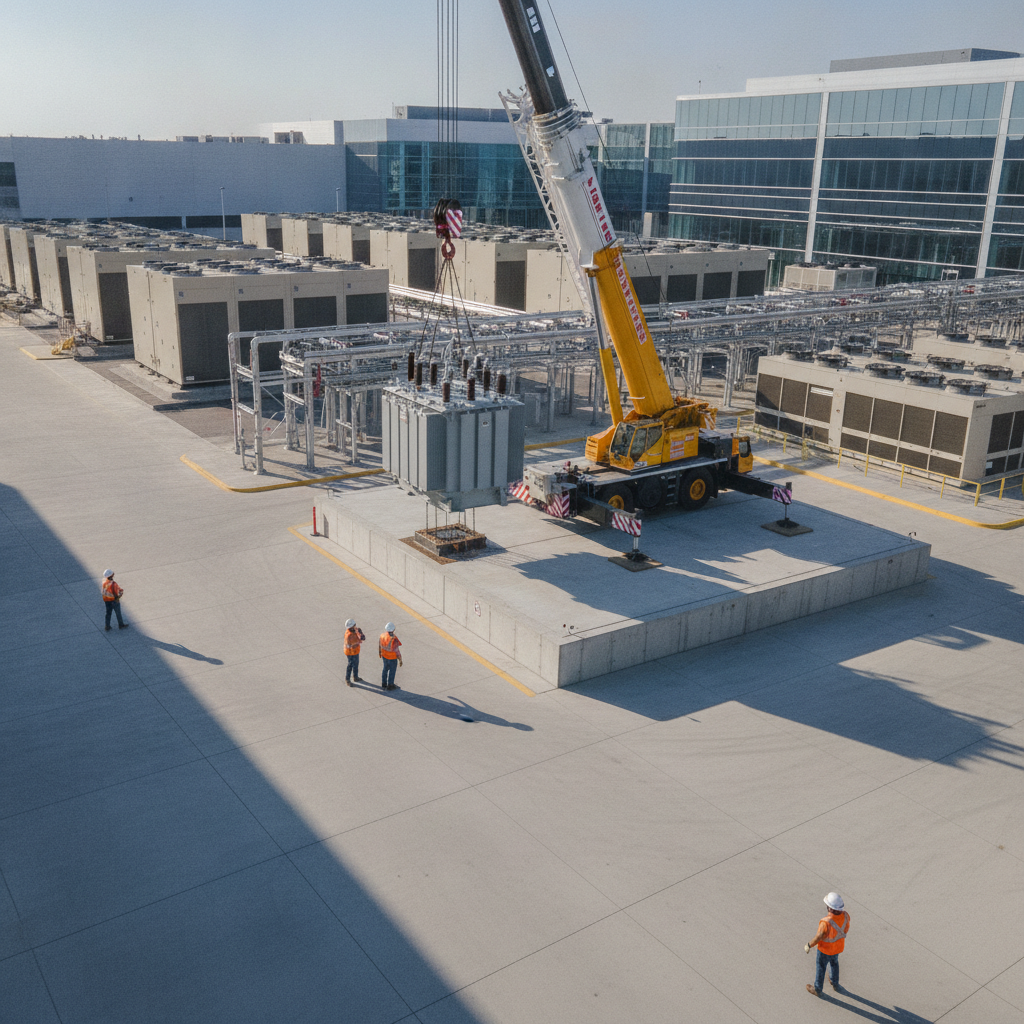
The primary function of an equipment yard service road is to provide reliable, all-weather access for a variety of specialized vehicles. The design must accommodate everything from daily maintenance trucks and fuel tankers to the massive lowboy trailers and mobile cranes required for equipment replacement. The entire civil engineering design is predicated on a clear understanding of the facility’s long-term operational and maintenance strategy. This strategy dictates the size and weight of the design vehicles that will use the road over the facility’s lifespan. Key considerations include defining clear pathways to each major piece of equipment, including transformers, backup generators, and cooling units. The layout must facilitate not just access but also safe working clearances for personnel and machinery. The ultimate goal of the site development plan is to guarantee that a catastrophic equipment failure doesn’t become an logistical nightmare, ensuring a failed transformer or chiller can be swapped out efficiently to maintain operational uptime.
Crane Operations and Structural Pad Design
Service Road Surface Comparison for Data Center Yards
| Surface Type | Primary Application | Load Capacity (Outriggers) | Maintenance Considerations | Relative Initial Cost |
|---|---|---|---|---|
| Reinforced Concrete | Crane pads, transformer access, high-traffic lanes | Excellent | Low; requires joint sealing | High |
| Heavy-Duty Asphalt | General access roads, employee vehicle paths | Poor to Fair; susceptible to punching shear | Moderate; requires crack sealing and periodic resurfacing | Medium |
| Geogrid-Stabilized Gravel | Equipment laydown areas, low-traffic service paths | Good (with proper design) | High; requires periodic regrading and top-dressing | Low |
| Pervious Pavement | Low-traffic areas where stormwater infiltration is desired | Poor; not suitable for heavy loads | High; requires vacuuming to maintain porosity | High |
| Roller-Compacted Concrete (RCC) | Large laydown yards, heavy-duty pavement areas | Very Good | Low to Moderate | Medium-High |
One of the most demanding aspects of equipment yard design is planning for crane operations. Service roads often double as setup pads for mobile cranes used to lift and place heavy equipment. These cranes impose immense point loads on the ground through their outriggers, which can far exceed the capacity of standard pavement. A failure under these loads is not an option. Therefore, a thorough Geotechnical Engineering investigation is a mandatory first step in the design process. The findings from a geotechnical soil report inform the structural design of the crane pads and service roads. This report details the soil’s bearing capacity and recommends subgrade improvements. Based on this data, engineers design thickened reinforced concrete pads or specialized geogrid-stabilized aggregate sections capable of distributing the concentrated outrigger loads safely into the ground. This structural design is a critical piece of the overall civil engineering package, ensuring the platform is safe for the heaviest planned lifts.
Geometric Design and Turning Radii for Specialized Vehicles
Data center equipment yards are notoriously tight spaces, packed with critical infrastructure. Navigating a lowboy trailer carrying a 100-ton transformer through this environment requires precise geometric design. Civil engineers use sophisticated vehicle turning simulation software to model the movements of the largest design vehicles, ensuring they can safely navigate corners, intersections, and access points without encroaching on buildings, bollards, or energized equipment. This analysis defines the necessary road widths, curve radii, and junction layouts. The design must also account for vertical and horizontal clearance envelopes around sensitive infrastructure. The goal is to create a site plan design that is efficient and safe, preventing costly and dangerous collisions during critical equipment delivery or removal operations. These designs often reference national standards for roadway geometry while adapting them to the unique constraints of a private industrial site.
Pavement and Surface Material Selection
The choice of surface material for an equipment yard service road is a balance of performance, cost, and maintenance. The decision is driven by the anticipated traffic loads, particularly the extreme point loads from crane outriggers. There is no single correct answer; the optimal solution often involves a combination of materials tailored to different zones within the yard. Reinforced Concrete: This is the premium choice for high-load areas, including crane setup pads, transformer access points, and primary travel lanes. It offers superior durability and load-spreading capability but comes at a higher initial cost. Proper jointing and reinforcement are critical to its long-term performance and pavement design. Heavy-Duty Asphalt: While suitable for general access roads with rolling traffic, asphalt is vulnerable to damage from the concentrated loads of crane outriggers and the static weight of parked trailers. It can be a cost-effective option for areas not designated for heavy lifting operations. Geogrid-Stabilized Aggregate: For laydown areas or less-trafficked service roads, a well-compacted aggregate base reinforced with geogrids can provide a robust and economical surface. This system improves load distribution and prevents rutting, but it may require more frequent maintenance than a paved surface.
Stormwater Management and Drainage in Equipment Yards
Effective stormwater management is paramount in an equipment yard. Uncontrolled runoff or ponding water near high-voltage transformers, switchgear, or generator connections poses a significant operational and safety risk. The drainage design must ensure positive flow away from all critical equipment pads and foundations. This is typically achieved with carefully sloped concrete surfaces, strategically placed trench drains, and catch basins. Because these yards may contain fuel storage tanks or oil-filled transformers, the drainage design must also address potential environmental contamination. This can involve the use of oil-water separators or containment berms around specific equipment to capture potential spills before they enter the main stormwater system. Effective stormwater management is governed by a complex web of regulations. Permitting requirements vary by jurisdiction, and every project team should confirm the applicable standards with the local, state, regional, and federal authorities that hold review authority over the site. This includes compliance with federal programs like the NPDES for construction activities.
Integrating Utility Corridors and Safety Clearances
An equipment yard is a dense network of both visible and buried infrastructure. The service road design must be meticulously coordinated with the location of underground utilities, including electrical duct banks, fuel lines, and communication conduits. The utility coordination process is a critical phase of design, aiming to prevent conflicts during construction and ensure future access for maintenance without disrupting roadway function. Equally important is maintaining code-mandated safety clearances around energized equipment. Service roads must be routed to respect these exclusion zones, which are defined by standards from bodies like the National Electrical Safety Code (NESC) and the facility’s specific operational protocols. Physical barriers such as concrete bollards or guardrails are often integrated into the civil engineering plans to provide robust protection for critical infrastructure from vehicle impacts.
The RSP Engineers Approach to Equipment Yard Design
At RSP Engineers, our process begins with a deep dive into the facility’s operational needs. We collaborate closely with data center owners, operators, and equipment vendors to understand the complete lifecycle of the facility’s infrastructure. Our approach integrates civil engineering, geotechnical analysis, and detailed logistics planning to deliver a comprehensive site development solution. We utilize advanced vehicle simulation software to validate every aspect of the geometric design, ensuring functionality from day one. Our team manages the entire process, from initial site assessment and Geotechnical Engineering coordination to final permitting and construction administration. We proactively address utility coordination and regulatory compliance to streamline the agency review process. By focusing on a robust, resilient, and maintainable design, we provide the foundational infrastructure that supports mission-critical operations for decades to come. We also offer Construction Management Services to ensure the design is implemented correctly.
Common Issues in Service Road Design and Construction
Even with careful planning, several common issues can arise during the design and construction of data center service roads. A primary pitfall is an inadequate geotechnical investigation, which can lead to under-designed crane pads that settle or fail under load. Another frequent problem is insufficient turning radii, discovered only when a critical piece of equipment cannot be delivered to its pad. Poor drainage design can lead to persistent ponding, creating safety hazards and accelerating the degradation of equipment foundations. Finally, last-minute conflicts with underground utilities can cause significant construction delays and budget overruns if not identified and resolved early in the design phase through thorough utility coordination.
Your Partner in Mission-Critical Site Development
Designing and permitting a data center equipment yard requires a specialized skill set that goes beyond standard commercial site design. The stakes are higher, and the technical requirements are more demanding. Contact RSP Engineers today to leverage our nationwide experience in civil engineering, site development, and permitting for mission-critical facilities. Our team is ready to help you develop a robust, compliant, and operationally efficient site that protects your investment and ensures long-term reliability.
Conclusion
The service roads within a data center equipment yard are a fundamental component of the facility’s critical infrastructure. Their design is a complex exercise in civil engineering that directly impacts operational resilience, safety, and long-term maintenance costs. By prioritizing a thorough geotechnical investigation, precise geometric design, and a robust stormwater management plan, developers can create a site that is prepared for any operational or maintenance challenge. Proper pavement design and utility coordination are not afterthoughts but core elements of a successful mission-critical project.
FAQs
-
The thickness and reinforcement of a crane pad are determined through a structural engineering analysis. This calculation depends on two primary inputs: the maximum outrigger loads from the crane manufacturer’s specifications and the soil’s load-bearing capacity, which is identified in the project’s geotechnical soil report.
-
Clearance requirements vary based on the equipment’s voltage and are governed by the National Electrical Safety Code (NESC), OSHA regulations, and the specific standards of the local utility provider. This requires careful utility coordination between the civil engineering team and electrical engineers to ensure compliance.
-
While a geogrid-stabilized gravel surface can be suitable for equipment laydown areas or very low-traffic zones, it is generally not recommended for primary access routes or crane setup pads. These critical areas require a rigid surface like reinforced concrete to safely handle the high-stress, repetitive dynamic and static loads from heavy vehicles and crane outriggers.