
Building Near Wetlands in Florida: Engineering Tips
Engineering, environmental, and permitting tips for building near wetlands in Florida: wetland delineation, buffers, mitigation, SFWMD ERP review, drainage, flood protection, and construction best pra
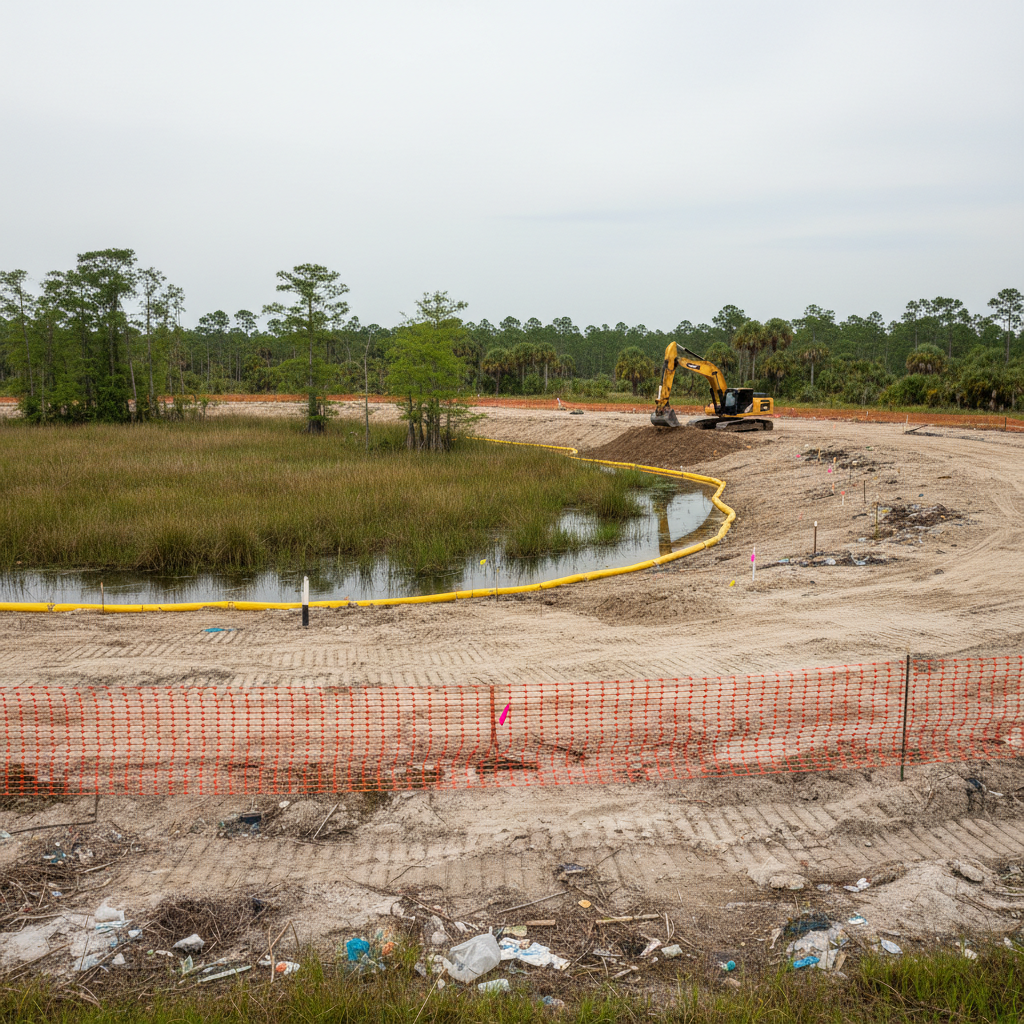
Wetland Delineation: Knowing Exactly Where the Line Is
Everything starts with an accurate wetland delineation. In Florida, wetland boundaries are established under the state’s Unified Wetland Delineation Methodology (Chapter 62-340, F.A.C.) and, at the federal level, the U.S. Army Corps of Engineers 1987 Wetland Delineation Manual with its applicable regional supplement. Qualified environmental scientists evaluate three indicators — hydrophytic vegetation, hydric soils, and wetland hydrology — to flag the wetland line in the field. That flagged line is then located by survey and tied to the project’s site plan and datum so the design team works from a real boundary, not an assumption. A flagged line is only an expert opinion until an agency confirms it. A jurisdictional determination converts the delineation into a boundary you can reliably design around. Because the 2023 Sackett v. EPA decision and the subsequent return of Section 404 dredge-and-fill permitting to the Corps in Florida have reshaped how federal jurisdiction is interpreted, confirming both the state and federal limits early protects the layout from expensive late-stage redesign. Treat delineation as the first engineering task on the project, not a box checked after the lots are drawn. Commission the delineation before finalizing the site layout — never after. Survey and tie the flagged line to a fixed datum for design use. Pursue a formal jurisdictional determination to lock in the boundary.
Buffer Requirements and Setbacks
Wetland-Adjacent Development: Constraints, Risks, and Engineering Solutions
| Constraint | Risk | Regulatory Agency | Recommended Engineering Solution |
|---|---|---|---|
| Jurisdictional wetlands on or near the parcel | Unpermitted impacts trigger fines, stop-work orders, and forced restoration | USACE (Section 404) + FDEP/SFWMD (state ERP) | Formal delineation and jurisdictional determination before layout; design impact avoidance into the site plan |
| Required upland buffer / setback | Encroachment invalidates the permit and shrinks usable area | SFWMD / local government | Survey and flag the buffer line; keep structures, pavement, and grading outside it; record a conservation easement |
| Net loss of wetland function | Mitigation shortfall stalls or denies the permit | FDEP/SFWMD (UMAM) + USACE | UMAM functional assessment; secure mitigation-bank credits in the correct service area early |
| Increased post-development runoff | Off-site flooding and water-quality violations | SFWMD (ERP) | Wet detention/retention sized to pre-development discharge; capture the required treatment volume |
| High seasonal water table | Pond, road, and foundation failure; inadequate treatment | SFWMD / geotechnical engineer of record | Establish SHWT from borings; set control elevations and underdrains; raise road and pad grades accordingly |
| Parcel within FEMA floodplain | Flood damage and NFIP non-compliance | FEMA / local floodplain administrator | FFE = BFE + freeboard; provide compensating storage for fill; comply with ASCE 24 |
| Construction turbidity reaching the wetland | Water-quality exceedance and enforcement action | FDEP (NPDES CGP) / USACE | Floating turbidity barriers, silt fence, stabilized entrance, controlled dewatering, and turbidity monitoring |
| Secondary and cumulative impacts | Permit denial or heavy additional conditions | SFWMD / USACE / FWC / USFWS | Preserve buffers, conduct listed-species surveys, and protect wetland hydroperiod in the drainage design |
Most Florida jurisdictions require an upland buffer — a protected, typically vegetated strip of land separating construction from the wetland edge. Buffer widths vary by water management district and local code, but a 15-foot minimum with a 25-foot average is a common standard, and some local governments or sensitive resources demand more. The buffer is not usable site area: it absorbs stormwater runoff, filters sediment, shades the wetland, and provides a wildlife transition zone, so it must be carried through the entire site development layout as off-limits. The single most common buffer mistake is designing as if the buffer were developable and discovering the conflict during agency review. Locate pavement, structures, grading, and utilities outside the buffer from the first concept sketch. Where a roadway or outfall must cross it, minimize the crossing width and document why the impact is unavoidable. Preserving the buffer in a conservation easement is frequently a permit condition, so plan for that encumbrance in the yield analysis rather than treating it as a surprise.
Mitigation: Offsetting Unavoidable Wetland Impacts
Florida and federal permitting both follow a mitigation sequencing hierarchy: first avoid wetland impacts, then minimize what cannot be avoided, and only then compensate for the residual loss. Compensation is quantified in Florida with the Uniform Mitigation Assessment Method (UMAM, Chapter 62-345, F.A.C.), which scores the functional value lost to impacts and the functional gain a mitigation action provides. The cleaner your avoidance and minimization, the smaller and cheaper the mitigation obligation. The most reliable way to satisfy compensation is purchasing credits from a permitted mitigation bank — but only if your site falls within that bank’s service area, and only if credits are actually available. Where banking is not an option, permittee-responsible mitigation such as on-site creation or restoration may be required, which adds long-term monitoring and maintenance obligations. Confirm credit availability and pricing during early due diligence; discovering a mitigation shortfall after design is locked is a budget and schedule shock.
SFWMD Review and the Environmental Resource Permit (ERP)
In South Florida, the South Florida Water Management District (SFWMD) — or the Florida Department of Environmental Protection, depending on project type — administers the Environmental Resource Permit (ERP) under the statewide rules in Chapter 62-330, F.A.C. The ERP is the central approval for wetland-adjacent work because it bundles three concerns into one review: water quantity (peak discharge and flood routing), water quality (treatment of runoff before it leaves the site), and the environmental impacts to wetlands and surface waters, including the mitigation just described. Projects fall under a General Permit or a more rigorous Individual Permit depending on impact thresholds, and an approved ERP carries enforceable operation and maintenance obligations for the life of the system. The most valuable step before submittal is a pre-application meeting with district staff. It surfaces concerns about secondary and cumulative impacts, buffer adequacy, and listed-species issues while the design is still flexible — far cheaper than absorbing those comments as a formal request for additional information.
Drainage Design Adjacent to Wetlands
Drainage is where wetland constraints meet hard engineering. Florida ERP rules generally require that post-development peak discharge not exceed the pre-development rate for the applicable design storm, so on-site stormwater management — typically wet detention or dry retention — must attenuate the extra runoff that pavement and roofs create. The system must also capture a defined water-quality treatment volume before discharge, with discharges to Outstanding Florida Waters held to an even higher treatment standard. The seasonal high water table (SHWT) drives nearly every drainage decision on these sites. It must be established from soil borings and used to set pond control elevations, underdrain inverts, and minimum road and pad grades — a pond bottom below the SHWT will not function as designed, and pavement set too low will fail. Discharges should be routed so that clean, attenuated, treated water — not raw construction or first-flush runoff — reaches the adjacent wetland, preserving the hydroperiod the wetland depends on.
Flood Protection and Floodplain Compliance
Wetland-adjacent parcels frequently sit within a FEMA Special Flood Hazard Area on the Flood Insurance Rate Map (FIRM). That triggers a second compliance track: the base flood elevation (BFE) governs the minimum finished floor elevation (FFE), which is typically set at BFE plus a freeboard margin of one to two feet under the Florida Building Code and ASCE 24. Building low to “save fill” is a false economy that creates flood-damage and insurance exposure for the life of the structure. If the project places fill within a regulated floodplain, most jurisdictions require compensating storage — excavating an equal volume elsewhere on site so flood storage is not lost and neighbors are not pushed into higher water. Coordinate the floodplain analysis with the ERP drainage design so the pond system, the fill balance, and the finished-floor strategy all reconcile. Treating flood compliance and stormwater as one integrated model, rather than two separate exercises, prevents contradictory grading late in design.
Construction Best Practices Near Sensitive Areas
Permits are won in design but protected in the field. Any project disturbing one acre or more needs coverage under the NPDES Construction General Permit and a Stormwater Pollution Prevention Plan (SWPPP). Along a wetland edge, erosion and sediment control is non-negotiable: install silt fence on the upland side, deploy floating turbidity barriers in or at the water, build a stabilized construction entrance, and clearly flag or fence the wetland and buffer lines so equipment never strays past them. Keep turbidity out of the wetland — exceedances are among the fastest ways to draw an enforcement action. Dewatering for ponds or foundations usually needs its own authorization and a discharge that is filtered and monitored, not pumped straight to the wetland. Inspect and repair controls after every significant rain, stabilize disturbed soils quickly, and stage materials and fuel well away from the buffer. Disciplined construction administration here is what keeps the approved permit from becoming a violation.
How RSP Engineers Approaches Wetland-Adjacent Sites
At RSP Engineers, wetland-adjacent projects begin with constraints, not concepts. We coordinate an early wetland delineation and jurisdictional confirmation, overlay the buffer and floodplain limits on the survey, and only then test development yield against what the parcel can actually support. That sequence keeps the Environmental Resource Permit strategy, the stormwater management design, and the mitigation plan aligned from day one instead of colliding during agency review. From there we carry the project through permit submittals, district and Corps coordination, and construction administration — including the erosion and sediment control detailing that protects the wetland once earthwork begins. The goal is a permit that survives both review and the field: a design that reconciles flood compliance, drainage, and environmental protection into one coherent set of plans.
Common Permitting Mistakes Near Wetlands
Most wetland permitting failures are avoidable and trace back to sequencing. The recurring ones we see include: Designing before delineating — laying out lots and roads, then discovering the wetland line runs through them. Misjudging jurisdiction — assuming a feature is or isn’t regulated rather than securing a jurisdictional determination. Treating the buffer as buildable — losing density late when the upland buffer is finally respected. Underestimating mitigation — failing to confirm mitigation bank credit availability and cost in the right service area. Ignoring the seasonal high water table — sizing ponds and setting grades without real soil borings. Skipping the pre-application meeting — absorbing avoidable comments on secondary and cumulative impacts as a formal RAI. Overlooking floodplain compensation — placing fill without providing compensating storage.
Plan Your Wetland-Adjacent Project With RSP Engineers
Building near wetlands rewards teams that engineer the constraints first. RSP Engineers supports Florida developers and property owners through wetland delineation coordination, Environmental Resource Permit strategy, stormwater management and drainage design, floodplain compliance, and field-ready erosion and sediment control for construction administration. Bring us in during due diligence and we will tell you what the site can realistically carry before you commit. Contact RSP Engineers to discuss project-specific guidance for your wetland-adjacent development.
Conclusion
Wetlands are not just an environmental concern — they are an engineering and permitting driver that touches layout, stormwater management, flood protection, and construction. Projects that begin with an accurate wetland delineation, respect the upland buffer, plan mitigation early, and design drainage around the seasonal high water table move through agency review faster and avoid costly enforcement. Get the sequence right, integrate the disciplines into one coherent plan, and a wetland-adjacent parcel becomes a buildable, defensible project rather than a permitting trap.
FAQs
-
A qualified scientist performs a wetland delineation using state and federal methodology, and a jurisdictional determination from the regulating agencies confirms whether — and where — wetlands are regulated. Do this before design, not after.
-
It varies by jurisdiction, but a 15-foot minimum and 25-foot average upland buffer is a common baseline. Sensitive resources or specific local codes can require more, so confirm the standard with the water management district and local government early.
-
Sometimes, but only after mitigation sequencing — avoid and minimize first. Unavoidable impacts are quantified with UMAM and offset through a mitigation bank or permittee-responsible mitigation, subject to agency approval.